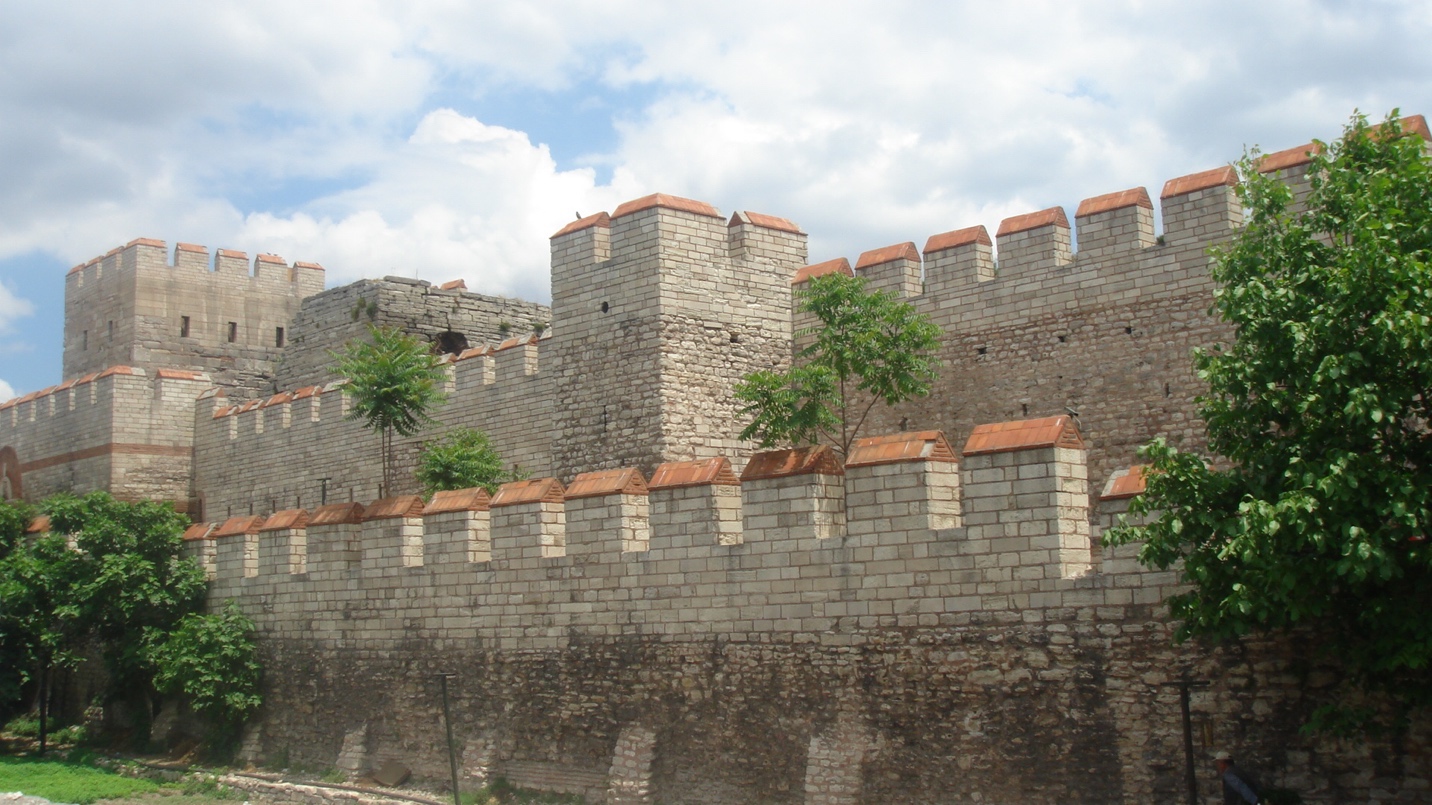
74. A restored section of the Theodosian Walls of Constantinople. These imposing walls, along with the Sea of Marmara, protected the eastern half of the Roman Empire from the Germanic peoples whose advances caused the western half to fall apart. The eastern or Byzantine empire survived until 1453, when a Turkish Sultan, Mehmed the Conqueror, captured the capital city. Mīrābile dictū, hic vīcit annōs ūnum et vīgintī nātus. Amazingly, he won his victory at age 21.
Explōrātiō Trīcēnsima Quārta (XXXIV) Adventure Thirty-Four
Q-Words and T-Words, Continued: Correlative Pairs
Indefinite (ali)quis, (ali)quid after sī, nisi, num, and nē
Vegetius, Dē Rē Mīlitārī, Excerpt
Where and When Are We Today?
Cōnstantīnopolis
Mēnsis December
Flāviō Eutolmiō Tatiānō Q. Aurēliō Symmachō cōnsulibus
Constantinople
December, 391 CE
Today our visit took us to a city of many different names. When it was founded, nearly a millenium earlier, on the south side of the Bosporus Strait by Greek settlers from the city of Megara, it went by the name Byzantion. In 330 CE, when Constantine became emperor, he designated it the official imperial residence, and renamed it, appropriately enough, Nova Rōma. After his death, the city government decided to renamed it in his honor, changing its title to Cōnstantīnopolis, the City of Constantine. And that is what it was called for nearly a thousand years until the Ottoman Turks made it the capital of their empire and renamed it Istanbul. Today it is a massive city with nearly 15 million residents. Even in antiquity it was huge, stretching for miles inland from a port overlooking the strait.
Vegetius
I couldn’t tell you exactly where in the city we landed, but to judge by the seagulls and the fish market down the street we were not far from the port. We were sitting outside of a well-house, where locals came to fetch fresh water, as we watched a house across the street, waiting for a man to appear. The man, Pūblius Flāvius Vegetius Renātus, or Vegetius, as I will call him, had sailed here all the way from Spain in order to visit the present emperor, Theodosius I, at his court.
Vegetius was a military man who had commanded armies in Spain and Gaul that were trying to repel incursions by the Goths, a Germanic people from the north. Despite his energy and talents as a commander, he had been discouraged by the lack of equipment and training among his troops, and the incompetence of his fellow officers. He desperately wanted to understand why the Rōmānī veterēs, the old Romans of the Republic, had been so successful fighting against the Celts and the Germans. To satisfy his curiosity he turned to the library, hunting down and studying old treatises on training, tactics, and strategy written by men like Cato the Elder. Eventually he wrote a book, the Dē Rē Mīlitārī, summarizing what he had learned, and sailed all the way here to present it to Theodosius. He wanted the emperor to recommend the work and ensure that it would be widely read. He also hoped that he would become a companion of the emperor and perhaps be put in charge of special projects, just as Vitruvius had been patronized by Augustus a long time ago. He was staying at the house of a friend in Constantinople, and he was about to make a trip to the imperial court the morning we arrived.
While we waited for Vegetius, Latinitas had me work on my own book.
Q-Words and T-Words
“Today you are going to learn more about some words you have encountered before in different places. These are various adjectives and adverbs that I call Q-words and T-words.”
“Let’s start with Q-words. These are words beginning with the letter q- that can be used to introduce questions – both direct questions and indirect questions – just like the interrogatives you have already learned.”
“You already know this adverb:”
| Latin Adverb | English Meaning |
|---|---|
| quam | how |
“Here are three new adjectives and one adverb that are Q-words:”
Vocabulary
US-A–UM Adjective (First and Second Declension Adjective)
| Latin Adjective | English Meaning |
|---|---|
| quantus, -a, -um | how much; how great |
Third Declension Adjective
| Latin Adjective | English Meaning |
|---|---|
| quālis, quāle | what sort of |
Irregular Adjective
| Latin Adjective | English Meaning |
|---|---|
| quot | how many |
Adverb
| Latin Adverb | English Meaning |
|---|---|
| quotiēns | how often |
Q-Word Examples
Quot populōs hic imperātor vīcit?
How many peoples has this emperor conquered?
Scīsne qualem urbem Romulus Rēmusque conderent?
Do you know what sort of city Romulus and Remus founded?
Quantum aurī Novae Rōmae iacet?
How much [of] gold lies in New Rome?
Exercises 1-3
1. Quot vōta fēcistī? Quāle beneficium precātus es?
2. Princeps scīre vult quantae nāvēs parārī possint intrā decem diēs. “The preposition intrā + acc. means ‘within’.”
3. Quālibus verbīs, Vegetī, ūtēris ut tibi prō istō labōre tuō praemium Theodosius det?
“T-words are spelled just like Q-words, but the letter t- replaces the qu-.”
“You already know the T-words that correspond to quam and quot:”
| Latin Adverb | English Meaning |
|---|---|
| tam | so |
| tot | so many |
“And here are the two new adjectives that correspond to quantus and quālis and the adverb that corresponds to quotiēns:”
Vocabulary
US-A-UM Adjective (First and Second Declension Adjective)
| Latin Adjective | English Meaning |
|---|---|
| tantus, -a, -um | so much; so great; such great |
Third Declension Adjective
| Latin Adjective | English Meaning |
|---|---|
| tālis, tāle | such |
Adverb
| Latin Adverb | English Meaning |
|---|---|
| totiēns | so often |
T-Word Examples
Tālis vir erat! Tam fortis bellō et in pāce tam hūmānus.
Such a man he was! So brave in war and so humane in peacetime.
Quārē tam timidē incurrit in ferrum?
Why does he run to the sword so timidly?
Exercises 4-6
4. Tālis vir erat frāter meus: tam honestus, tam nōbilis, sine ūllō vitiō.
5. Tot sīdera in caelō ārdent.
6. Tantās opēs ille dīves habuit, sed totiēns poscentēs nihil accēpimus.
Result Clauses
“Now you are ready to learn another use of the subjunctive in a subordinate clause: result clauses. A result clause states a consequence or result; it is introduced by ut or, if negated, ut nōn. The subjunctive verb in a result clause can be translated like the corresponding indicative form. A result clause can be distinguished from other clauses introduced by ut (such as purpose clauses) by the presence of a T-word or the adverb ita, sīc, or adeō in the main clause:”
tantum... ut ‘so great that’
tot... ut ‘so many... that’
ita... ut ‘so... that’
sīc... ut ‘so... that’
adeō... ut ‘to such a degree... that’
Vocabulary
Adverb
| Latin Adverb | English |
|---|---|
| adeō | to such a degree |
Result Clause Examples
Adeō hortābor mīlitēs ut fortissimē pugnent.
I will encourage the soldiers to such a degree that they fight most bravely.
ut... pugnent (present subjunctive) is a result clause; notice adeō in the main clause
Tot et tam ingentia perīcula rūre expertī erāmus ut ex moenibus discēdere nōllēmus.
We had experienced so many and such enormous dangers in the countryside that we were not willing to depart from the city walls.
ut... nōllēmus (imperfect subjunctive) is a result clause; notice tot and tam in the main clause
Exercises 7-10
7. Nēmō est tam dūrus ut nōn lacrimīs huius movērī possit.
8. Tantae erat illa mulier sapientiae ut nōn sōlum amīcī sed etiam ducēs cōnsilium eius peterent.
9. Adeō mē pepulit ut subitō praeceps caderem in terram. “The adjective praeceps, praecipitis means ‘headlong’.”
10. Antōnius adeō saevus erat ut urbem sanguine implēret.
At that point Vegetius stepped out the door, accompanied by an attendant who was carrying a large book in a backpack. We got up to follow the pair through the winding streets, keeping our distance as we did so. At one point we passed a massive stadium which Latinitas said was called the Hippodrome. This was where chariot races were held in Byzantium – an incredibly popular sport, with four ‘colors’ or teams, the Blues, Greens, Reds, and Whites, whose supporters were absolutely devoted to them, sometimes to the point of violence. No races were being held today, but we passed the stables where the horses were kept – beautiful white chargers, lovingly cared for – and spotted some of the chariots, which glittered in the sun like sports cars.
People love sports.
“That’s true, very true. But I should point out something. Two years from now, Theodosius will ban the Olympic games, ending a thousand-year tradition. Too pagan, you know.”
Oh, I said.
We reached the imperial palace, a beautiful, imposing structure, like a mansion with bits of church and castle in its design. The men at the entrance let Vegetius in after he tipped them; Latinitas took us in through a service entrance, then marched me back to the room where Vegetius and dozens of other supplicants were waiting for their time with the emperor. Latinitas told me not to worry about being picked out as a stranger, and had me work on my notebook again.
Q-Words and T-Words, Continued: Correlative Pairs
“Let’s come back to Q-words and T-words. Sometimes a Latin sentence will contain both a Q-word and a T-word. These words then form what is called a correlative pair. Often you need to adjust the translation of the T-word in a correlative pair:”
Correlative Pair Example
Vir tam (T-word) malus cīvibus quam (Q-word) bonus hostibus erat.
He was a man as bad to the citizens as he was good to the enemy
(lit., so bad ... as good)
“In English you can translate correlative pairs with the following formulae:”
Correlative Pairs
| Latin correlatives | English translation |
|---|---|
| tam… quam | as… as |
| tālis… quālis | such… as |
| tantus… quantus | as much, as great… as |
| tot… quot | as many… as |
| totiēns... quotiēns | as often... as |
| tantō (+ comparative)… quantō (+ comparative) | the more… the more |
| eō (+ comparative)… quō (+ comparative) | the more… the more |
“If tantō, quantō, eō, or quō are paired with minus, they will mean ‘the less’, not ‘the more’.”
Exercises 11-13
11. Quantō plūs turbae discessit, tantō facilius erat et dīcere et audīre.
12. Quotiēns ībis, totiēns magis placēbit quod bonum erit. “Cato’s advice to the estate-buyer.”
13. Dominam nōvit passer tam bene quam puella matrem. “This is based on a line of Catullus. Passer, passeris, m. means ‘sparrow’.”
Indefinite (ali)quis, (ali)quid after sī, nisi, num, and nē
“There is one more bit of grammar to learn before you read Vegetius. When the word sī, nisi, num, or nē is followed by a form of the pronoun quis, quid, you must treat the pronoun as if it began with the prefix ali-, as in aliquis ‘some(one)’, ‘any(one)’. To put this the other way round, if you want to say ‘if anyone thinks...’ in Latin, you must drop the prefix ali- from the word aliquis: sī quis putat. Just remember the rhyme: after sī, nisi, num, or nē, all the ali-’s drop away.
Nōs homunculī indignāmur, sī quis nostrum interiit aut occīsus est?
Do we little humans complain if some one of us has died or been killed?
Exercises 14-16
14. Nōnne metuis nē quid malī nōbīs accidat?
15. Sī quem clārum in urbe istā vidēbimus, vōbīs referēmus.
16. Nisi quis viam rēctiōrem invenīre potest, arbitror nōs itūrōs esse illā.
“Now let’s work on our vocabulary; Vegetius is about to be let in.”
Vocabulary
A-Verbs (First Conjugation)
| Latin Verb | English Meaning |
|---|---|
| probō, probāre, probāvī, probātus | to prove; approve |
| temptō, temptāre, temptāvī, temptātus | to try out |
E-Verb (Second Conjugation)
| Latin Verb | English Meaning |
|---|---|
| pateō, patēre, patuī | to lie open |
Irregular Verbs
| Latin Verb | English Meaning |
|---|---|
| prōsum, prōdesse, prōfuī, prōfūtūrus + dat. | to profit; be of use; help |
| trānseō, trānsīre, trānsiī, trānsitus | to cross; pass |
Second Declension Nouns
| Latin Noun | Noun Gender | English Meaning |
|---|---|---|
| campus, -ī | m. | field |
| equus, -ī | m. | horse |
| gladius, -ī | m. | sword |
Third Declension Noun
| Latin Noun | Noun Gender | English Meaning |
|---|---|---|
| latus, lateris | n. | side; flank |
Fourth Declension Nouns
| Latin Noun | Noun Gender | English Meaning |
|---|---|---|
| cursus, cursūs | m. | running; course |
| impetus, impetūs | m. | attack |
| ūsus, ūsūs | m. | experience; use |
US-A-UM Adjective (First and Second Declension Adjective)
| Latin Adjective | English Meaning |
|---|---|
| sēcūrus, -a, -um | free from care |
Third Declension Adjective
| Latin Adjective | English Meaning |
|---|---|
| vetus, veteris | old |
Adverbs
| Latin Adverb | English Meaning |
|---|---|
| ideō | for this reason |
| quasi | as if |
| velut / velutī | just like; just as |
Exercises 17-23
17. Hic cursus nōbīs patet.
18. Dī sōlī, ut ferunt, vītam sēcūram agunt.
19. Nē vītam silentiō trānseāmus velutī pecora.
“The noun pecus, pecoris, n. means ‘cattle’, ‘flock’; silentiō is ablative.”
20. Quid? Ego quasi canis hīc iaceam?
21. Haec verba commūnī in ūsū nōn sunt ideō, quod vetera sunt.
22. Temptēmus bellī fortūnam. Faciāmus impetum in latera hostium gladiīs, et equī trānseant campum ut mīlitibus prōsint.
23. Itaque quārtum quoddam genus reī pūblicae maxime probandum esse sentiō, quod est ex hīs, quae prīma dīxī, moderātum et permixtum tribus.
“Cicero writing as a political scientist. Try to determine the meaning of moderātum and permixtum from the context.”
A well-fed attendant wearing a purple cross on his robe came out and beckoned Vegetius in. Latinitas found a narrow interior window that afforded a view of the interview. Theodosius was sitting with his advisors. He was a strong-looking man with a deceptively sleepy look on his face. Vegetius introduced himself to him as, like Theodosius, a Roman from Spain, and this won the emperor’s approval. Otherwise, he kept silent, with his advisors doing all the talking.
While they went back and forth, Latinitas took out a copy of Vegetius’ book which she had brought along and showed me some of its advice on training tīrōnēs or new soldiers.
Vegetius, Dē Rē Mīlitārī, Excerpt
1) Natandī ūsum aestīvīs mēnsibus omnis aequāliter dēbet tīrō condiscere. Nōn enim semper pontibus flūmina trānseuntur, sed et cēdēns et īnsequēns natāre cōgitur frequenter exercitus.
natō, natāre, natāvī, natātus to swim
aestīvus, -a, -um summer (adj.)
mēnsis, mēnsis, m. month
aequālis, aequāle equal
tīrō, tīrōnis, m. recruit; new soldier
condiscō, condiscere, condidicī the prefix con- adds ‘thoroughly’, ‘carefully’ to the verb’s meaning
pōns, pontis, m. bridge
insequor, insequī, insecūtus sum to pursue
frequēns, frequentis frequent
2) Ideōque Rōmānī veterēs, quōs tot bella et continuāta perīcula ad omnem reī mīlitāris ērudīverant artem, campum Mārtium vīcīnum Tiberī dēlēgērunt, in quō iuventūs post exercitium armōrum sūdōrem pulveremque dīlueret ac lassitūdinem cursūs natandī labōre dēpōneret.
continuātus, -a, -um continuous
mīlitāris, mīlitāre military (adj.)
ērudiō, ērudīre, ērudīvī, ērudītus to educate; school
vīcīnus, -a, -um + dat. close to; neighboring
Tiberis, Tiberis, m. the Tiber river
dēligō, dēligere, dēlēgī, dēlectus to select
in quō the relative clause expresses purpose, with the subjunctive
iuventūs, iuventūtis, f. (the) youth
exercitium, -ī, n. training
sūdor, sūdōris, m. sweat
pulvis, pulveris, m. dust
dīluō, dīluere, dīluī, dīlūtus to wash off
lassitūdō, lassitūdinis, f. weariness
dēpōnō, dēpōnere, dēposuī, dēpositus the prefix dē- adds ‘down’, ‘aside’ to the verb’s meaning
3) Nōn sōlum autem peditēs sed et equitēs ipsōsque equōs vel lixās, quōs galiāriōs vocant, ad natandum exercēre percommodum est, nē quid imperītīs, cum necessitās incumbit, ēveniat.
pedes, peditis, m. foot-soldier
lixa, lixae, m. attendant; soldier’s servant
percommodus, -a, -um the prefix per- adds ‘thoroughly’ to the adjective’s meaning
imperītus, -a, -um inexperienced
incumbō, incumbere, incubuī, incubitus to press on; lean on
ēveniō, ēvenīre, ēvēnī, ēventus to happen, be the outcome
Antīquī, sīcut invenītur in librīs, hōc genere exercuēre tīrōnēs:
antiquus, -a, -um ancient
“The next sentence is translated for you. What sort of subjunctive clause is here introduced by ut?”
4) Scūta dē vīmine in modum crātium conrotundāta texēbant, ita ut duplum pondus crātis habēret quam scūtum pūblicum habēre cōnsuēvit.
They would weave rounded shields from willow twigs, in the style of wickerwork, in such a way that the wicker had twice the weight as a regulation shield was accustomed to have.
5) Īdemque clāvās ligneās duplī aequē ponderis prō gladiīs tīrōnibus dabant. Eōque modō nōn tantum māne sed etiam post merīdiem exercēbantur ad pālōs. Pālōrum enim ūsus nōn sōlum mīlitibus sed etiam gladiātōribus plūrimum prōdest.
clāva, ae, f. club
ligneus, -a, -um wooden
duplus, -a, -um double
māne early in the morning
merīdiēs, merīdiēī, m. noon
pālus, -ī, m. stake (acting as a dummy)
6) Nec umquam aut harēna aut campus invictum armīs virum probāvit, nisi quī dīligenter exercitātus docēbātur ad pālum. Ā singulīs autem tīrōnibus singulī pālī dēfīgēbantur in terram, ita ut nūtāre nōn possent et sex pedibus ēminērent.
harēna, -ae, f. sand; arena
invictus, -a, -um undefeated
dīligēns, dīligentis careful; diligent
singulī, -ae, -a separate; single
dēfīgō, dēfīgere, dēfīxī, dēfīxus to fix down; stick down
nūtō, nūtāre, nūtāvī, nūtātus to lean over; nod
ēmineō, ēminēre, ēminuī to stand tall; project
7) Contrā illum pālum tamquam contrā adversārium tīrō cum crāte illā et clāvā velut cum gladiō sē exercēbat et scūtō, ut nunc quasi caput aut faciem peteret, nunc ā lateribus minārētur, interdum contenderet poplitēs et crūra succīdere, recēderet adsultāret īnsilīret, quasi praesentem adversārium, sīc pālum omnī impetū, omnī bellandī arte temptāret.
adversārius, -ī, m. opponent
crātis, crātis, f. wickerwork
scūtum, ī n. shield
minor, minārī, minātus sum to threaten
contendō, contendere, contendī, contentus to strive
poples, poplitis, m. ham; back of knee
crūs, crūris, n. leg; lower leg
succīdō, succīdere, succīdī, succīsus to cut; sever
recēdō, recēdere, recessī, recessus to step back
adsultō, adsultāre, adsultāvī, adsultātus to jump at; assault
īnsiliō, īnsilīre, īnsiluī to jump on
bellō, bellāre, bellāvī, bellātus to make war
8) In quā meditātiōne servābātur illa cautēla, ut ita tīrō ad īnferendum vulnus īnsurgeret, nē quā parte ipse pateret ad plāgam.
meditātiō, meditātiōnis, f. practice
cautēla, -ae, f. caution; here, introduces first a substantive ut clause, then a fear clause
inferō, inferre, intulī, illātus to inflict
īnsurgō, īnsurgere, insurrēxi to launch himself; rise up
plāga, -ae, f. blow
9) Duplī autem ponderis illa crātis et clāva ideō dabantur, ut, cum vēra et leviōra tīrō arma sūmpsisset, velut graviōre pondere līberātus, sēcūrior alacriorque pugnāret.
alacer, alacris, alacre eager; keen
At the end of the interview, Theodosius gave his response to Vegetius’ plea, which Latinitas interpreted for me. He offered him his greatest thanks and spoke in glowing terms of the book, which he said was worthy of the great majesty of the Roman empire. I could see Vegetius swallow in anticipation. But then the emperor broke his heart: he ordered his chamberlain to give Vegetius 1,000 sesterces – an amount slightly more than what he had just spent to sail across the Mediterranean – and bid him to return to the West and fight bravely against the barbarians. That was it; the emperor’s silence made it clear that Vegetius was to leave, and an imperial functionary added the book to a large pile of gifts previous petitioners had brought the emperor that morning, as the author slowly retreated from the room.
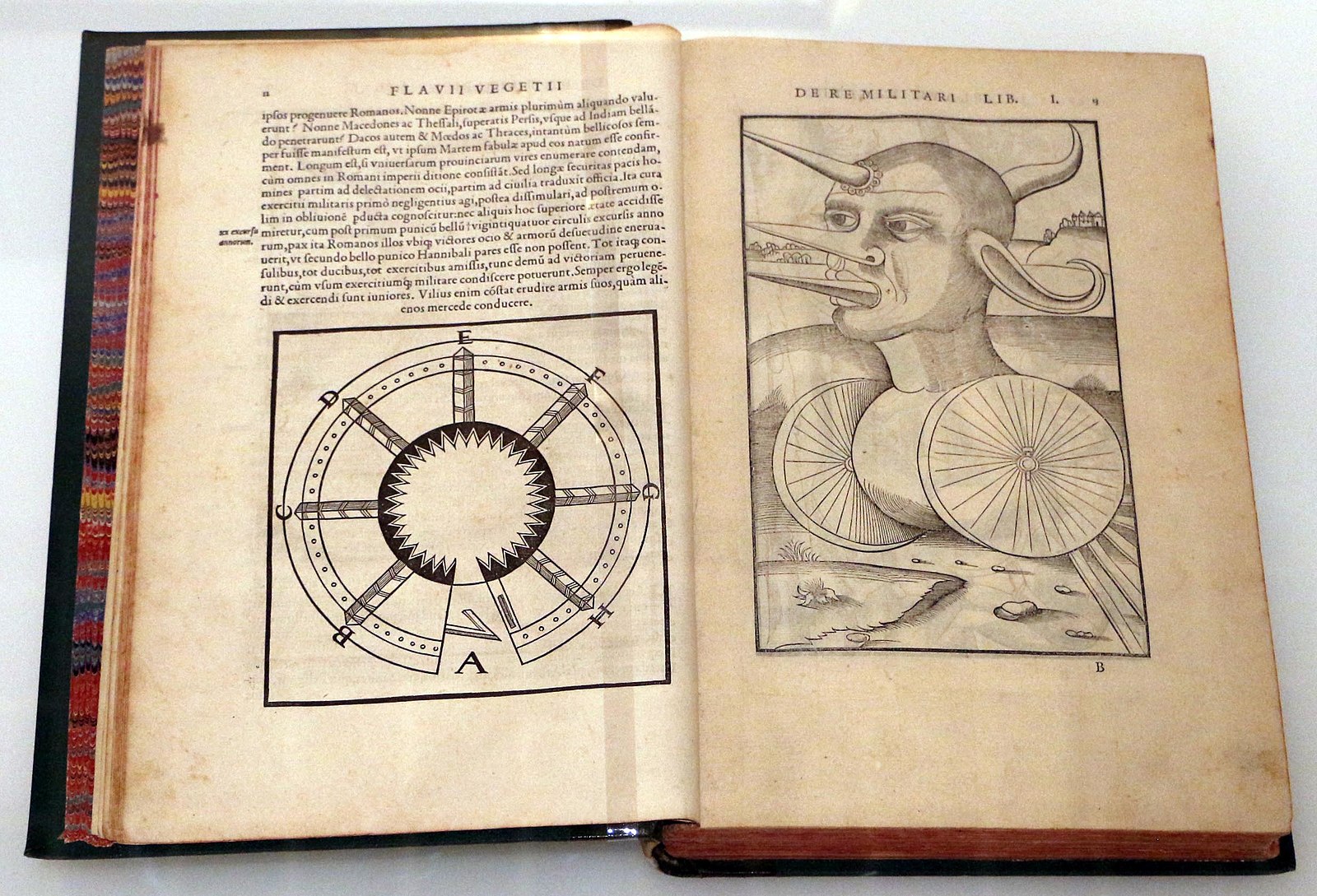
75. A page from an early manuscript of Vegetius’ treatise, printed in 1535, with the heading Flāviī Vegetiī Dē Rē Mīlitārī Lib(er) I, Of Flavius Vegetius On Military Matters Book One. The illustration is the editor’s wildly imaginative recreation of one of the siege machines that Vegetius describes in his fourth book. Vegetius’ treatise is the source of the phrase, quī dēsīderat pācem praeparet bellum, ‘He who desires peace should prepare for war.’