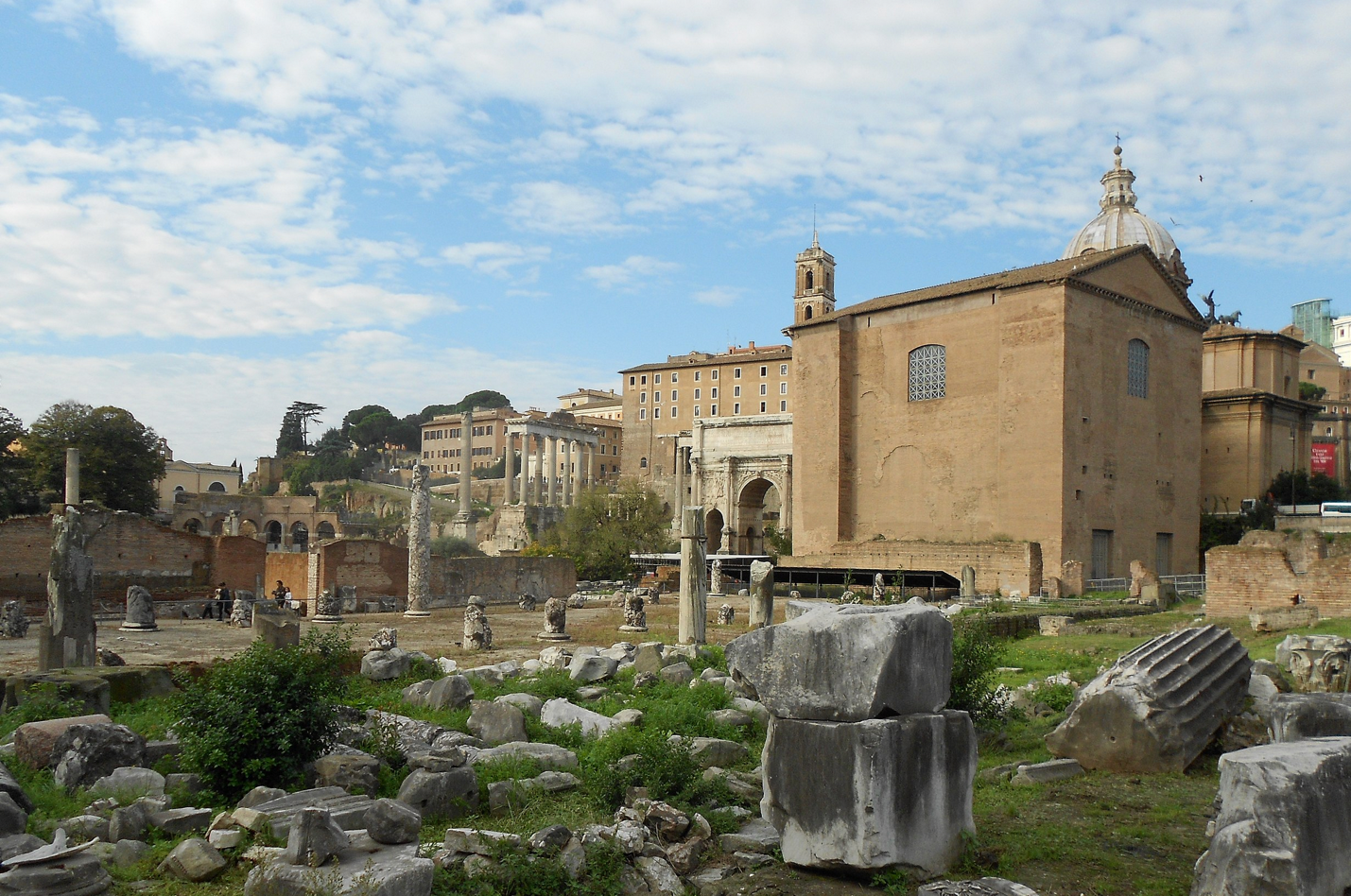
70. To the right, the Cūria Iūlia, the building where the Roman Senate met, among the ruins of the Roman Forum. The sight of such ruins have often inspired writers to reconstruct the story of the society that created them. The author Edward Gibbon conceived the idea of writing his massive history, The Decline and Fall of the Roman Empire, not far from this spot, on the Capitoline Hill: “It was at Rome, on the 15th of October 1764, as I sat musing amidst the ruins of the Capitol, while the barefooted fryars were singing Vespers in the temple of Jupiter, that the idea of writing the decline and fall of the City first started to my mind.”
Explōrātiō Trīcēnsima Secunda (XXXII) Adventure Thirty-Two
Symmachus and the Altar of Victory
Present Subjunctive of volō, nōlō, and mālō
Present Subjunctive Forms of fīō
Special Translation of the Subjunctive in Fear Clauses
Special Translation of the Jussive Subjunctive
The Demonstrative iste, ista, istud
Symmachus, Relātiō dē Ārā Victōriae
Symmachus, Relātiō dē Ārā Victōriae, Excerpt
Where and When Are We Today?
Forum, Rōma
Mēnsis Augustus
Flāviō Ricomer Flāviō Clearchō cōnsulibus
The Forum, Rome
August, 384 CE
After our visit to Aquileia I took a week off – not from Latin, of course, but from time-traveling. The reason was that I had started a part-time job working for my uncle as a surveyor, which involved standing in the street with a sighting pole while traffic whizzed past me. As a result, most days I wasn’t home when Latinitas stopped by. But when I had some free time, I would read a bit of the book Latinitas bought for me in Aquileia, the Historia Apollōniī. I made decent progress just using my notebook and a dictionary.
One Sunday when I had the day off Latinitas returned. I told her I had been reading the novel and she seemed pleased. She handed me the magic wine and instantly we turned up in Rome again. This time we were sitting in a large stone building with tiers of seats, about the size and shape of a high-school gymnasium, but beautifully ornamented with tapestries, statues, and intricate carvings.
Symmachus and the Altar of Victory
“Welcome to the Cūria,” she whispered. “This is the building where the Roman Senate, or what remains of it, holds its meetings. There has been a Senate meeting house almost since the beginning of the Roman Republic. But the original is long gone; after a mob set fire to the Cūria in 58 BCE, a new one was constructed. Augustus gave it the finishing touches and named it the Cūria Iūlia after the gēns of Julius Caesar. He had an altar installed at the front, the Āra Victōriae, which will be subject of a speech we shall hear shortly.”
I pointed quizzically to a large cross on the wall. Does that mean what I think it does?
“Ah, the cross, yes it does. All those days recently when we didn’t travel? Well, time flies. We are now in the year 384 CE. The cross has been there ever since Constantine became the first Christian Roman emperor.”
A few dozen senators were milling about and talking to each other. There was a sense of anticipation in the air, though little visible action.
“These days things can be pretty sleepy around here. Rome, you know, is no longer the capital of the empire.”
I did a double take when she said that. What?
“Nearly a century ago, in the year 286 CE, the emperor Diocletian made the city of Mediōlānum, what you call Milan, the new capital of the western half of the Roman empire. We’ll be visiting Milan tomorrow. Rome remains the spiritual and cultural center of things, but its political importance has long been fading.”
“Other changes are also afoot. The last emperor, Gratian, ordered that the altar I just mentioned, the one Augustus installed so many years ago, be removed from the Cūria on the grounds that it is a pagan monument. It’s sitting in a back room,” she pointed behind us, “gathering dust. A pagan senator named Quīntus Aurēlius Symmachus is about to come and read out a letter he wrote to the current emperor, Valentinian, asking him to restore the altar. His reading is what everyone is waiting for.”
With an attendant leading the way, Symmachus entered the Curia and made for the platform at the front. He appeared to be in his forties, balding, with a touch of red hair, and very serious eyes. Coming in from the sunlight, he squinted at the crowd, then began to address his allies by name. Avē, Symmache, I heard a fellow in front of us say. Two senators with crosses stitched on their robes overtook him from behind, apparently making a last-ditch effort to convince him not to speak. While they were arguing, Latinitas steered my attention back to our work.
Present Subjunctive of volō, nōlō, and mālō
“Let’s conclude our study of present subjunctive forms. In addition to sum and eō, the verbs volō, nōlō, and mālō have irregular forms in the present subjunctive. These three verbs use endings similar to those of sum in the present subjunctive. What was the present subjunctive of sum?”
And I told her:
Present Subjunctive of sum, Reviewed
| Singular | Plural |
|---|---|
| sim | sīmus |
| sīs | sītis |
| sit | sint |
“Good. The present subjunctive forms of volō, nōlō, and mālō feature the same endings as sim, sīs, etc. Notice that the stem of volō is changed to vel-:”
Present Subjunctive of volō, nōlō, mālō
| Singular | Plural |
|---|---|
| velim | velīmus |
| velīs | velītis |
| velit | velint |
| Singular | Plural |
|---|---|
| nōlim | nōlīmus |
| nōlīs | nōlītis |
| nōlit | nōlint |
| Singular | Plural |
|---|---|
| mālim | mālīmus |
| mālīs | mālītis |
| mālit | mālint |
Exercises 1-3
1. Dīc mihi quem colōrem mālīs ad nāvem pingendam.
2. Mīlitēs rogant ut eīs frūmentum accipere liceat ex quō locō velint.
3. Sequitur itaque ut mūtārī nōlīmus quia nōs optimōs esse putāmus.
Present Subjunctive of fīō
“One more verb you know that has an irregular present subjunctive is fīō. Let’s first review the forms of the verb fīō, which you encountered a long time ago in Explōrātiō 15. It is a long I-verb except the -ī- is also long in: the present tense first-person singular and third-person plural, fīō, fīunt; the imperfect, fīēbam, etc.; and the future, fīam, etc. In the perfect system it has passive forms: factus sum; factus eram, etc. It serves as the passive of the verb faciō.
Vocabulary
Irregular Verb
| Latin Verb | English Meaning |
|---|---|
| fīō, fierī, factus sum | to happen; become; be made. “When this verb means ‘become’ or ‘be made’, it can have a nominative subject and a nominative predicate, like sum, esse, fuī does. The present infinitive form is irregular.” |
Present Subjunctive Forms of fīō
“In the present subjunctive, fīō behaves like a long I-verb except the -ī- remains long:”
Present Subjunctive of fīō
| Singular | Plural |
|---|---|
| fīam | fīāmus |
| fīās | fīātis |
| fīat | fīant |
Exercises 4-6
4. Factus est mihi carcer subitō praetōrium. “A praetōrium, -ī, n. is a ‘palace’ or ‘mansion’.”
5. Eōdem diē cōnsul Cicerō factus erat.
6. Facile est, cum id fit, quemadmodum et ā quibus hominibus fīat vidēre.
Fear Clauses
“Another new use for the subjunctive in a subordinate clause is a fear clause. A fear clause is a substantive clause (like substantive ut clauses of result and indirect commands) with two special features. First, the clause is introduced by a verb that means ‘fear’ or ‘worry’, like timeō or metuō (sometimes a noun, like timor or metus, can introduce it).”
“Second, a fear clause is introduced by ut or nē, but the usual meaning of ut and nē appear to be reversed. This means that nē is translated ‘that’, and ut is translated ‘that… not’ in a fear clause. You can also translate nē with the old-fashioned word ‘lest’.”
Special Translation of the Subjunctive in Fear Clauses
“The present subjunctive in a fear clause is translated ‘may verb’, and the imperfect subjunctive is translated ‘might verb’.”
Vocabulary
| Latin Verb | English Meaning |
|---|---|
| metuō, metuere, metuī | to fear |
Fear Clause Examples
Metus oritur nē Caesar potestātem summam teneat.
A fear arises that/lest Caesar may possess the highest power.
metus introduces the fear clause nē... teneat (present subjunctive); nē is translated ‘that/lest’
Timēbāmus quidem ut nostrī auxilium nōbīs adferre possent.
We were indeed fearing that our men might not be able to bring aid to us.
timēbāmus introduces the fear clause ut ... possent (imperfect subjunctive); ut is translated ‘that... not’
Exercises 7-10
7. Dominī metuēbant nē servī arma sūmerent.
8. Timeō ut ille princeps urbem nostram servet; timeō nē rēs pūblica pereat.
9. Fuit magnus timor nē pīrātae bona nostra et līberōs raperent. “A pīrāta, -ae, m. is a ‘pirate’.”
10. Perīculum est nē in carcerem iaciāmur et lībertātem āmittāmus.
The Jussive Subjunctive
“In addition to featuring in several kinds of subordinate clause, the subjunctive can also be used as the main verb of a sentence, in an independent clause. There are four uses of the subjunctive as the main verb of a sentence. The first of these is called the jussive subjunctive; we will study the other three tomorrow.”
“The jussive subjunctive is used to express a command or exhortation. (It is named after the Latin verb iubeō, iubēre, iussī, iussus, ‘to order’.) To express a negative command or exhortation, use nēwith the subjunctive verb.”
Special Translation of the Jussive Subjunctive
“When a jussive subjunctive verb in the present tense is first or third person, it is translated ‘let (me/us/him/her/it/them) verb’. When the verb is second person, it is translated ‘you (all) should verb’. If the jussive subjunctive is negated by nē, then translate ‘let us not, let them not, you should not, etc.’. The imperfect and pluperfect subjunctive are not common in this use.”
Jussive Subjunctive Examples
Sit praedium in hīs agrīs quī nōn saepe dominum mūtant.
Let the farm be in those fields which do not often change owner.
sit (present subjunctive) is jussive, the verb in the main clause of the sentence
Amēmus patriam, pāreāmus senātuī.
Let us love the country, let us obey the senate.
amēmus and pāreāmus (present subjunctive) are jussive.
Exercises 11-15
11. Fīat lūx.
12. Nē difficilia optēmus.
13. Vīvāmus, mea Lesbia, atque amēmus.
14. Cautus sīs, frāter mihi cārissimus.
15. Proelium faciant mīlitēs et pugnent. Nē hostēs fugiant in silvās.
The Demonstrative iste, ista, istud
“Let’s learn a new demonstrative pronoun and adjective before we turn to other vocabulary. You already know the pronoun hic, haec, hoc, which refers to something close by, and the pronoun ille, illa, illud, which points to something farther away. There is another demonstrative iste, ista, istud, which is used when a speaker wants to add a strong emotional coloring to their indication, either positive or negative, and it usually refers to a second-person addressee. It can be translated as ‘this’ or ‘that’, in the singular, or ‘these’ or ‘those’, in the plural. It is formed like ille, illa, illud, with ist- in place of ill-:”
Vocabulary
Demonstrative Pronoun and Adjective
| Latin Demonstrative | English Meaning |
|---|---|
| iste, ista, istud | that (s.), those (pl.) “Emotionally positive or negative.” |
Forms of iste, ista, istud
| Singular ‘this/that’ | Singular ‘this/that’ | Singular ‘this/that’ | Plural ‘these/those’ | Plural ‘these/those’ | Plural ‘these/those’ | |
|---|---|---|---|---|---|---|
| M. | F. | N. | M. | F. | N. | |
| Nom. | iste | ista | istud | istī | istae | ista |
| Gen. | istīus | istīus | istīus | istōrum | istārum | istōrum |
| Dat. | istī | istī | istī | istīs | istīs | istīs |
| Acc. | istum | istam | istud | istōs | istās | ista |
| Abl. | istō | istā | istō | istīs | istīs | istīs |
“This pronoun provides Spanish and Italian with their words for ‘this’: esta, esto and questa, questo.”
Exercises 16-17
16. Ubi est iste pius frāter tuus? Nam optō eī grātiās agere.
17. Quam diu etiam furor iste tuus nōs ēlūdet? “The verb ēlūdō, ēlūdere, ēlūsī, ēlūsus means ‘to mock’.”
“The Christian senators are still trying to dissuade Symmachus from speaking. So let us go over our vocabulary.”
Vocabulary
Irregular Verb
| Latin Verb | English Meaning |
|---|---|
| intersum, interesse, interfuī | to make a difference; to be different; to attend. “This verb is often used impersonally: Quid interest? ‘What difference does it make?’.” |
Impersonal E-Verb (Second Conjugation)
| Latin Verb | English Meaning |
|---|---|
| paenitet, paenitēre, paenituit | to cause regret |
3rd Conjugation (I-Verbs)
| Latin Verb | English Meaning |
|---|---|
| accēdō, accēdere, accessī, accessus | to approach; go near; occur; occur in addition |
| accidō, accidere, accīdī | to happen; occur; befall. “This verb can introduce a substantive ut clause of result; a dative expresses the person to whom it happens.” |
| pellō, pellere, pepulī, pulsus | to push; beat; drive |
Deponent I-Verb (Third Conjugation)
| Latin Verb | English Meaning |
|---|---|
| ūtor, ūtī, ūsus sum + abl. | to use; make use of; enjoy. “The object of this verb is in the ablative.” |
Second Declension Nouns
| Latin Noun | Noun Gender | English Meaning |
|---|---|---|
| mundus, -ī | m. | world; universe |
| saeculum, -ī | n. | generation; age |
Third Declension Nouns
| Latin Noun | Noun Gender | English Meaning |
|---|---|---|
| auctōritās, auctōritātis | f. | authority; will; credibility |
| custōs, custōdis | m./f. | guardian; guard |
| sermō, sermōnis | m. | phrase; speech; conversation |
US-A-UM Adjectives (First and Second Declension Adjectives)
| Latin Adjective | English Meaning |
|---|---|
| rēctus, -a, -um | correct; right; straight |
| reliquus, -a -um | left over; remaining |
| sacer, sacra, sacrum | sacred; holy |
| secundus, -a, -um | favorable; second |
Third Declension Adjectives
| Latin Adjective | English Meaning |
|---|---|
| commūnis, commūne | common |
| fēlīx, fēlīcis | lucky. “This adjective has one nominative form for all three genders.” |
Adverbs
| Latin Adverb | English Meaning |
|---|---|
| unde | from where |
| haud | by no means; not at all |
Exercises 18-24
18. Custōs reī pūblicae est auctōritās senātūs.
19. Nūllā in parte mundī, nūllō saeculō, homō fēlīcior inventus est quam istō.
20. Sciat sē nihil mēcum habēre commūne; inter nōs maximum quidem interest.
21. Metuō nē pellar ā cīvitāte. Nam multa haud rēcta fēcī; mē paenitet.
22. Reliquum est ut sacrās ad ārās pius accēdam et secunda precer.
23. Utendum est ratiōne in hōc sermōne, nē malum nōbīs accidat.
24. Hostis, cum venit, nōn prae sē fert aut quī sit aut unde veniat aut etiam quid velit.
“The idiom prae sē ferre (lit., ‘to bear before onself’) means ‘to make known’, ‘to reveal’.”
Symmachus, Relātiō dē Ārā Victōriae
We were interrupted at this point by a shuffling of feet, as a large group of senators hurried from the chamber. The Christians were leaving in protest, leaving only the traditionalists as Symmachus’ audience. As for his letter to the emperor that he read, a Dispatch On the Altar of Victory, the tone was conciliatory, a plea to respect the gods of the ancestors and to acknowledge that there is more than one path to knowledge of the divine. I understood bits and pieces of it, and Latinitas told me to focus on this section, about midway through:
Symmachus, Relātiō dē Ārā Victōriae, Excerpt
1) Suus enim cuique mōs, suus cuique rītus est. Variōs custōdēs urbibus cultūs mēns dīvīna distribuit. Ut animae nāscentibus, ita populīs fātālēs geniī dīviduntur. Accēdit ūtilitās, quae maximē hominī deōs adserit. Nam cum ratiō omnis in opertō sit, unde rēctius quam dē memoriā atque documentīs rērum secundārum cognitiō venit nūminum?
rītus, -ūs, m. rite
cultus, -ūs, m. cult; religion
distribuō, distribuere, distribuī, distribūtus to distribute
fātālēs geniī ‘deities that watch over (a people’s) fate’
dīvidō, dīvidere, dīvīsī, dīvīsus to divide; distribute
ūtilitās, ūtilitātis, f. practical value
adserō, adserere, adseruī, adsertus to declare
in opertō ‘in the dark’ (lit. ‘in the concealed thing’)
documentum, -ī, n. example; proof
cognitiō, cognitiōnis, f. knowledge
2) Iam sī longa aetās auctōritātem religiōnibus faciat, servanda est tot saeculīs fidēs et sequendī sunt nōbīs parentēs, quī secūtī sunt fēlīciter suōs. Rōmam nunc putēmus adsistere atque hīs vōbīscum agere sermōnibus: “Optimī principum, patrēs patriae, reverēminī annōs meōs, in quōs mē pius rītus addūxit! Ūtar caerimōniīs avītīs; neque enim paenitet. Vīvam meō mōre, quia lībera sum!”
religiō, religiōnis, f. religion
faciat translate like the indicative
adsistō, adsistere, adstitī to stand (by)
agere here, ‘plead’
revereor, reverērī, reveritus sum to revere; respect
addūxit ~ dūxit
caerimōnia, -ae, f. ceremony
avītus, -a, -um ancestral
3) Aequum est, quidquid omnēs colunt, ūnum putārī. Eadem spectāmus astra, commūne caelum est, īdem nōs mundus involvit. Quid interest, quā quisque prūdentiā vērum requīrat? Ūnō itinere nōn potest pervenīrī ad tam grande sēcrētum.
astrum, -ī, n. star
involvō, involvere, involvī, involūtus to envelope, surround
quā ... prudentiā ‘with what wisdom’
requīrō, requīrere, requīsīvī, requīsītus to search for
pervenīrī to arrive at (intransitive verb used impersonally in the passive voice)
grandis, grande great
sēcrētum, -ī, n. secret; mystery
When he was finished, the senators who had stayed to hear him greeted him with shouts of approval, and not a few tears. Symmachus remained there, standing still as a statue for several minutes, until at last he turned and walked slowly from the building with a solemnness that sent chills down my spine. The outcome was a foregone conclusion: his plea was doomed, and pagan traditions would soon cease to be part of the official religion of the Roman empire.
“Symmachus is a major figure with many friends, many rivals, and many enemies. Perhaps his most well-known rival is Saint Ambrose, the Christian bishop of Milan. As it happens, one of Symmachus’ students is now working for Ambrose. Tomorrow, when we visit the cathedral in Milan, we will encounter him. He is the famous Christian writer Saint Augustine.”
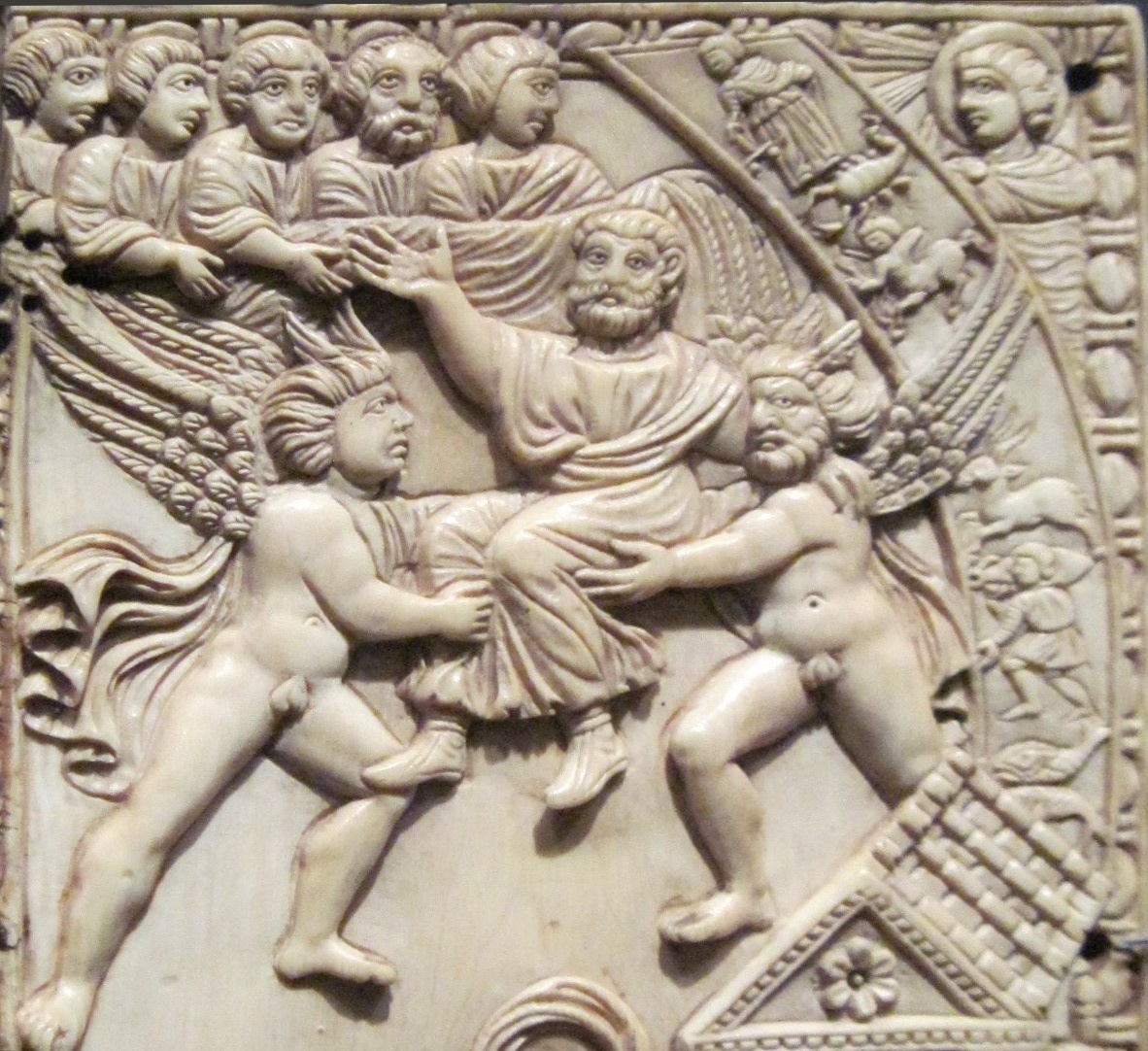
71. Detail of an ivory diptych created by Symmachus’ family around 402 CE that shows the statesman being carried by benevolent spirits to the gods in heaven. In limbō notā bene haec signa: Virginem, Scorpiōnem, Sagittārium, Capricornum, Aquārium, Piscēs. Note these zodiacal signs on the border: Virgo, Scorpio, Sagittarius, Capricorn, Aquarius, and Pisces.