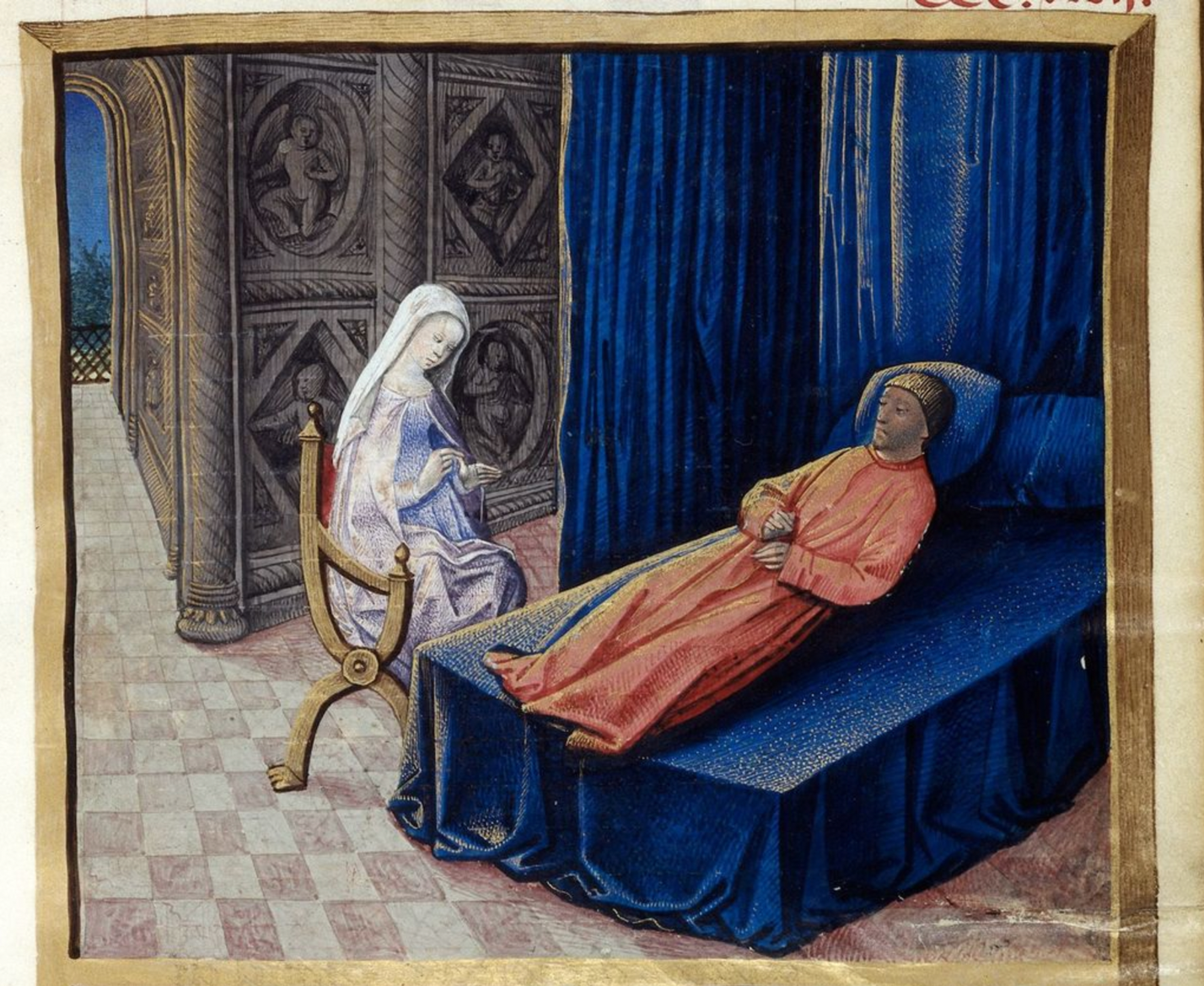
78. Domina Philosophia Boēthium iacentem adloquitur; Lady Philosophy addresses Boethius as he lies down. From a miniature illustration to the Consolation of Philosophy that accompanied a popular French translation of the work, created in 1477.
Explōrātiō Trīcēnsima Sexta (XXXVI) Adventure Thirty-Six
Anonymous, from the Carmina Burāna
Relative Clauses of Characteristic, Purpose, and Result
Relative Clauses of Characteristic
Ablative of Specification and Ablative of Description
The Irregular Verb sum: fore and forem
Alternative Imperfect Subjunctive Forms
Boēthius, Dē Cōnsōlātiōne Philosophiae
Where and When Are We Today?
Tīcīnum, Ītalia
Mēnsis Aprīlis
Flāviō Iūstīnō Augustō Venantiō Opiliōne cōnsulibus
Pavia, Italy
April, 524 CE
You’ve now heard about all my visits to the world of ancient Rome – all except the very last. Of all the trips we made, this was, in some respects, the most unbelievable. And that is the real reason why it took me so long to write down this account of my adventures.
Soon after Latinitas stopped visiting me, our explorations started to feel to me like a long, weird dream. If she hadn’t given me the as coin and the tunic, it’s possible I would have just dismissed all of them as delusions. But there they are: I still carry the as with me everywhere I go, and I have it on my desk right now as I write. The tunic sits in my bottom dresser drawer next to some sweaters. I still have and treasure my old Latin notebook, with its dirt-smudged pages and doodles and notes I made to myself. These three objects serve to remind me that our journeys were real, but for a long time I could not bring myself to write about them, much less tell anyone about what happened.
I finished college a few months after the visits stopped. I attended law school for a year, dropped out, then became a real estate agent and discovered that I was good at it. A few years later I got in a car accident that put me in the hospital for a month, then fell in love with one of the witnesses to the accident, whom I later married. Over time I also developed an inexplicable obssession with zoning regulations – the laws about what kinds of structures can be built in which places – and ran for an open spot on our city’s zoning board; I now lead a national organization that is focused on zoning reform.
Years passed; my partner and I raised three wonderful children. Once they left the house, two things happened that finally pushed me to write this book. First, I started to have lucid dreams in which I would relive our explorations of the ancient world. Some dreams were long, some short, some boring, some highly emotional, but all featured little twists and variations on the original experiences. After a few such dreams I began to worry that they would contaminate my real memories so much that I would be unable to tell them apart. The other thing that happened was this. One day, when we were cleaning, my partner asked me about the tunic. I said it was a gift from an old friend – which was true – and shared a few boring details about Latinitas. But I wanted to tell my partner the full story, from start to finish, with all the amazing parts. And so I came to the realization that I had to write this book.
Writing the first thirty-five chapters was not hard, because their lessons were straightforward and remarkably fresh in my mind. But this last visit was another matter. I am still not sure what to make of it, or how to describe what it meant. At any rate, this is what happened.
The year of our last adventure fell at the beginning of a time that people used to call ‘the Dark Ages’. The Roman Empire had collapsed in western Europe and given way to an assortment of local kingdoms. But it was, of course, not literally dark in Pavia, the city in northern Italy that we were visiting. The air was foggy, but it was clear that there was plenty of business and activity going on. The styles had changed since our last visit, reflecting the tastes of the Goths who now governed these kingdoms; and people’s language was changing too. Theodoric the Great, the current king of Italy, was born in the land that today we call Austria. In the street I hear Latin, but also Gothic. As Latinitas pointed out to me, people in the marketplace were speaking a hybrid language with elements of both.
I listened to passersby for a while, then turned to ask her about the odd design embroidered on the robe she was wearing today. It was a kind of ladder or scale, with the Greek letter thēta at the top and pē at the bottom. It reminded me of some kind of sorority symbol, but it only had two letters, not three.
“Oh, that. Yes, the thēta stands for theorēticē, ‘theorical’ and the pē stands for practicē, ‘practical’. That’s all.”
Before I could ask any more questions, Latinitas led me down to the Ticinus river, which ran through the middle of the city and offered us a good view up and down its banks. She gestured to it with a wooden staff which she was carrying today.
“It was right here in Pavia that the western Roman empire finally died,” she remarked, while plucking a pair of daisies from the grass to put behind her ear. “About fifty years ago the last Roman emperor, a young man of sixteen named Romulus Augustulus, was trapped in this city along with his father, Orestes, who had arranged for his son to be made emperor. The Gothic general Odoacer had chased the two of them here along with their pitiful army, then laid siege to the city, which quickly surrendered and was plundered. Orestes, who posed the real threat to Odoacer, was put to death, his body tossed in the river. As for Romulus Augustulus, he was sent down to Naples to live out the rest of his life in retirement.”
He retired at sixteen?
“He was forced to retire. Think of it as a form of lifelong house arrest. Speaking of which…”
Once again she turned around rather abruptly and marched me to a church just a few blocks away. As churches go it was not very impressive; in fact it struck me that all the buildings in Pavia, while relatively new and tidy, were smaller and less extravagant than what I had been used to seeing; some even had thatch roofs. Attached to the side of the church was a small cell about the side of a shed, with a guard sitting in front of it, half-singing songs to himself to pass the time. Latinitas smiled at him and handed him one of her daisies; he took it and promptly fell into a deep sleep. She then chanted a little poem over him.
Anonymous, from the Carmina Burāna
Ō quam fēlīx est
antidotum sopōris,
quot cūrārum tempestātēs
sēdat et dolōris!
Dum surrēpit clausīs
oculōrum porīs,
ipsum gaudiō aequiperat
dulcēdinī amōris.
antidotum, -ī, n. antidote; remedy
sopor, sopōris, m. slumber
tempestās, tempestātis, f. storm
sēdō, sēdāre, sēdāvī, sēdātus to calm
dum while
surrēpō, surrēpere, surrēpsī, surrēptus to creep in; slip through
clausus, -a, -um closed
porus, -ī, m. passage; channel
gaudium, -ī, n. joy
aequiperō, aequiperāre, aequiperāvī, aequiperātus + dat. to match; equal
dulcēdō, dulcēdinis, m. sweetness
The song sounded familiar. Only later did I recognize it as the poem she had me read on her first visit. It is a poem that comes from a Medieval anthology called the Carmina Burāna.
Boēthius
“The prisoner in this cella,” she explained, “is a man, Anicius Mānlius Sevērīnus Boēthius; the people of your day simply call him Boethius. He is a philosopher, and one of the last people in this part of the world to be fluent in philosophical Greek. He is also a powerful Roman administrator, who’s seen both of his two sons appointed consul. But, as often happens to powerful people, he has been caught up in intrigues at the court of Theodoric and accused of conspiring with the enemies of the king. Theodoric ordered him to be thrown in prison, and a few weeks from now, as part of a purge, he will be put to death.”
“Boethius is working right now on a book that will become famous after his death: the Cōnsōlātiō Philosophiae. I have been helping him write it, and I will show you some of it when we go in. But before that happens, you need to finish your last Latin lesson.”
This is it? I asked, suddenly struck by the reality that this was our last exploratio.
“It is. You will never stop learning more about Latin, just as you can never stop learning more about any language. Languages are too vast for any one human to fully master them, and that is why,” she said, with a knowing look, “you think of us as gods. Every author and every speaker of Latin has his or her own brand of language, with favorite words and quirks of grammar. But I have given you enough Latin so that, with a little help from dictionaries and other documents, you can figure out what texts say, and what they really mean,” she added, again looking at me significantly. “You have been a fine student. I’m sure you be able to absorb and understand what I teach you today. So now, for the last time, take out your notebook.”
“Let’s start with some vocabulary, which you will encounter in Boethius’ book.”
Vocabulary
A-Verb (First Conjugation)
| Latin Verb | English Meaning |
|---|---|
| cūrō, cūrāre, cūrāvī, cūrātus | to care for; look after |
E-Verb (Second Conjugation)
| Latin Verb | English Meaning |
|---|---|
| soleō, solēre, solitus sum | to be accustomed; to be usual “Semi-deponent.” |
I-Verbs (Third Conjugation)
| Latin Verb | English Meaning |
|---|---|
| alō, alere, aluī, altus / alitus | to nourish; sustain |
| permittō, permittere, permīsī, permissus | to let go; allow; permit |
Deponent I-Verb (Third Conjugation)
| Latin Verb | English Meaning |
|---|---|
| queror, querī, questus sum | to complain; lament |
Second Declension Nouns
| Latin Noun | Noun Gender | English Meaning |
|---|---|---|
| aevum, -ī | n. | age; time; antiquity |
| humus, -ī | f. | ground “The form humī means ‘on the ground’ (locative case).” |
| morbus, -ī | m. | disease; sickness |
Fourth Declension Noun
| Latin Noun | Noun Gender | English Meaning |
|---|---|---|
| gradus, -ūs | m. | step |
Fifth Declension Nouns
| Latin Noun | Noun Gender | English Meaning |
|---|---|---|
| aciēs, -ēī | f. | edge; sharpness (of vision); line of battle |
| speciēs, -ēī | f. | appearance |
US-A-UM Adjective (First and Second Declension Adjectives)
| Latin Adjective | English Meaning |
|---|---|
| aeger, aegra, aegrum | sick; weary |
| extrēmus, -a, -um | farthest; the edge of; bottom |
| īnferus, -a, -um | low “The superlative form is īnfimus, -a, -um or īmus, -a, -um.” |
| maestus, -a, -um | sad |
| plēnus, -a, -um | full “What one is ‘full of’ or ‘full with’ goes in the genitive or ablative.” |
Conjunction
| Latin Conjunction | English Meaning |
|---|---|
| quamvīs | although; however you want “Also an adverb meaning ‘ever so’, ‘very much’.” |
Preposition
| Latin Preposition + Case | English Meaning |
|---|---|
| ultrā + acc. | beyond; further “Also an adverb.” |
Exercises 1-4
1. Mēns alitur discendō et cōgitandō.
2. Multa cūrānda sunt: faciāmus prīmum gradum.
3. Aciēs ultrā fīnēs īvit.
4. Nē humī iacueris!
Clauses Introduced by dum
“A small word you have seen before, dum, is used to introduce a subordinate clause, but it has a few different meanings. With an indicative verb it means ‘while’. With a subjunctive verb, it can mean ‘while’ or ‘until’ (implying expectation), or ‘provided that’. The context will help you to decide which meaning of dum with a subjunctive verb is correct in a sentence.”
Vocabulary
Conjunction
| Latin Conjunction | English Meaning |
|---|---|
| dum | while (with indicative); while; until; provided that (with subjunctive) |
Clauses Introduced by dum: Examples
Dum anima est, spēs esse dīcitur.
While there is life (a soul), there is said to be hope.
est is indicative; dum means ‘while’
Illa quidem dum tē fugeret, hydrum nōn vīdit.
While that woman was fleeing you, she did not see the serpent.
fugeret is imperfect subjunctive; dum means ‘while’
Manēbāmus dum nāvēs advenīrent.
We were waiting until the ships would arrive / for the ships to arrive.
advenīrent is imperfect subjunctive; dum means ‘until’ (implying expectation)
Ōderint, dum metuant.
Let them hate, provided that they fear.
metuant is present subjunctive; dum means ‘provided that’ (ōderint is perfect subjunctive, jussive)
Exercises 5-7
5. Dum loquimur, fūgerit invida aetās: carpe diem! “From Horace. The adjective invidus, -a, -um means ‘envious’.”
6. Id faciat saepe, dum nē lassus fīat. “The adjective lassus, -a, -um means ‘tired’.”
7. Scrībis in Ītaliā tē morātūrum dum tibi litterae meae veniant. “From one of Cicero’s letters.”
Relative Clauses of Characteristic, Purpose, and Result
“Now we are going to talk one last time about relative clauses. A relative clause can contain a subjunctive verb instead of an indicative one. There are three different reasons why it might do so that affect the English translation. It may be a relative clause of characteristic, which describes a typical feature of a person or thing; a relative clause of purpose, which describes an action someone or something intends to perform; or a relative clause of result, which describes the outcome of an action. The context will help you to decide which kind of relative clause with the subjunctive you have. Let’s consider each type and learn how to identify and translate them.”
Relative Clauses of Characteristic
“A relative clause of characteristic defines a type: ‘he is the kind of guy who...’. Typically, the subjunctive verb requires no special translation. Often the verb in the main clause is sum.”
Relative Clauses of Characteristic: Examples
Erant quī cēnsērent...
There were (those) who were proposing...
cēnsērent is imperfect subjunctive; note erant in the main clause
Quaesō, Chārīne, quoniam nōn potest id fierī quod vīs, id velīs quod possit.
Please, Charinus, because that which you wish for cannot happen, you should wish for that which can.
possit is present subjunctive
Relative Clauses of Purpose
“A relative clause of purpose is similar to a purpose clause: you can add ‘may’ when you translate a present subjunctive, or ‘might’ when you translate an imperfect subjunctive; sometimes it will sound best in English to rephrase using ‘for’, ‘supposed to’, ‘intended to’ and similar phrases.”
Relative Clauses of Purpose: Examples
Scrībēbat ōrātiōnēs quās aliī dīcerent.
He wrote speech which other men might deliver / for other men to deliver.
dīcerent is imperfect subjunctive
Campum Mārtium vīcīnum Tiberī dēlēgērunt, in quō iuventūs post exercitium armōrum sūdōrem pulveremque dīlueret.
They chose a part of the Campus Martius near the Tiber in which the youth might wash off / were supposed to wash off their sweat and dust after their exercise in arms.
dīlueret is imperfect subjunctive
Relative Clauses of Result
“A relative clause of result is similar to a result clause: the relative pronoun is often best translated ‘that’ (like ut introducing a result clause).”
Relative Clauses of Result: Example
Nēmō est tam senex quī sē annum nōn putet posse vīvere.
Nobody is so old that he does not think that he can live a year (more).
putet is present subjunctive; notice tam in the main clause
Exercises 8-13
8. Quis est quī nōn probet, quī nōn laudet aevum sine morbō?
9. Quid querar? Nihil videō quod timeam.
10. Ad castra eōs mīsit quī pācem peterent.
11. Solēbat scrībere carmina quae aliī legerent vel canerent.
12. Sunt quī Propertium mālint. Permittō.
13. Fortem posce animum mortis terrōre carentem,
quī spatium vītae extrēmum inter mūnera pōnat
nātūrae, quī ferre queat quōscumque labōrēs,
nesciat īrascī, cupiat nihil.
“These lines are from Juvenal. The verb queō, quēre, quīvī, quitus means ‘to be able’, and quōscumque ‘any whatsoever’.”
Ablative of Specification and Ablative of Description
“Let’s now look at the ablative case one more time. You remember the translations that correspond to f.w.i.b.: from, with, in by. Sometimes ‘at’ or ‘by’ is used with a time word like nocte or diē for indicating the time when something happens.”
“Another use of the ablative without a preposition is to qualify a word, typically an adjective, to specify the area to which the word applies. This is called the ablative of specification. An ablative of specification is typically best translated with the preposition ‘at’ or ‘in’, or with the phrase ‘with respect to’.”
Ablative of Specification: Example
Bonus cōnsiliō erat vir.
The man was good with respect to his judgement.
ablative cōnsiliō gives specification to the adjective bonus
“An ablative noun modified by an ablative adjective, without a prepostion, can be used to give a description. This is called the ablative of description. It can be translated using the preposition ‘of’, or with the phrase ‘characterized by’.”
Ablative of Description: Example
Mulier summō ingeniō erat.
She was a woman of the highest (utmost) talent.
ablative ingeniō, with ablative summō in agreement gives a description
Exercises 14-16
14. Iste est aeger corpore, quamvīs integer mente.
15. Mulier ea maestō vultū et vōce haud plēnā erat.
16. Īnferiōrēs fortūnā factī sumus.
The Irregular Verb sum: fore and forem
“One last thing. The verb sum has a form, fore, which is an alternative form in two parts of its conjugation.”
The Future Infinitive fore
“First, fore can be used as the future infinitive, replacing the longer form futūrum, -am, -um esse. It is often used in indirect statement.”
Examples of fore, Future Infinitive of sum, in Indirect Statement
Spērō nostram amīcitiam posteritātī nōtam fore.
I hope that our friendship will be known to posterity.
Putābam tē hīc tūtissimum fore.
I thought that you would be most safe here.
Alternative Imperfect Subjunctive Forms
“Secondly, when fore has personal endings, it serves as an alternative form of the imperfect subjunctive of sum (essem, essēs, etc.). There is no difference of meaning.”
Alternative Imperfect Subjunctive Forms of sum, esse
| Singular | Plural |
|---|---|
| forem | forēmus |
| forēs | forētis |
| foret | forent |
“Again, the forms above can be used interchangeably with the forms below.”
| Singular | Plural |
|---|---|
| essem | essēmus |
| essēs | essētis |
| esset | essent |
Example of Imperfect Subjunctive Form forem, forēs
Eam hominem esse arbitrātī sumus quamvīs sapientiae tam plēna foret ut dea esse vidērētur.
We judged that she was a human being although she was so full of wisdom that she seemed to be a goddess.
Exercises 17-18
17. Ista mulier respondit sē Rōmae fore.
18. Sī mīlitēs nostrī nōn ita paucī forent, servāre imperium possent.
Boēthius, Dē Cōnsōlātiōne Philosophiae
When that was finished we stepped into Boethius’ cella. I was immediately surprised, because Boethius recognized Latinitas and began talking to her at once, as if they were old acquaintances. He seemed to be complaining about something, but he spoke too fast for me to follow, so I was not sure what it was all about; Latinitas answered him at length. Boethius then picked up a piece of paper with a carmen written on it, which he recited. Latinitas shook her head, as if finding it inadequate, and went on again. When she finished, he nodded, apparently agreeing to what she said, and began to write something, very deliberately, all while I sat there and watched in amazement, because I had never seen Latinitas interact with someone like this before.
When he was finished with his writing, Latinitas walked over to him and placed the other daisy behind his ear. Boethius immediately fell asleep, like the guard outside had. She felt his forehead, as if checking to make sure he was not feverish, then, satisfied, turned back to me again.
“Here,” she said, handing me a copy of Boethius’ manuscript. “Read this. It comes from the beginning of his work, right after his first short poem.” The Consolation, you see, is a mix of poetry and prose.
She fed me vocabulary I did not know, but I managed to get the sense of it. The work takes the form of a dialogue, one between Boethius and a woman he calls Philosophia, and addresses as his domina. Translate it for yourself, and you will understand why I found this visit so bewildering.
Excerpts, Boēthius, Dē Cōnsōlātiōne Philosophiae
1) Haec dum mēcum tacitus ipse reputārem querimōniamque lacrimābilem stilī officiō signārem, astitisse mihi suprā verticem vīsa est mulier reverendī admodum vultūs, oculīs ārdentibus et ultrā commūnem hominum valentiam perspicācibus, colōre vīvidō atque inexhaustī vigōris, quamvīs ita aevī plēna foret ut nūllō modō nostrae crēderētur aetātis, statūrā discrētiōnis ambiguae.
reputō, reputāre, reputāvī, reputātus to go over (in one’s mind)
querimōnia, -ae, f. complaint
lacrimābilis, lacrimābile tearful
stilus, -ī, m. stylus; pen
officiō ‘with the help of’
signō, signāre, signāvī, signātus to write down; mark
astō, astāre, astitī + dat. to stand near
suprā + acc. above
vertex, verticis, m. crown (of the head)
reverendus, -a, -um reverend; venerable
admodum very
valentia, -ae, f. strength
perspicāx, perspicācis clear
vīvidus, -a, -um full of life; vivid
inexhaustus, -a, -um inexhaustible
vigor, vigōris, m. liveliness; vigor
statūra, -ae, f. height
discrētiō, discrētiōnis, f. discernment
ambiguus, -a, -um uncertain
2) Nam nunc quidem ad commūnem sēsē hominum mēnsūram cohibēbat, nunc vērō pulsāre caelum summī verticis cacūmine vidēbātur; quae cum altius caput extulisset, ipsum etiam caelum penetrābat rēspicientiumque hominum frūstrābātur intuitum.
sēsē = sē
mēnsūra, -ae, f. measure
cohibeō, cohibēre, cohibuī, cohibitus to confine
pulsō, pulsāre, pulsāvī, pulsātus to hit; strike
cacūmen, cacūminis, n. top
efferō, efferre, extulī, ēlātus to raise
penetrō, penetrāre, penetrāvī, penetrātus to penetrate
rēspiciō, rēspicere, rēspēxī, rēspectus to look on; look back on
frūstror, frūstrārī, frūstrātus sum to frustrate
intuitus, intuitūs, m. gaze
3) Vestēs erant tenuissimīs fīlīs, subtīlī artificiō, indissolūbilī māteriā perfectae, quās suīs manibus ipsa texuerat; quārum speciem, velutī fūmōsās imāginēs solet, cālīgō quaedam neglēctae vetustātis obdūxerat.
tenuis, tenue thin; fine
fīlum, -ī, n. thread
subtīlis, subtīle subtle
artificium, -ī, n. art; artifice
indissolūbilis, indissolūbile imperishable
māteria, -ae, f. material
texō, texere, texuī, textus to weave
fūmōsus, -a, -um smoky
cālīgō, cālīginis, m. blurriness
neglēctus, -a, -um neglected
vetustās, vetustātis, f. antiquity
obdūcō, obdūcere, obdūxī, obductus to cover
4) Hārum in extrēmō margine ‘P’ Graecum, in suprēmō vērō ‘Th’ legēbātur intextum atque inter utrāsque litterās in scālārum modum gradūs quīdam īnsignītī vidēbantur, quibus ab īnferiōre ad superius elementum esset ascēnsus.
margō, marginis, m. edge; fringe
intextus, -a, -um woven on
scāla, -ae, f. ladder
īnsignītus, -a, -um marked
elementum, -ī, n. letter (of the alphabet)
ascēnsus, ūs, m. ascent; climb
5) Eandem tamen vestem violentōrum quōrundam sciderant manūs et particulās quās quisque potuit abstulerant. Et dextrā quidem eius libellōs, scēptrum vērō sinistrā gestābat.
violentus, -a, -um violent
scindō, scindere, scidī, scissus to tear; rip up
particula, ae, f. scrap
scēptrum, -ī, n. staff
gestō, gestāre, gestāvī, gestātus to carry
6) Quae ubi poēticās Mūsās vīdit nostrō assistentēs torō flētibusque meīs verba dictantēs, commōtā paulisper ac torvīs īnflammāta lūminibus: Quis, inquit, hās scēnicās meretrīculās ad hunc aegrum permīsit accēdere, quae dolōrēs eius nōn modo nūllīs remediīs fovērent, vērum dulcibus īnsuper alerent venēnīs? Sed ābīte potius, Sīrēnēs usque in exitium dulcēs, meīsque eum Mūsīs cūrandum sānandumque relinquite.
assistō, assistere, astitī + dat. to stand next to
torus, -ī, m. couch; bed
flētus, -ūs, m. weeping
dictō, dictāre, dictāvī, dictātus to dictate
commōtus, -a, -um moved; upset
paulisper for a moment
torvus, -a, -um fierce; penetrating
īnflammātus, -a, -um enflamed; excited
scēnicus, -a, -um theatrical
meretrīcula, -ae, f. sex-worker
foveō, fovēre, fōvī, fōtus to soothe
īnsuper further; additionally
venēnum, -ī, n. poison
potius instead; rather
Sīrēn, Sīrēnis, f. Siren, legendary singers who lure men to death
exitium, -ī, n. destruction
sānō, sānāre, sānāvī, sānātus to heal
7) Hīs ille chorus increpitus dēiēcit humī maestior vultum cōnfessusque rubōre verēcundiam līmen trīstis excessit. At ego, cuius aciēs lacrimīs mersa cālīgāret nec dīnōscere possem quaenam haec esset mulier tam imperiōsae auctōritātis, obstupuī vīsūque in terram dēfīxō quidnam deinceps esset āctūra exspectāre tacitus coepī.
hīs ‘by these (words)’
chorus, -ī, m. chorus; band
increpō, increpere, increpuī, increpitus to reprimand
vultum ‘in their faces’ (with maestior)
cōnfiteor, cōnfitērī, cōnfessus sum to confess
rubor, rubōris, m. a blush
verēcundia, -ae, f. shame
excēdō, excēdere, excessī, excessus the prefix ex- adds ‘over’ or ‘out’ to the verb’s meaning
mergō, mergere, mersī, mersus to drown
cālīgō, cālīgāre, cālīgāvī, cālīgātus to be blurry; be blind
dīnōscō, dīnōscere, dīnōvī, dīnōtus to discern
quisnam, quaenam, quidnam = quis, quid
imperiōsus, -a, -um imperious; commanding
obstupeō, obstupēre, obstupuī to be stunned
vīsus, vīsūs, m. vision
dēfīgō, dēfīgere, dēfīxī, dēfīxus to fix downward
deinceps next
expectō, expectāre, expectāvī, expectātus to await
8) Tum illa propius accēdēns in extrēmā lectulī meī parte cōnsēdit meumque intuēns vultum lūctū gravem atque in humum maerōre dēiectum hīs versibus dē nostrae mentis perturbātiōne conquesta est…
propius ‘nearer’
lectulus, -ī, m. bed
cōnsīdō, cōnsīdere, cōnsēdī, cōnsessus to sit
intueor, intuērī, intuitus sum to look at
lūctus, lūctūs, m. grief
maeror, maerōris, m. sadness
perturbātiō, perturbātiōnis, f. confusion
conqueror, conquerī, conquestus sum the prefix con- is intensifying
When I finished translating this text, I sat for a while in deep thought; then went through it all again; then flipped forward to skim several of the chapters that follow. Boethius was clearly talking about Latinitas, who had visited him in his cell, just like she had visited me. Except the odd thing was that he did not call her by that name; instead, he called her Lady Philosophy, Domina Philosophia. So who was she? Was she Latinitas, the goddess (as I thought of her) of the Latin language? Or was she Philosophia, the personification of philosophy? Or was she some kind of Muse, or force, or being… or what?
When I asked her this question, she gently clasped my head in her hands. She looked me straight in the eye for what seemed like an eternity, then planted a kiss on my forehead, which returned me to my apartment.
And after that I never saw her in the physical world again.