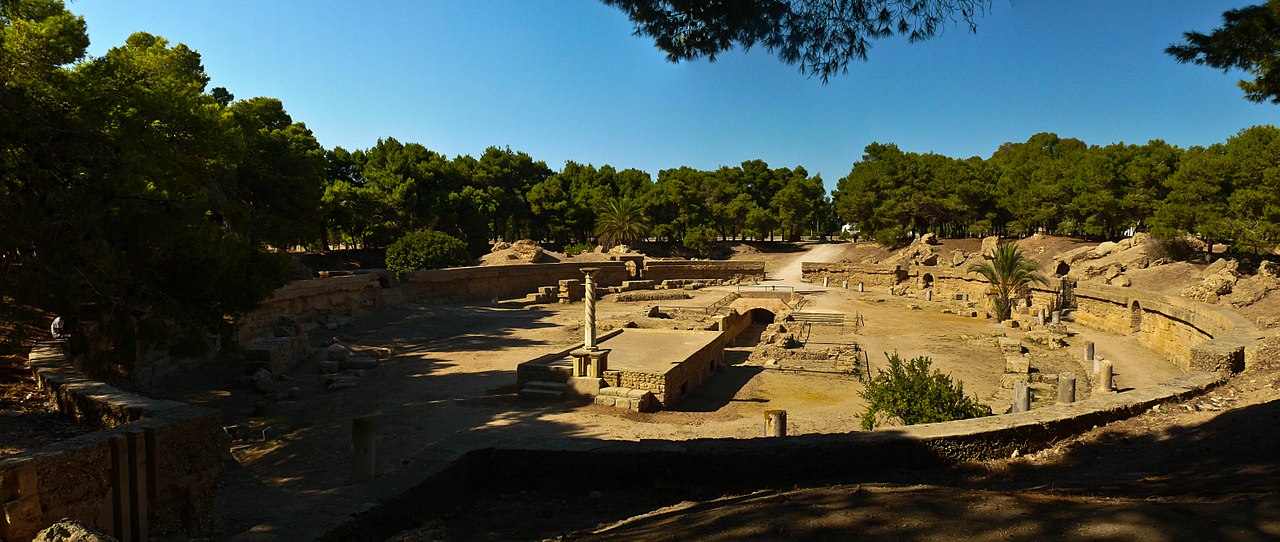
65. Amphitheātrum Carthāgine in quō Perpetua sociīque Chrīstiānī occīsī sunt postquam sē cultūrōs esse Imperātōrem dīvīnum negārent. The Amphitheater at Carthage in which Perpetua and her fellow Christians were murdered after they said they would not worship the divine Emperor.

66. A second-century CE mosaic from North Africa showing gladiators, hunters, and animals. Note the musical instrument being played in the top register, including a small pipe organ. The other registers show violent combats in different pairings: gladiātōrēs cum gladiātōribus, hominēs cum animālibus, animālia cum animālibus.
Explōrātiō Trīcēnsima (XXX) Adventure Thirty
Introduction to the Subjunctive
Active and Passive Personal Endings with the Subjunctive
Formation of the Imperfect Subjunctive
Translation of the Imperfect Subjunctive
Formation of the Pluperfect Active Subjunctive
Translation of the Pluperfect Active Subjunctive
Formation of the Pluperfect Passive Subjunctive
Translation of the Pluperfect Passive Subjunctive
Three Uses of the Subjunctive and their Translation
Special Translation of the Subjunctive in a Purpose Clause
Perpetua’s Martyrdom: The Passiō Sānctārum Perpetuae et Fēlīcitātis
Perpetua’s Martyrdom: The Passiō Sānctārum Perpetuae et Fēlīcitātis, Excerpt
Where and When Are We Today?
Carthāgō
Mēnsis Octōber
C. Fulviō Plautiānō P. Septimiō Getā cōnsulibus
Carthage
October, 203 CE
The amphitheater at Carthage was empty, save for a few sleepy vultures waiting patiently for the next event. We walked across the harēna, or sand, that covered the floor of the combat area. Latinitas had warned me that this had been the site, just a few days ago, of a violent gladitorial show, where thousands of Carthaginians watched Christians, criminals, “and other perceived enemies of the Emperor,” as she called them, being exposed to hungry beasts, who devoured them alive before they were themselves hunted down and killed. This was hallowed, horrible ground. Thankfully – since I have little tolerance for such things – there were no visible signs of what had transpired. The dead had been buried or burned, and Mother Nature had reclaimed what was hers. But the spirits of those who were killed weighed on my mind as we walked. I thought of the crowds that had listened with civilized delight to Apuleius’ speech about India, and wondered if some of those same people had cheered on the violence here. It’s true, Apuleius was speaking forty years ago; but gladiator shows were being held even back then, in Carthage and all the major cities of the Empire. A few days after our visit, I was talking to a friend who quoted me a line by a thinker named Walter Benjamin: “There is no document of civilization which is not at the same time a document of barbarism.” Maybe that’s a little cynical sounding, but the more we explored the Roman Empire, the more it seemed to me like a plain statement of the truth in this case.
The arena was surrounded by high walls – designed to keep the wild animals from attacking the spectators – but someone had left a ladder out that allowed us to climb up into the stands. Once we sat down, it occurred to me that I had visited a lot of theaters and amphitheaters during our travels. Theater culture was a clearly a Roman thing.
Latinitas confirmed my suspicious. “Pānem et circēnsēs, bread and circuses – that’s a line from Juvenal. It is what the empire provides ordinary people, to keep them entertained and content with their lot.”
Saint Perpetua
“Of course, there are many alternatives to the mainstream culture of bread and circuses. One of these alternatives is now growing and spreading and becoming a community that will radically change the character of the empires’ culture. It is made up of the people who call themselves Chrīstiānī. Their way of life marks a radical break from traditional culture in several respects, but also preserves some of its elements in new form. Today I want you to read a bit of the testimony left by a young Christian woman named Perpetua who was executed here the other day. Her memoir is one of the most famous examples of Christian martyr literature. You will be able to understand most of it in the original once we go over another new feature of Latin.”
After a pause – I was distracted by the weight of the topic – I asked: what’s that?
“Subjunctive verbs.”
‘Subjunctive verbs,’ I repeated, and slowly took out my book.
Introduction to the Subjunctive
“The subjunctive,” she continued, “is one of the three moods of Latin verbs. You have previously seen verbs in either the indicative or imperative mood. The indicative mood is used for statements and questions of fact. The imperative mood is used for direct commands. The subjunctive mood is used in a variety of ways: it is used to describe actions that are possible or hoped for; it is also used in several kinds of subordinate (or dependent) clauses.”
Translating the Subjunctive
“Because the subjunctive mood is used in several different ways, the translation of a verb in the subjunctive depends on its particular use in the context of a sentence. Sometimes you must add an English auxiliary verb such as ‘may’, ‘might’, ‘should’ or ‘would’ when translating a subjunctive verb. Often, however, a subjunctive verb can be translated just as you would translate the corresponding indicative verb form, and no ‘special’ translation is required. You will learn the uses and translation of the subjunctive one by one.”
Forms of the Subjunctive
“Subjunctive verb forms in Latin exist for all persons and numbers, both active and passive voice. However, they only appear in four tenses – the present, imperfect, perfect, and pluperfect; there is no future subjunctive. Today I will teach you the imperfect and the pluperfect subjunctive. They are frequently encountered, and their forms are straightforward.”
Review of Personal Endings
“The subjunctive uses the same personal endings that you already know from the indicative:”
Active and Passive Personal Endings with the Subjunctive
| Person | Active Singular | Active Plural | Passive Singular | Passive Plural |
|---|---|---|---|---|
| 1st | -m | -mus | -r | -mur |
| 2nd | -s | -tis | -ris/-re | -minī |
| 3rd | -t | -nt | -tur | -ntur |
The Imperfect Subjunctive
Formation of the Imperfect Subjunctive
“The imperfect subjunctive is formed by adding the twelve personal endings to the present active infinitive of the verb. The -e- at the end of the infinitive remains short before the endings -m, -t, -nt, -r, and -ntur, otherwise it is long. This rule holds for most all verbs, in all verb families, even irregular verbs like sum and eō and ferō and volō. One exception is fīō, whose infinitive fierī changes to fiere- for the imperfect subjunctive.”
Imperfect Subjunctive Forms
| Pres. Act. Inf. | Active Singular | Active Plural | Passive Singular | Passive Plural |
|---|---|---|---|---|
| amāre | amārem | amārēmus | amārer | amārēmur |
| amāre | amārēs | amārētis | amārēris/re | amārēminī |
| amāre | amāret | amārent | amārētur | amārentur |
| movēre | movērem, etc. | movērēmus, etc. | movērer, etc. | moverēmur, etc. |
| dīcere | dīcerem, etc. | dīcerēmus, etc. | dīcerer, etc. | dīcerēmur, etc. |
| capere | caperem, etc. | caperēmus, etc. | caperer, etc. | caperēmur, etc. |
| audīre | audīrem, etc. | audīrēmus, etc. | audīrer, etc. | audīrēmur, etc. |
| ferre | ferrem, etc. | ferrēmus, etc. | ferrer, etc. | ferrēmur, etc. |
| īre | īrem, etc. | īrēmus, etc. | –––––––––––– | –––––––––––– |
| velle | vellem, etc. | vellēmus, etc. | –––––––––––– | –––––––––––– |
| esse | essem, etc. | essēmus, etc. | –––––––––––– | –––––––––––– |
| fierī (fiere-) | fierem, etc. | fierēmus, etc. | –––––––––––– | –––––––––––– |
“The subjunctive of deponent verbs is formed from the active infinitive you would expect them to have if they were not deponent – an infinitive ending in -āre, -ēre, -ere, or -īre. As usual, their endings are passive, but with active meanings:”
Imperfect Subjunctive Forms of Deponent Verbs
| Hypothetical Pres. Act. Inf. | Imperfect Subjunctive |
|---|---|
| ‘mīrāre’ | mīrārer, etc. |
| ‘sequere’ | sequerer, etc. |
| ‘patere’ | paterer, etc. |
| ‘mentīre’ | mentīrer, etc. |
Translation of the Imperfect Subjunctive
“As noted already, the imperfect subjunctive can sometimes be translated just like you would translate the imperfect indicative, without any helping words. Sometimes they require a ‘special’ translation, with a helping verb in English. The correct translation depends on the context; as we learn those contexts, you will learn how to choose the correct one:”
Translation Possibilities for the Imperfect Subjunctive, Depending on Context
| 1. same translation as the imperfect indicative |
| 2. ‘might verb’ |
| 3. ‘would verb’ |
| 4. ‘were verbing’ |
Drill
The Pluperfect Subjunctive
Formation of the Pluperfect Active Subjunctive
“The pluperfect active subjunctive is formed by adding the active personal endings to the perfect active infinitive. The perfect active infinitive for all verbs is the perfect stem plus -isse. The -e at the end of the infinitive remains short before -m, -t, and -nt, otherwise it is long.”
Pluperfect Active Subjunctive Forms
| Perf. Act. Inf. | Singular | Plural |
|---|---|---|
| amāvisse | amāvissem | amāvissēmus |
| amāvisse | amāvissēs | amāvissētis |
| amāvisse | amāvisset | amāvissent |
| mōvisse | mōvissem, etc. | mōvissēmus, etc. |
| dīxisse | dīxissem, etc. | dīxissēmus, etc. |
| cēpisse | cēpissem, etc. | cēpissēmus, etc. |
| audīvisse | audīvissem, etc. | audīvissēmus, etc. |
| tullisse | tullissem, etc. | tullissēmus, etc. |
| īvisse | īvissem, etc. | īvissēmus, etc. |
| voluisse | volluissem, etc. | voluissēmus, etc. |
| fuisse | fuissem, etc. | fuissēmus, etc. |
Translation of the Pluperfect Active Subjunctive
“Once again, the pluperfect active subjunctive is sometimes translated like the corresponding pluperfect active indicative form, that is, ‘had verbed’. But sometimes, depending on context, they are translated ‘would have verbed’.”
Translation Possibilities for the Pluperfect Active Subjunctive, Depending on Context
| 1. same translation as the pluperfect active indicative |
| 2. ‘would have verbed’ |
Formation of the Pluperfect Passive Subjunctive
“Now what is the imperfect subjunctive of sum?”
I checked my notes and after a while I said:
Imperfect Subjunctive of sum, esse
| Singular | Plural |
|---|---|
| essem | essēmus |
| essēs | essētis |
| esset | essent |
“Good. The pluperfect passive subjunctive has two parts: it consists of a nominative form of the perfect passive participle plus the imperfect subjunctive of sum, esse: essem, essēs, etc. (Note that this is similar to the pluperfect passive indicative, which uses the imperfect indicative of sum, esse: eram, erās, etc.)”
Pluperfect Passive Subjunctive Forms
| Perf. Pass. Participle (4th Principal Part) | Singular | Plural |
|---|---|---|
| amātus | amātus, -a, -um essem | amātī, -ae, -a essēmus |
| amātus | amātus, -a, -um essēs | amātī, -ae, -a essētis |
| amātus | amātus, -a, -um esset | amātī, -ae, -a essent |
| mōtus | mōtus, -a, -um essem, etc. | mōtī, -ae, -a essēmus, etc. |
| dictus | dictus, -a, -um essem, etc. | dictī, -ae, -a, essēmus etc. |
| captus | captus, -a, -um essem, etc. | captī, -ae, -a essēmus, etc. |
| audītus | audītus, -a, -um essem, etc. | audītī, -ae, -a essēmus, etc. |
| lātus | lātus, -a, -um essem, etc. | lātī, -ae, -a essēmus, etc. |
“Deponent verbs in the pluperfect subjunctive will, as usual, have passive forms with active meanings:”
Pluperfect Subjunctive Forms of Deponent Verbs
| Perf. Participle | Plupf. Subjunctive |
|---|---|
| mīrātus | mīrātus, -a, um essem, etc. |
| secūtus | secūtus, -a, -um essem, etc. |
| passus | passus, -a, -um essem, etc. |
| ‘mentītus | mentītus, -a, -um essem, etc. |
Translation of the Pluperfect Passive Subjunctive
“The pluperfect passive subjunctive is sometimes translated like the corresponding pluperfect active indicative form, that is, ‘had been verbed’. But sometimes, depending on context, they are translated ‘would have been verbed’.”
Translation Possibilities for the Pluperfect Passive Subjunctive, Depending on Context
| 1. same translation as the pluperfect passive indicative |
| 2. ‘would have been verbed’ |
Drill
“Here are twenty-five pluperfect tense verbs. Ten of these are subjunctive, the other fifteen are indicative. Ignore the indicative forms. When you encounter a subjunctive, identify the person, number, and voice (active or passive). Remember: the indicative forms contain the sequence -era-, while the subjunctive ones have the marker -sse- before the personal ending.”
| Indicative or Subjunctive? | Person | Number | Voice | |
|---|---|---|---|---|
| vīcissent | ||||
| docuerat | ||||
| mōtus esset | ||||
| īvissēs | ||||
| dūxeram | ||||
| sēnsae erātis | ||||
| spectāvissem | ||||
| missī erant | ||||
| iussissēmus | ||||
| cōgitāverat | ||||
| gesta essent | ||||
| mūtātī erant | ||||
| rogāveram | ||||
| cessissem | ||||
| parāta essēs | ||||
| relīquerātis | ||||
| quaesierās | ||||
| mixtus esset | ||||
| scīverat | ||||
| spērāta erant | ||||
| mortuus erās | ||||
| fēcerat | ||||
| dūxissent | ||||
| perdita eram | ||||
| secūtī erant |
Drill
“Write out a synopsis of dūcō, dūcere, dūxī, ductus in your notebook. Use the third-person singular, feminine. For guidance, see Synopsis of Verb forms in Explōrātiō 24.”
Synopsis of dūcō, dūcere, dūxī, ductus ‘to lead’ Third-Person Singular, Feminine
| Indicative | Indicative | Subjunctive | Subjunctive | |
|---|---|---|---|---|
| Active | Passive | Active | Passive | |
| Present | [not yet learned] | [not yet learned] | ||
| Imperfect | ||||
| Future | –––––––––––––– | –––––––––––––– | ||
| Perfect | [not yet learned] | [not yet learned] | ||
| Pluperfect | ||||
| Pres. Inf. | –––––––––––––– | –––––––––––––– | ||
| Perf. Inf. | –––––––––––––– | –––––––––––––– | ||
| Fut. Inf. | –––––––––––––– | –––––––––––––– | –––––––––––––– | |
| Impv. Sg. | –––––––––––––– | –––––––––––––– | ||
| Impv. Pl. | –––––––––––––– | –––––––––––––– | ||
| Pres. Act. Participle | –––––––––––––– | –––––––––––––– | –––––––––––––– | |
| Pf. Pass. Participle | ____________ | –––––––––––––– | –––––––––––––– | |
| Gerundive | ––––––––––– | –––––––––––––– | –––––––––––––– |
Three Uses of the Subjunctive and their Translation
“Now let’s talk about some of the uses of the subjunctive and how to translate them. English does not use the subjunctive as often as Latin does, and thus, as I said before, a Latin subjunctive verb is often translated as if it were the corresponding indicative form.”
Indirect Questions
“One use of the subjunctive that does not call for any special translation occurs in an indirect question. An indirect question is any question that appears in a subordinate clause; an indirect question can be distinguished from a direct question because it includes a question word like ‘what’, ‘why’, or ‘where’ but lacks a question mark. For example, ‘What happened?’ is a direct question, whereas ‘He asked what happened’ contains an indirect question (‘what happened’), which is subordinate to the main clause (‘He asked’).”
“In Latin, the verb in an indirect question is in the subjunctive mood. It does not, however, require any special translation. If you see an interrogative word like quis, quid, quandō, ubi, or cūr with a subjunctive verb but no question mark, then you probably have an indirect question. Here are some examples:”
Indirect Question Examples
Quid vidēret, nescīvit. He did not know what he was seeing.
vidēret, imperfect subjunctive, is translated like vidēbat, imperfect indicative
Rogābāmus quis discessisset. We were asking who had departed.
discessisset, pluperfect subjunctive, is translated like discesserat, pluperfect indicative
Exercises 1-4
“Before you attempt to translate, identify any subjunctive verb and its person, number, tense, and voice.”
1. Cicerō rogāvit testem quis apud Laecam illā nocte fuisset.
“Catiline and his conspirators met at the house of Laeca in 63 BCE.”
2. Ab cōnsulibus quaesīvī cūr mūtāre plūrima dē lēgibus vellent.
3. Ubi fuissēs, cūr discessissēs, quandō rēs tuae gestae essent, discere voluimus.
4. Scīvitne Āpulēius ubi Indī sitī essent et quemadmodum vīverent?
“Careful: this sentence includes both a direct and indirect questions.”
Clauses Introduced by cum
“The verb in a clause introduced by cum is very often in the subjunctive mood. Such a subjunctive verb does not call for any special translation. However, the meaning of the conjunction cum can vary if the verb is subjunctive: cum can mean ‘when’, ‘since’, or ‘although’. The context of the sentence will help you to decide which translation of cum is best.”
Vocabulary
Conjunction
| Latin Conjunction | English Meaning |
|---|---|
| cum | when; since; although (with a subjunctive verb) “Translate ‘although’ if tamen ‘neverthless’ appears in the sentence.” |
Clauses Introduced by cum, Examples
Cum auxilia advēnissent, mīlitēs ad bellum gerendum mīsit.
When/Since/(Although) the reinforcements had arrived, he sent the soldiers to wage war.
advēnissent, pluperfect subjunctive, is translated like advēnerant, pluperfect indicative; ‘when’ or ‘since’ makes the most sense in context.
Cum māne profectī essēmus, tamen tardī erāmus.
(When)/(Since)/Although we had set out early in the morning, nevertheless we were late.
profectī essēmus, pluperfect subjunctive, is translated like profectī erāmus, pluperfect indicative; ‘although’ makes the most sense in context – notice tamen.
Exercises 5-8
5. Cum canis immānis in līmine iacēret, domum nōn intrāvī.
6. Cum urbs caperētur, plūrimī cīvium sē in silvās recēpērunt.
7. Cum nostrae cōpiae dēfēcissent, oppidum hostibus trāditum est.
8. Cicerō, cum clārissimus in dīcendō esset, tamen minimō in oppidō nātus erat.
Purpose Clauses
“Another use of the subjunctive occurs in purpose clauses. A purpose clause is a subordinate clause that expresses the purpose for which the action of the main clause is done. A purpose clause is introduced by ut, which you have learned means ‘as’, ‘how’, or ‘when’ with an indicative verb; in a purpose clause with a subjunctive verb, ut should be translated ‘so that’ or ‘in order that’. To express a negative purpose, the conjunction nē is used in place of ut; translate nē ‘so that… not’ or ‘in order that ... not’.”
Vocabulary
Conjunctions
| Latin Conjunction | English Meaning |
|---|---|
| ut + subjunctive verb | so that ... / in order that ... (purpose clause) |
| nē + subjunctive verb | so that ... not / in order that ... not (purpose clause) |
Special Translation of the Subjunctive in a Purpose Clause
“An imperfect subjunctive verb in a purpose clause should be translated ‘might verb’, with the English helping verb ‘might’. The pluperfect subjunctive is not used in purpose clauses.”
Purpose Clause Examples
Prope amnem senex stābat, ut colōrēs arborum mīrārētur.
The old man was standing near the river, so that he might admire the colors of the trees.
In exilium Catilīnam mīsī, nē ille Rōmam perderet.
I sent Catiline into exile, so that that man might not destroy Rome.
Exercises 9-12
9. Adulēscentēs morātī sunt illīc nē magister eōs cerneret, et ut lūderent.
10. Ingēns aureōrum pondus deō dedit dux ut exercitus suus in proeliō vinceret.
11. Fortissimē pugnāvērunt ut moenia, domūs, agrōs servārent, neque servī fierent.
12. I followed you into the city so that I might see all kinds of human beings.
“Ok? Now let’s add some more vocabulary that appears in Perpetua’s memoir.”
Vocabulary
A-Verb (First Conjugation)
| Latin Verb | English Meaning |
|---|---|
| nārrō, nārrāre, nārrāvī, nārrātus | to recount; tell |
E-Verb (Second Conjugation)
| Latin Verb | English Meaning |
|---|---|
| careō, carēre, caruī + abl. | to lack; be without “This verb takes an abl. word, e.g. spē carēmus, ‘we are without hope’.” |
I-Verbs (Third Conjugation)
| Latin Verb | English Meaning |
|---|---|
| cōnstituō, cōnstituere, cōnstituī, cōnstitūtus | to set up; arrange; resolve |
| vertō, vertere, vertī, versus | to turn |
Deponent I-Verb (Third Conjugation)
| Latin Verb | English Meaning |
|---|---|
| loquor, loquī, locūtus sum | to speak |
Mixed I-Verbs (Third Conjugation -iō)
| Latin Verb | English Meaning |
|---|---|
| iaciō, iacere, iēcī, iactus | to throw “Do not confuse with iaceō, iacēre, iacuī, iacitus ‘to lie’.” |
| dēiciō, dēicere, dēiēcī, dēiectus | to throw down |
Deponent Long I-Verb (Fourth Conjugation)
| Latin Verb | English Meaning |
|---|---|
| experior, experīrī, expertus sum | to experience; try out |
First Declension Nouns
| Latin Noun | Noun Gender | English Meaning |
|---|---|---|
| grātia, grātiae | f. | favor; thanks “The phrase grātiās agere (with the verb agō, agere) means ‘to give thanks’.” |
| tenebrae, tenebrārum | f. | darkness “This word is only used in the plural.” |
| turba, turbae | f. | crowd |
Second Declension Noun
| Latin Noun | Noun Gender | English Meaning |
|---|---|---|
| praemium, praemiī | n. | reward; price |
Third Declension Nouns
| Latin Noun | Noun Gender | English Meaning |
|---|---|---|
| carcer, carceris | m. | prison |
| frāter, frātris | m. | brother |
US-A-UM Adjectives (First and Second Declension Adjectives)
| Latin Adjective | English Meaning |
|---|---|
| honestus, -a, -um | honorable; noble |
| validus, -a, -um | strong |
Conjunction
| Latin Conjunction | English Meaning |
|---|---|
| sīcut | just like |
Interrogative
| Latin Interrogative | English Meaning |
|---|---|
| num / numquid | Surely… not? “Introduces a question expecting ‘no’ for an answer.” |
Adverbs
| Latin Adverb | English Meaning |
|---|---|
| statim | at once |
| subitō | suddenly |
Exercises 13-19
13. Dī sē in plūrimās imāginēs vertere possunt.
14. Grātiās tibi agam et praemia dabō maxima.
15. Num ille frāter honestus carcere dignus est?
16. Ego tibi ea nārrō quae tū melius scīs quam ipse, quī nārrō.
“Cicero, in a moment of self-awareness.”
17. Miserrima est fortūna quae inimīcō caret.
“A saying of Publilius.”
18. Nē hostēs saxa in nōs iacerent, statim moenia cōnstituimus validissima.
19. Expertus loquor pēius esse caecīs in tenebrīs errāre quam subitō dēicī in turbam hominum.
Perpetua’s Martyrdom: The Passiō Sānctārum Perpetuae et Fēlīcitātis
“The Christian movement that Perpetua belongs to began in the Roman province of Judaea around the start of the emperor Tiberius’ reign. A Jewish teacher and holy man named Jesus from a town called Nazareth presented himself as the son of the supreme deity, and identified himself as the Messiah foretold in the Hebrew prophets. The title Messiah, which means ‘Anointed One’, translates into Greek as Christos, hence his name, Christ. His teaching had many facets, which you may know something about; among other things, he taught his followers to practice radical dependence on the deity, to show forgiveness and love, and to value people who were despised by society. He healed sick people and performed wonders. He acquired disciples and hundreds of followers, and he challenged the powers-that-be so much that the Roman colonial government put him to death. According to his disciples, a miracle then took place: Jesus rose from the dead and rose to heaven.”
“His followers were inspired by Jesus’ words and life and aspired to live up to his example as individuals. They worship in communities which provided mutual aid to their members. Like their observant Jewish predecessors, they reject the worship of any god who is not the supreme deity. This put them in conflict with the Roman authorities, for whom it was a matter of patriotism to regard the emperor as a divinity who needed to be worshipped.”
“The Christians drew new followers into their movement and spread rapidly all over the Roman empire. The writings of the early witnesses and leaders were treated as holy texts which many years from now will be collected into what you call the Bible. After the sack of Jerusalem in 70 CE, groups of Christians began to distinguish themselves from Jews; and gradually, a new religion was formed. The converts were known as catēchūmenī until they were initiated into the religion by baptism, and dipped in water. In the passage below, Perpetua mentions her baptism.”
“Perpetua wrote down an account of the last days of her life and had it smuggled out of prison the day before she died. It starts with an introduction written by the anonymous person who published it. Let’s see what it says.”
Perpetua’s Martyrdom: The Passiō Sānctārum Perpetuae et Fēlīcitātis, Excerpt
“Working with partners, translate the Latin using the vocabulary and notes provided.”
1) Apprehēnsī sunt adolēscentēs catēchūmenī, Revocātus et Fēlīcitās, cōnserva eius, Sāturnīnus et Secundulus. Inter hōs et Vibia Perpetua, honestē nāta, līberāliter īnstitūta, mātrōnāliter nūpta, habēns patrem et mātrem et frātrēs duōs, alterum aequē catēchūmenum, et fīlium īnfantem ad ūbera.
apprehendō, apprehendere, apprehendī, apprehēnsus to arrest
catēchūmenus, -ī, m. new convert
cōnserva, -ae, f. fellow slave
līberāliter like a freeborn person; nobly
īnstitūtus -a, -um educated; established
mātrōnāliter like a matron
nūptus, -a, -um married
īnfāns, īnfantis, m. / f. infant
ūber, ūberis, n. (lactating) breast
2) Erat autem ipsa circiter annōrum vīgintī duo. Haec ōrdinem tōtum martyriī suī iam hinc ipsa nārrāvit sīcut cōnscrīptum manū suā et suō sēnsū relīquit.
circiter around
martyrium, -ī, n. testimony; martyrdom
hinc from here
cōnscrīptum ~ scrīptum
sēnsus, -ūs, m. feeling; perception
3) Cum adhūc, inquit, cum prōsecūtōribus essēmus et mē pater verbīs ēvertere cupīret et dēicere prō suā affectiōne persevērāret: ‘Pater,’ inquam, ‘vidēs verbī grātiā vās hoc iacēns, urceolum sīve aliud?’ Et dīxit: ‘Videō.’ Et ego dīxī eī: ‘Numquid aliō nōmine vocārī potest quam quod est?’ Et ait: ‘Nōn.’
prōsecūtor, prōsecūtōris, m. overseer; attendant (in charge of persons under house arrest)
ēvertō, ēvertere, ēvertī, ēversus to subvert; turn away from
cupīret = cuperet
prō + abl. here, ‘because of’
affectiō, affectiōnis, f. disposition; affection
persevērō, persevērāre, persevērāvī, persevērātus to persist
verbī grātiā ~ exemplī grātiā
vās, vāsis, n. vessel
urceolum sīve aliud ‘a pitcher or some other (vessel)’
ait ‘he says’
4) ‘Sīc et ego aliud mē dīcere nōn possum nisi quod sum, Chrīstiāna.’ Tunc pater mōtus hōc verbō mittit sē in mē ut oculōs mihi ērueret, sed vexāvit tantum et profectus est, victus cum argūmentīs diabolī.
ēruō, ēruere, ēruī, ērutus to tear out
vexō, vexāre, vexāvī, vexātus to harass
cum ‘(he) along with...’
argūmentum, -ī, n. argument; sign; mark
diabolus, -ī, m. the devil
5) Tunc paucīs diēbus quod caruissem patre, dominō grātiās ēgī et refrīgerāvī absentiā illīus. In ipsō spatiō paucōrum diērum baptīzātī sumus, et mihi Spīritus dictāvit nōn aliud petendum ab aquā nisi sufferentiam carnis.
paucīs diēbus here, the ablative means ‘for...’
quod here, equivalent to cum ‘when / since / although’ + subjunctive
refrīgerō, refrīgerāre, refrīgerāvī, refrīgerātus to be relieved; cool off
absentia, -ae, f. absence
baptīzō, baptīzāre, baptīzāvī, baptīzātus to baptize
mihi dative of agent with the gerundive verb
Spīritus, -ūs m. (Holy) Spirit; breath
dictō, dictāre, dictāvī, dictātus to proclaim; tell
petendum [esse] infinitive in indirect statement
aquā i.e., the baptismal water
sufferentiam carnis ‘endurance of the flesh’
6) Post paucōs diēs recipimur in carcerem; et expāvī, quia numquam experta eram tālēs tenebrās. Ō diem asperum! Aestus validus turbārum beneficiō, concussūrae mīlitum.
expavēscō, expavēscere, expāvī to become very afraid
tālis, tāle such
asper, aspera, asperum harsh
aestus, aestūs, m. heat
beneficiō ‘because of’, with turbārum
concussūra, -ae, f. extortion; threat of violence
7) Novissimē mācerābar sollicitūdine īnfantis ibi. Tunc Tertius et Pompōnius, benedictī diāconī quī nōbīs ministrābant, cōnstituērunt praemiō ut paucīs hōrīs ēmissī in meliōrem locum carceris refrīgerārēmus…
novissimē ‘lastly; most of all’
mācerō, mācerāre, mācerāvī, mācerātus to distress
sollicitūdō, sollicitūdinis, f. concern; anxiety
ibi ‘there’ i.e., in prison
benedictus, -a, -um blessed
diāconus, -ī, m. deacon; minister
ministrō, ministrāre, ministrāvī, ministrātus to take care of
cōnstituērunt ... ut ‘arranged that; brought it about that...’ + subjunctive clause
8) Ego īnfantem lactābam iam inediā dēfectum; sollicita prō eō adloquēbar mātrem et cōnfortābam frātrem, commendābam fīlium; tābēscēbam ideō quod illōs tābēscere vīderam meī beneficiō.
lactō, lactāre, lactāvī, lactātus to nurse; give milk to
inedia, -ae, f. not eating; starvation
dēfectum ‘weakened’, from dēficiō, dēficere, dēfēcī, dēfectus
sollicitus, -a, -um concerned; anxious
adloquor, adloquī, adlocūtus sum the prefix ad- adds ‘to’ to the meaning of the verb
cōnfortō, cōnfortāre, cōnfortāvī, cōnfortātus to encourage; give strength to
commendō, commendāre, commendāvī, commendātus to entrust
tābēscō, tābēscere, tābuī to waste away
ideō quod ‘because; for this reason, because’
9) Tālēs sollicitūdinēs multīs diēbus passa sum; et ūsūrpāvī ut mēcum īnfāns in carcere manēret; et statim convaluī et relevāta sum ā labōre et sollicitūdine īnfantis, et factus est mihi carcer subitō praetōrium, ut ibi māllem esse quam alicubi.
ūsūrpāvī ut ‘I gained permission that; permission for...’ + subjunctive clause
convalēscō, convalēscere, convaluī to recover
relevō, relevāre, relevāvī, relevātus to relieve
praetōrium, -ī, n. court; mansion
ut ‘with the result that...’ + subjunctive clause
alicubi ‘anywhere (else)’
I found her story very remarkable, while the accounts of her suffering were hard to take. The next time I saw Latinitas I shared the quote from Walter Benjamin with her. She thought for a moment and said, “Well, from my point of view – and since I’m a goddess, what I think may not be relevant – but from my point of view, what humans call ‘barbarism’ and ‘civilization’ seem to feed each other. Is there something that falls somewhere in the middle?”
 67. The martyrdom of Perpetua and her companions, as represented in a holy book belonging to the Byzantine emperor Basil II, circa 985 CE. Sānctī orbibus lūce caelestī plēnīs dēmōnstrantur; the sainted ones are marked out by circles full of heavenly light.