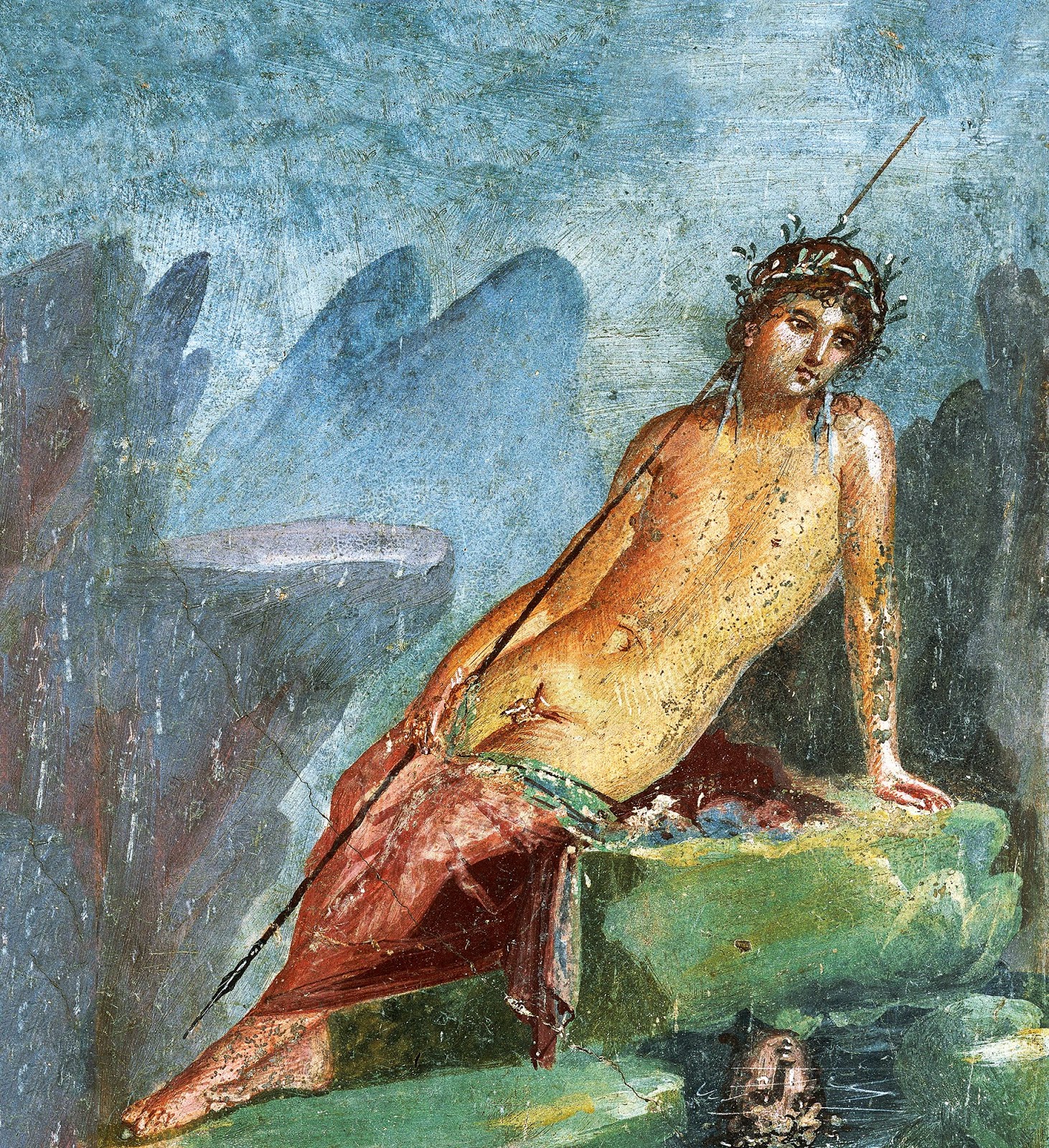
41. A fresco painting from Pompeii, circa 50 CE. Narcissus iuvenis imāginem in fonte mīrātur; the youth Narcissus admires his reflection in a spring.
Explōrātiō Ūndēvīcēnsima (XIX) Adventure Nineteen
The Demonstrative Pronoun and Adjective ille, illa, illud
Case Forms of the Demonstrative ille, illa, illud
The Adjective alter, altera, alterum
Case Forms of the Adjective alter, altera, alterum
The Adjective īdem, eadem, idem
Case Forms of the Adjective īdem, eadem, idem
First and Second Person Reflexive Pronouns
The Third Person Reflexive Pronoun suī, sibi, sē
The Intensive Adjective ipse, ipsa, ipsum
Case Forms of the Intensive Adjective ipse, ipsa, ipsum
Ovid, Metamorphoses: The Myth of Narcissus
Where and When Are We Today?
Tomis, Thrācia
Mēnsis Aprīlis
Germānicō Iūliō Caesare C. Fonteiō Capitōne cōnsulibus
Tomis, Thrace
April, 12 CE
I could smell the salt-spray ex marī, and feel it misting my neck as we strolled up to the city from the harbor, where boats were bobbing nervously under the onslaught of a strong, cold spring ventus, or wind. It was clear we were not in Rome anymore, or Italy for that matter, to judge by the local attire: too many people in the city were wearing furs – fur hats, fur outer garments – for that to be the case; pants and ponytails were also in fashion. Quite a few residents, including some women, had bows and arrows slung over their shoulders. There were more horses on the streets, somewhat taller than the horses in Rome. Sailors and workers spoke a language that was full of z and sh sounds and did not sound much like Latin. In the marketplace we saw hints of long-distance trade, like merchants sitting silently next to giant baskets full of amber, silver nuggets, chips of sky-blue lapis lazuli, and dozens of other precious stones. The amber dealers, who were light-skinned and blonde, seemed like they came from the north; those who dealt in silver and lapis had clothing that made me think of a documentary I once watched about the Silk Road in central Asia. Latinitas noticed me shivering and bought me a snack from a street vendor. The warm, round flatbread she handed me was incredibly tasty, as were the tiny roasted fish. But the wine was… an acquired taste, a mix of vinegar and brine. When she wasn’t looking, I dumped it out and rinsed the taste out of my mouth with water from a rain barrel.
We sat down and made a picnic on a street corner next to a small statue of a god who was riding a horse. Latinitas drew my attention to the city walls, and to an isolated figure standing on the parapet, gazing off into the distance. A middle-age man with black curls turning grey, he was the only person I had seen so far dressed in a Roman toga.
Ovid
“Ille est Ovidius, that is Ovid; Pūblius Ovidius Nāsō. We are visiting him today, not in eastern Italy, where he grew up, or Rome, where he was a famous celebrity, but here” – she gestured all around us – “in Tomis. We are on the northwest shore of the Black Sea, Pontus, a thousand miles from Rome. Ovid has been exiled here and in a few years he will here reach the end of his life.”
“What was he famous for?”
“For being a talented poet who wrote about two timeless subjects: love and mythology. The Metamorphōsēs is an epic poem that tells all the famous stories from Greek and Roman mythology. Each story ends with its characters transforming into some other form, which is what ‘metamorphosis’ means in Greek. He also composed a long elegiac poem called the Ars Amātōria, the so-called ‘Art of Love’. It’s in three parts; the first is a manual for seduction, and the second is a lecture on how to keep a relationship alive. Both are written for men; the third part offers similar advice for women. It was because the Ars seems to promote adultery that the emperor Augustus sent him into exile here.”
He was exiled for writing poetry?
“That was the official reason given for his banishment, the carmen, or poem, that he wrote. The real reason was an error, a mistake Ovid made: Augustus caught Ovid and his daughter Julia together in bed trying not to make too much noise.”
I guessed that explained why he ruined Ovid’s life. Does he still write poetry?
“More than ever. Every month he completes litterae aliae in verse about the state of his despair, which he sends to Rome in the hope that Augustus will have a change of heart. Ovid also has friends making his case there. But Augustus won’t listen to them; nor will the next emperor, Augustus’ stepson Tiberius. Tiberius was married to Julia, you see.”
“Ille est Ovidius,” she repeated, then reviewed the pronoun hic: “Hic est pānis, this is bread, hī sunt piscēs, these are fishes, et… ubi est tuum vīnum?” I shrugged my shoulders. “Apparently you’ve turned the wine I bought you into water. Haec est aqua. Now add these words to your vocabulary.”
Vocabulary
A-Verbs (First Conjugation)
| Latin Verb | English Meaning |
|---|---|
| errō, err-āre, errāv-ī | to wander; make a mistake |
| iuvō, iuv-āre, iūv-ī | to help “This verb often governs an infinitive, e.g.,bonafacereiuvat‘it helps to do good things’.” |
| spectō, spect-āre, spectāv-ī | to watch |
Deponent A-Verb (First Conjugation)
| Latin Verb | English Meaning |
|---|---|
| mīror, mīr-ārī, mīrātus sum | to admire; wonder at |
I-Verb (Third Conjugation)
| Latin Verb | English Meaning |
| dūcō, dūc-ere, dūx-ī | to lead; consider |
First Declension Noun
| Latin Noun | Noun Gender | English Meaning |
|---|---|---|
| umbra, umbr-ae | f. | shadow; shade; ghost |
Third Declension Nouns
| Latin Noun | Noun Gender | English Meaning |
|---|---|---|
| error, errōr-is | m. | mistake |
| imāgō, imāgin-is | f. | image |
US-A-UM Adjectives (First and Second Declension Adjectives)
| Latin Adjective | English Meaning |
|---|---|
| caecus, caec-a, caecum | blind |
| medius, medi-a, medium | middle, the middle of “The adjective medius often comes before a noun that it agrees with; when it does, translate it as ‘the middle of’: ex mediā urbe, ‘out of the middle of the city’.” |
Exercises 1-6
1. Mediō in oppidō errōrēs multōs fēcī.
2. Eum quī beneficia facit mīrābor et iuvābō.
3. Ad umbrās caecās quae sub terrā sunt precor.
4. Nōnne hās imāginēs nōbilēs spectās? Errāvitne animus tuus?
5. Multā vī rēgnum condēmus et moenia pōnēmus.
6. In the middle (of) the day I was following the woman whom I loved.
The Demonstrative Pronoun and Adjective ille, illa, illud
“Today we are going to study five new adjectives and pronouns. The first of these is ille, illa, illud. This is a demonstrative word meaning ‘that’ or ‘those’. It contrasts with hic, haec, hoc, which, as you know, means ‘this’ or ‘these’. The demonstrative hic, haec, hoc points to something closer, while ille, illa, illud points to something further away.”
Vocabulary
Demonstrative Pronoun and Adjective
| Latin Demonstrative | English Meaning |
|---|---|
| ille, illa, illud | that; those |
“This demonstrative is formed like alius, alia, aliud, with -ud for the neuter singular nominative and accusative, and the irregular genitive (-īus) and dative singular (-ī) forms:”
Case Forms of the Demonstrative ille, illa, illud
| Case | M. | F. | N. | M. | F. | N. |
|---|---|---|---|---|---|---|
| Singular | Plural | |||||
| Nom. | ille | illa | illud | illī | illae | illa |
| Gen. | illīus | illīus | illīus | illōrum | illārum | illōrum |
| Dat. | illī | illī | illī | illīs | illīs | illīs |
| Acc. | illum | illam | illud | illōs | illās | illa |
| Abl. | illō | illā | illō | illīs | illīs | illīs |
“When there is no expressed noun in agreement, once again you must supply a suitable noun in English:”
Demonstrative Adjective and Pronoun Uses, Illustrated
| Demonstrative Adjective | ille mōs | that custom |
| Demonstrative Pronoun | ille | that (man) |
“By the way, the words that mean ‘the’ in the Romance languages, like el and la and los and las in Spanish, come from ille, illa, illud, but they have a different meaning.”
Drill
“Put these noun and demonstrative adjective pairs in the specified case form:”
| Latin Noun with Gender | Form of ille, illa, illud | Latin Noun / Adjective Combination in correct case, gender and number |
|---|---|---|
| umbra, umbr-ae, f. | + ille, illa, illud: accusative plural form | |
| error, errōr-s, m. | nominative plural | |
| imāgō, imāgin-is, f. | accusative singular | |
| somnium, somni-ī, n. | accusative singular | |
| nūmen, nūmen-is, n. | dative plural |
Exercises 7-11
7. Lacrimae dulcēs cecidērunt quandō illum iuvenem vīdī.
8. Cūr virgō illa vōs diū spectābat? Nescīmus.
9. Illa lūmina in caelō omnī diē crēvī.
10. Imāgine vērōrum dūcēbāminī, sed falsa sequēbāminī.
11. Those dangers and these duties confused our minds.
The Adjective alter, altera, alterum
“Now, tell me, what does the adjective alius, ali-a, aliud mean?”
Other; another; one, the other; some, others; or different.
“Good. Latin has another adjective that means something similar, but it is used only when there is a pair: two eyes, two brothers, two consuls, two opposites.”
Vocabulary
| Latin Adjective | English Meaning |
|---|---|
| alter, alter-a, alterum | other (of two); another; one (of two) “When this word occurs once it means ‘other’ or ‘another’. When it occurs twice it means ‘one... the other’.” |
“The endings are like those for miser, miser-a, miserum, except all genders of the genitive and dative singular have the irregular endings -īus and -ī, respectively. The genitive singular form, alterīus, is used as the genitive singular of alius, ali-a, aliud.”
Case Forms of the Adjective alter, altera, alterum
| Case | M. | F. | N. | M. | F. | N. |
|---|---|---|---|---|---|---|
| Singular | Plural | |||||
| Nom. | alter | altera | alterum | alterī | alterae | altera |
| Gen. | alterīus | alterīus | alterīus | alterōrum | alterārum | alterōrum |
| Dat. | alterī | alterī | alterī | alterīs | alterīs | alterīs |
| Acc. | alterum | alteram | alterum | alterōs | alterās | altera |
| Abl. | alterō | alterā | alterō | alterīs | alterīs | alterīs |
Use of the Adjective alter, altera, alterum, Illustrated
| Alter cōnsul iūra dīcit, alter bellum gerit. | One consul gives judgments; the other wages war. |
Exercises 12-14
12. Spectā: altera manus ferrum habet, signum altera.
13. Ille alterō pede terram premere incēpit.
14. Do you, who speak these (things), desire the life of another (man)?
The Adjective īdem, eadem, idem
“The Latin adjective that means ‘same’ is related to the English word ‘identical’:”
Vocabulary
| Latin Adjective | English Meaning |
|---|---|
| īdem, eadem, idem | the same |
“The first part of each form is based on the pronoun and adjective is, ea, id, which you have already learned. Remember these? ‘He, she, it’ and so on?”
Review of Forms: The Pronoun and Adjective is, ea, id
| Case | M. | F. | N. | M. | F. | N. |
|---|---|---|---|---|---|---|
| Singular | Plural | |||||
| Nom. | is | ea | id | eī | eae | ea |
| Gen. | eius | eius | eius | eōrum | eārum | eōrum |
| Dat. | eī | eī | eī | eīs | eīs | eīs |
| Acc. | eum | eam | id | eōs | eās | ea |
| Abl. | eō | eā | eō | eīs | eīs | eīs |
Yep.
“To make īdem, eadem, idem, you add the syllable -dem to each of those forms. But, before -dem, the form is becomes ī-; the form id shortens to i-, and the -m in eum, eam, eōrum, and eārum becomes an -n-:”
Case Forms of the Adjective īdem, eadem, idem
| Case | M. | F. | N. | M. | F. | N. |
|---|---|---|---|---|---|---|
| Singular | Plural | |||||
| Nom. | īdem | eadem | idem | eīdem | eaedem | eadem |
| Gen. | eiusdem | eiusdem | eiusdem | eōrundem | eārundem | eōrundem |
| Dat. | eīdem | eīdem | eīdem | eīsdem | eīsdem | eīsdem |
| Acc. | eundem | eandem | idem | eōsdem | eāsdem | eadem |
| Abl. | eōdem | eādem | eōdem | eīsdem | eīsdem | eīsdem |
“For this adjective, the case ‘ending’ is inside the word, before the -dem syllable. Vidēsne?”
“When this adjective appears without a noun in agreement, it is a substantive, and you supply ‘man’, ‘woman’, ‘thing’, or a suitable noun based on context in the usual way.”
Uses of the Adjective īdem, eadem, idem, Illustrated
| eadem dea | the same goddess |
| in eōdem locō | in the same place |
| Eōsdem sciō. | I know the same men. |
We came to Rome at the same time, and helped the same (men).
Eōdem tempore Rōmam vēnimus, et eōsdem iūvimus.
Exercises 15-17
15. Eadem urbs et patria est mihi.
16. Eōdem tempore idem spectāvimus.
17. I saw the same (things) which you saw, Ovidius.
Reflexive Pronouns
As I worked on these sentences, Latinitas walked over to a vendor in the marketplace and, after a bit of haggling, paid for a small metal object, which she came back and handed to me. It was a hand-mirror, speculum, made of metal – bronze, I think – with a female figure carved on the handle and a mythological scene of two lovers engraved on the back. It was not as bright as a modern glass mirror, but I could see myself clearly in it.
“Vidēsne tē in speculō? Do you see yourself in the mirror?”
Yeah.
“Say: Videō mē, and translate it.”
Videō mē, I see me. That felt a little like baby-talk, so I corrected myself, saying, I see myself in the mirror.
“Good. When the subject of a sentence acts upon itself, then in English you use the pronouns yourself, myself, himself, herself, itself, ourselves, yourselves, themselves. These are called reflexive pronouns. Many verbs can be used reflexively, but a few are often used with a reflexive, like ‘bathing’ or ‘caring for’: I bathe myself, I care for myself, and so on.”
First and Second Person Reflexive Pronouns
“In Latin, unlike in English, the first- and second-person reflexive pronouns are the same forms as the non-reflexive first- and second-person pronouns:”
First and Second Person Reflexive and Non-Reflexive Pronouns, Illustrated
| Mē videō. | I see myself. (reflexive) |
| Mē videt. | He/she sees me. (non-reflexive) |
| Vōs servāvistis. | You all saved yourselves. (reflexive) |
| Nōbīs parcit. | He/she spares us (non-reflexive) |
The Third Person Reflexive Pronoun suī, sibi, sē
“For the third person, however, there is a special reflexive pronoun, suī, sibi, sē. Those forms are the genitive, dative, and accusative or ablative; they do not differentiate gender or number. There is no nominative form.”
Vocabulary
| Latin Pronoun | English Meaning |
|---|---|
| suī (gen.), sibi (dat.), sē (acc., abl.) | himself; herself; itself; themselves |
“Remember: a reflexive pronoun refers back to the subject of the sentence.”
Third Person Reflexive Pronoun, Illustrated
| Catullus dē sē cōgitābat. | Catullus was thinking about himself. |
| Dea sē ad illum locum fert. | The goddess brings herself to that place. |
| Partem urbis sibi servant. | They preserve part of the city for themselves. |
Exercises 18-23
18. Mē magnā cum cūrā mīror.
19. Venus sē ad moenia urbis fert quae vocātur Carthāgō. “The city name is Carthāgō, Carthāgin-is, f.”
20. Quī mīlitēs dūcit dux in perīculō sē pōnet.
21. The wave carried itself to land.
22. Caesar was ordering his own soldiers to follow himself.
23. Caesar was ordering those soldiers to follow him.
The Intensive Adjective ipse, ipsa, ipsum
“English is ambiguous because the words ‘yourself’, ‘myself’, ‘himself’, ‘herself’, ‘itself’, ‘ourselves’, ‘yourselves’, and ‘themselves’ can be used in two different ways. Consider these sentences:”
English Intensifying Adjectives
I did the job myself.
You yourself were there.
I gave the letter to the woman herself.
They told us themselves.
“These are not reflexive pronouns – the subject does not act upon itself. Instead, these adjectives emphasize. You can call them intensive adjectives.”
“Latin has a separate form for the intensive adjective, to distinguish it from the reflexive pronoun. This adjective is ipse, ipsa, ipsum:
Vocabulary
| Latin Adjective | English Meaning |
|---|---|
| ipse, ipsa, ipsum | himself; herself; itself; themselves; the actual; the very |
“It has a few irregular endings: -e in the nominative masculine singular, like ille; -īus and -ī in the genitive and dative singular, respectively (like alter and ille). But the other endings are regular US-A-UM ones:”
Case Forms of the Intensive Adjective ipse, ipsa, ipsum
| Case | M. | F. | N. | M. | F. | N. |
|---|---|---|---|---|---|---|
| Singular | Plural | |||||
| Nom. | ipse | ipsa | ipsum | ipsī | ipsae | ipsa |
| Gen. | ipsīus | ipsīus | ipsīus | ipsōrum | ipsārum | ipsōrum |
| Dat. | ipsī | ipsī | ipsī | ipsīs | ipsīs | ipsīs |
| Acc. | ipsum | ipsam | ipsum | ipsōs | ipsās | ipsa |
| Abl. | ipsō | ipsā | ipsō | ipsīs | ipsīs | ipsīs |
“When this adjective appears without a noun in agreement, it is a substantive, and you must supply another pronoun or noun in English in the appropriate gender and number.”
Intensive Adjective ipse, ipsa, ipsum, Illustrated
| ipse dux | the leader himself, the very leader |
| timor ipse | fear itself, the very fear |
| urbēs ipsae | the cities themselves, the actual cities |
| ipse | (he / the man) himself |
| ipsae | (they / the women) themselves |
Exercises 24-25
24. Cīvitās tōta ab cīvibus ipsīs servābātur.
25. Rēx ipse paucōs ad castra illa dūxit.
Exercises 26-28
“In these sentences, you should translate the underlined words with a form of ipse.”
26. Love itself is not able to move the blind ghosts.
27. Under the earth the very image of a man wanders.
28. The very bodies of the citizens who had virtue were being carried to the tomb.
“So, we have learned many pronouns and adjectives. Explain to me what each one means, as a review, and then we will go.”
After I did that, we crossed the street and took a ladder up to the top of the city wall to look around. The landscape was very flat, and she explained the purpose of the walls: sometimes the horse-riding nomads who visited Tomis came to raid instead of trade. These walls gave archers a commanding view of the surrounding territory; but the walls also provided us with a good view of Ovid in the garden of his house below.
Ovid’s Metamorphoses
In his garden, the poet was giving a reading for a small audience: there was a male visitor from Rome, two women, and several families with children. When he performed – and like Vergil, he did not merely read, but acted out his poetry, moving about and gesticulating – he did not face the audience; instead, he addressed a statue of Augustus and his wife Livia, as if performing for them. As we watched he performed a scene from the third book of his Metamorphoses, which contains the story of Narcissus, the beautiful boy who was cursed to fall in love with his own reflection.
Ovid, Metamorphoses: The Myth of Narcissus
“Read the Latin verses aloud with a partner. Some verses are already translated for you; for these, match the Latin words in bold to the translation. The other verses you need to translate, but I’ve provided vocabulary help below.”
1) Hic puer et studiō vēnandī lassus et aestū
prōcubuit faciemque locī fontemque secūtus…
Hic...secutus
This boy, weary both from the passion of the hunt and the heat,
lay down, pursuing the appearance of the place and the spring…
Vocabulary
dum while
sitis, sitis, f. thirst
sēdō, sēdāre, sēdāvī to assuage
2) Dumque sitim sēdāre cupit, sitis altera crēvit,
dumque bibit, vīsae correptus imāgine fōrmae
spem sine corpore amat; corpus putat esse, quod umbra est.
Vocabulary
crescō, crescere, crēvī to grow
bibō, bibere, bibī to drink
vīsus, -a, -um seen; visible
correptus, -a, -um captured
putō, putāre, putāvī to suppose; think
3) Adstupet ipse sibī vultūque inmōtus eōdem
haeret, ut ē Pariō fōrmātum marmore signum;
spectat humī positus geminum, sua lūmina, sīdus,
adstupeō, adstupēre, adstupuī to be stunned at
haereō, haerēre, haesī to hold still; fixate
Parius, -a, -um Parian, from Paros, a Greek island famous for marble
fōrmātus, -a, -um shaped
marmor, marmoris, n. marble
humī on the ground
positus, -a, -um laid
geminus, -a, -um twin, double “(Take geminum and sīdus together.”)
4) et dignōs Bacchō, dignōs et Apolline crīnēs
inpūbēsque genās et eburnea colla decusque
ōris et in niveō mixtum candōre rubōrem,
…and hair worthy of Bacchus, worthy even of Apollo,
and beardless cheeks and ivory neck and the gloriousness
of his face and a red blush mixed in a snowy whiteness...
5) cūnctaque mīrātur, quibus est mīrābilis ipse.
sē cupit imprūdēns et, quī probat, ipse probātur,
dumque petit, petitur, pariterque accendit et ārdet.
Vocabulary
mīrābil-is, mīrābile worthy of admiration
imprūdēns, imprūdent-is unwittingly
probō, probāre, probāvī to approve
pariter equally
accendō, accendere, accēnsī to set on fire
ārdeō, ārdēre, ārsī to burn
6) Inrita fallācī quotiēns dedit ōscula fontī,
in mediīs quotiēns vīsum captantia collum
bracchia mersit aquīs nec sē dēprēndit in illīs!
How many times he gave empty kisses to the deceptive spring,
how many times, reaching for the neck he saw, he sank his arms
in the middle of the waters and could not embrace himself in them!
Vocabulary
quotiēns how many times
7) Quid videat, nescit; sed quod videt, ūritur illō,
atque oculōs īdem, quī dēcipit, incitat error.
Vocabulary
videat he sees (from the verb videō)
ūrō, ūrere, ussī to burn
dēcipiō, dēcipere, dēcēpī to deceive
incitō, incitāre, incitāvī to excite
8) Crēdule, quid frūstrā simulācra fugācia captās?
Naïve boy, why do you grasp in vain at fleeing images?
9) Quod petis, est nusquam; quod amās, āvertere, perdēs!
Vocabulary
nusquam nowhere
āvertere you will turn away (2nd singular future deponent)
10) Ista repercussae, quam cernis, imāginis umbra est:
nīl habet ista suī; tēcum vēnitque manetque,
tēcum discēdet, sī tū discēdere possīs!
Vocabulary
iste, ista, istud that
repercussus, -a, -um reflected
possīs you are able (from the verb possum)
Hic puer et studiō vēnandī lassus et aestū
prōcubuit faciemque locī fontemque secūtus…
This boy, weary both from the passion of the hunt and the heat,
lay down, pursuing the appearance of the place and the spring…
Dumque sitim sēdāre cupit, sitis altera crēvit,
dumque bibit, vīsae correptus imāgine fōrmae
spem sine corpore amat; corpus putat esse, quod umbra est.
dum while
sitis, sitis, f. thirst
sēdō, sēdāre, sēdāvī to assuage
crescō, crescere, crēvī to grow
bibō, bibere, bibī to drink
vīsus, -a, -um seen; visible
correptus, -a, -um captured
putō, putāre, putāvī to suppose; think
Adstupet ipse sibī vultūque inmōtus eōdem
haeret, ut ē Pariō fōrmātum marmore signum;
spectat humī positus geminum, sua lūmina, sīdus,
adstupeō, adstupēre, adstupuī to be stunned at
haereō, haerēre, haesī to hold still; fixate
Parius, -a, -um Parian, from Paros, a Greek island famous for marble
fōrmātus, -a, -um shaped
marmor, marmoris, n. marble
humī on the ground
positus, -a, -um laid
geminus, -a, -um twin, double
“Take geminum and sīdus together.”
et dignōs Bacchō, dignōs et Apolline crīnēs
inpūbēsque genās et eburnea colla decusque
ōris et in niveō mixtum candōre rubōrem,
…and hair worthy of Bacchus, worthy even of Apollo,
and beardless cheeks and ivory neck and the gloriousness
of his face and a red blush mixed in a snowy whiteness...
cūnctaque mīrātur, quibus est mīrābilis ipse.
sē cupit inprūdēns et, quī probat, ipse probātur,
dumque petit, petitur, pariterque accendit et ārdet.
mīrābil-is, mīrābile worthy of admiration
imprūdēns, imprūdent-is unwittingly
probō, probāre, probāvī to approve
pariter equally
accendō, accendere, accēnsī to set on fire
ārdeō, ārdēre, ārsī to burn
Inrita fallācī quotiēns dedit ōscula fontī,
in mediīs quotiēns vīsum captantia collum
bracchia mersit aquīs nec sē dēprēndit in illīs!
How many times he gave empty kisses to the deceptive spring,
how many times, reaching for the neck he saw, he sank his arms
in the middle of the waters and could not embrace himself in them!
Quid videat, nescit; sed quod videt, ūritur illō,
atque oculōs īdem, quī dēcipit, incitat error.
videat he sees (from the verb videō)
ūrō, ūrere, ussī to burn
dēcipiō, dēcipere, dēcēpī to deceive
incitō, incitāre, incitāvī to excite
Crēdule, quid frūstrā simulācra fugācia captās?
Naïve boy, why do you grasp in vain at fleeing images?
Quod petis, est nusquam; quod amās, āvertere, perdēs!
nusquam nowhere
āvertere you will turn away (2nd singular future deponent)
Ista repercussae, quam cernis, imāginis umbra est:
nīl habet ista suī; tēcum vēnitque manetque,
tēcum discēdet, sī tū discēdere possīs!
iste, ista, istum that
repercussus, -a, -um reflected
possīs you were able (from the verb possum)
And so the story went, until Narcissus, who found it impossible to tear himself away, was transformed into a flower.
When Ovid was finished, I was surprised to hear a voice that seemed to emanate from the statue of Augustus. It was actually the voice of an enslaved boy hiding behind it who recited the words Ovid wanted to hear from the emperor:
Euge, euge (very good), Ovidī, quī in Pontō extrēmō vīvis. Tū redīre ad urbem quam amās cupis; bene sciō. Saepe hoc per litterās rogābās, saepe hoc petēbās, saepe quaerēbās viam quae ad nōs dūcere potest. Nunc magnam spem tuam dabō tibi; fīnem exsiliī tuī faciam. Postquam iter longum cōnficiēs (you will finish), tē in urbem accipiam amīcum meum.
But all frustrā, as the Romans say, all in vain; Augustus would never let Ovid come home again. The poet bowed ostentatiously, the small crowd clapped, and the young children, who were being taught Latin by Ovid, jumped up and down. But there was no follow-up to the act, and the noise from a nearby ironworks, of steel being hammered on anvils, shattered the illusion of reconciliation and return.
Once the show was over, we walked back to the harbor. Two of the children whom we had seen in Ovid’s courtyard, a young girl and her brother, were walking ahead of us. They went down to the rocks by the seashore, and as her brother threw stones at seagulls, the girl stared out to sea, practicing the declension of its Latin name that the poet had taught her. I mouthed words as she said them:
| Case | Singular | Plural |
|---|---|---|
| Nom. | mare | maria |
| Gen. | maris | marium |
| Dat. | marī | maribus |
| Acc. | mare | maria |
| Abl. | marī | maribus |

42. Maris fluctūs ventō volvuntur; the waves of the sea are rolled by the wind. A view of the Black Sea from Constanta, Romania, the site of ancient Tomis.