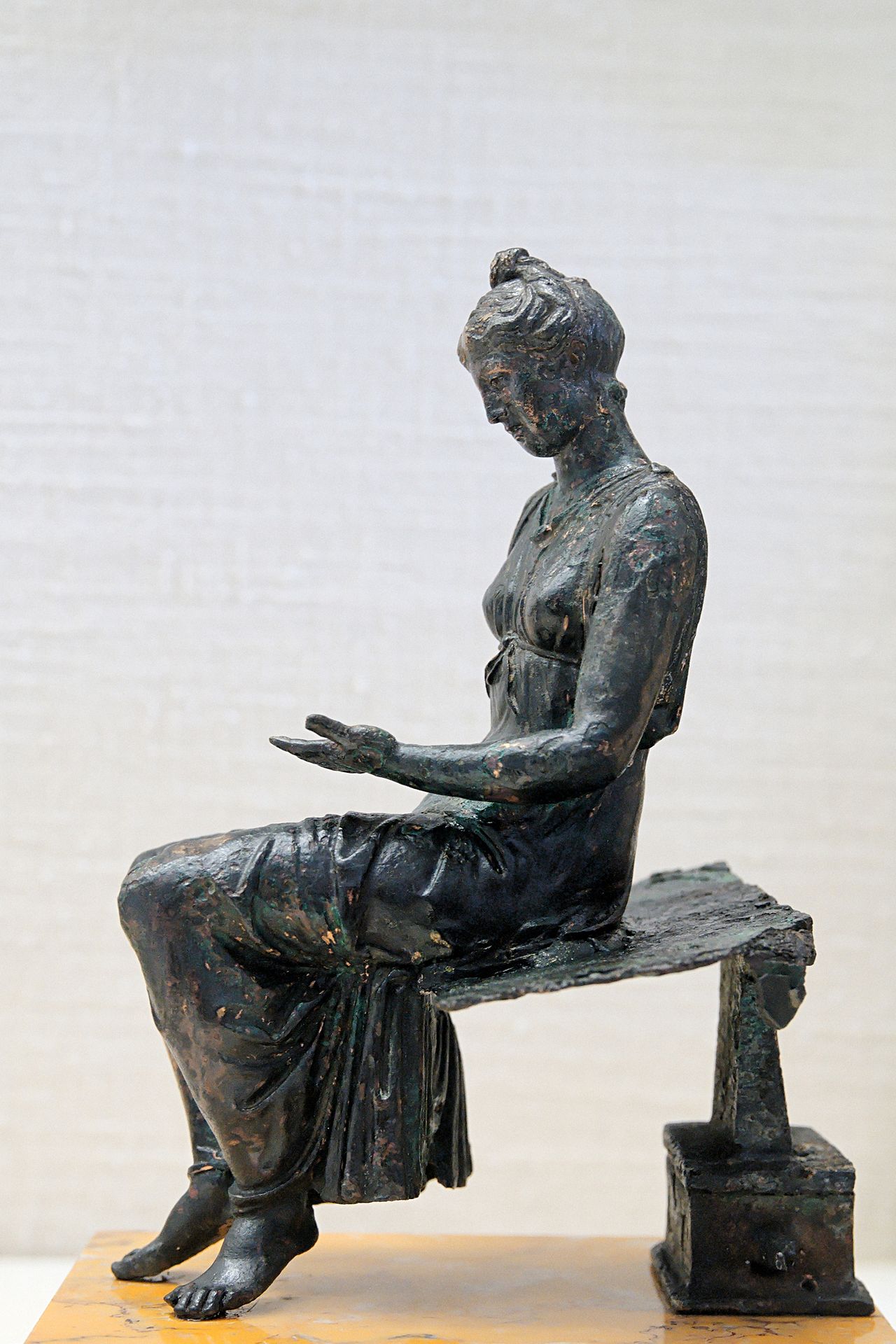
45. Signum aereum virginis legentis, saeculō secundō post Chrīstum, A bronze statuette of a young woman reading, from the second century CE.
Explōrātiō Vīcēnsima Prīma (XXI) Adventure Twenty-One
The Fourth Principal Part of the Verb
Translating the Perfect Passive Participle
The Perfect Passive Participle of Deponent Verbs
Translating the Perfect Passive Participle, Continued
Substantive Use of the Perfect Passive Participle
Ablative of Means, Ablative of Personal Agent with a Perfect Passive Participle
Ablative Absolute with a Perfect Passive Participle
Livy, Ab Urbe Conditā: The Narrative of Lucretia
Where and When Are We Today?
Patavium, Ītalia
Mēnsis Iūnius
M. Aemiliō Lepidō T. Statiliō Taurō cōnsulibus
Padua, Italy
June, 11 CE
Today when Latinitas and I reached the past we were standing on a path in a sloping pine forest. Before us flowed a mountain stream full of cascades and pools; it wound past a castle-like villa that sprawled down below us, then was swallowed up in a vast expanse of land which Latinitas said was the floodplain of the river Po – “the Mississippi of northern Italy,” in her words. Turning around I could see the foothills of the Alps rise steeply into the sky. The sky was bright and warm and filled with the whispers of pine trees and a murmuring work-song sung by three women who were washing clothes on rocks in the stream, their voices rising and falling in sync with the motion of their hands. They were light-haired, tanned, freckled, and going grey; at first, I thought they were elderly, but then it dawned on me that their wrinkles, like the calluses on their knees and elbows, came from stress and overwork, not just ordinary aging. They had a dozen white togas to wash – surprisingly large garments, each the size of a large living-room rug. One pair of togas had the narrow stripes that signify that the wearer is a Roman eques.
Livy
“Those equestrian togas belong to the owner of this estate, Titus Līvius, or Livy, as you call him. Livy is a historian, and large pieces of his massive history of Rome, the Ab Urbe Conditā, still survive. It tells the story of Rome from its foundation to his own day, a period of nearly 800 years; it is the source of much of your knowledge of Roman history under the kings and the early Republic. Livy was born south of here in the city of Padua, but his family has ties to this area; many of the farms that you see off in the distance belong to his tenants. We won’t be seeing him today; he is an old hypochondriac who doesn’t stray very far from the villa now, because he is terrified of catching ‘the Fever’, febris – what you call malaria, a disease common in areas with standing water. The two figures you see coming our way are his daughter, Livilla, and his youngest granddaughter, who is also named Livilla, although people call her Lepidilla, ‘little charming girl’.”
We watched the pair exit the villa by the back gate, escorted by a woman who carried a folded-up umbrella and a basket for them. The two Livillas were watching birds in the trees, whistling and offering them crumbs. Latinitas had us rest under the shade of an old pine and start the day’s lesson.
Perfect Passive Participles
“The other day we talked about present active participles: third declension adjectives derived from verbs that end in -ns, -ntis, etc. We translated these in English with an ‘–ing’ verbal adjective, like māter amāns, ‘the loving mother’. Today you will learn about another common type of participle called the perfect passive participle. You can call it the PPP for short. Let me give you a quick preview of how they work. If you have, for example, the verb rogō, rogāre, ‘to ask’, the perfect passive participle is rogātus, rogāta, rogātum. This is another verbal adjective, but it has US-A-UM (first and second declension) endings. It can be translated ‘having been asked’, or simply ‘asked’. There is much more to the story than that, but that is the gist of what we are going to learn – how to form and translate the perfect passive participle.”
The Fourth Principal Part of the Verb
“First, let’s go over the formation of the perfect passive participle. Most Latin verbs have a fourth principal part in addition to the three principal parts that you already know. This fourth principal part represents the masculine nominative singular form of the perfect passive participle. The ending is -us. For example, the fourth principal part of the verb amō, amāre, amāvī is amātus. From this form you can deduce the feminine and neuter nominative singular forms: amāt-us, amāt-a, amāt-um. This declines as a regular US-A-UM adjective, with second declension forms for the masculine and neuter and first declension forms for the feminine (review the formation of US-A-UM adjectives in Explōrātiō 9).
Translating the Perfect Passive Participle
As for the meaning of the perfect passive participle, an English approximation would be ‘having been verbed’ – ‘having’ because it is perfect tense and ‘been verbed’ because it is passive voice. For a smoother, more idiomatic English translation, you can often drop the ‘having been’ part and just use the English passive participle, which usually ends in -ed, or -t, or -n; ‘noticed’, ‘thought’, and ‘seen’ are some examples. So, the English translation of amātus, amāta, amātum is ‘having been loved’, or simply ‘loved’ – someone or something that has been loved.
Distinguishing the Perfect Active Tense and Perfect Passive Participle in Translation
Be careful, however, not to confuse amātus, amāta, amātum ‘loved’, with the English translation of the Latin perfect active tense. For example, māter amāvit means ‘The mother loved’, where the subject ‘mother’ did the action of the verb. By contrast, māter amāta means ‘the (having been) loved mother...’, where ‘loved’ is an adjective with passive meaning modifying the noun ‘mother’.”
The Perfect Passive Participle of Deponent Verbs
“Deponent verbs like precor, precārī take their perfect passive participle from their third instead of their fourth principal part (they have no perfect active form). Because they are deponent, their perfect passive participle is translated actively; so, precātus, precāta, precātum means ‘having prayed’.”
“Let’s go over the fourth principal part for all the verbs that you know. Add these to your entries in your vocabulary:”
Vocabulary: Fourth Principal Part
“Most A-verbs (first conjugation), as well as some long I-verbs (fourth conjugation), add -tus to the present stem to make the fourth principal part:”
| Latin Verb | Fourth Principal Part | Sample English Meaning of Fourth Principal Part |
|---|---|---|
| amō, amāre, amāvī, | amātus | having been loved |
| audiō, audīre, audīvī, | audītus | having been heard |
| cōgitō, cōgitāre, cōgitāvī, | cōgitātus | having been thought |
| dō, dare, dedī, | datus | having been given |
| errō, errāre, errāvī, | errātus | having been mistaken |
| laudō, laudāre, laudāvī, | laudātus | having been praised |
| mīror, mīrārī, | mīrātus | having admired (deponent) |
| mūtō, mūtāre, mūtāvī, | mūtātus | having been changed |
| parō, parāre, parāvī, | parātus | having been prepared |
| precor, precārī, | precātus | having prayed (deponent) |
| putō, putāre, putāvī, | putātus | having been thought |
| rogō, rogāre, rogāvī, | rogātus | having been asked |
| sciō, scīre, scīvī, | scītus | having been known |
| servō, servāre, servāvī, | servātus | having been preserved |
| spectō, spectāre, spectāvī, | spectātus | having been watched |
| spērō, spērāre, spērāvī, | spērātus | having been hoped |
| stō, stāre, stetī, | status | having been stood |
| vocō, vocāre, vocāvī, | vocātus | having been called |
| eō, īre, iī / īvī, | itus | [used in compounds] |
“For many E-verbs (second conjugation), I-verbs (third), mixed I-verbs (third -iō), as well as some long I-verbs (fourth), either there is no vowel before -tus, or the vowel -i- is added before it. In addition, some of these have a stem that is slightly different from the present stem:”
| Latin Verb | Fourth Principal Part | Sample English Meaning of Fourth Principal Part |
|---|---|---|
| accipiō, accipere, accēpī | acceptus | having been received |
| agō, agere, ēgī, | āctus | have been done |
| capiō, capere, cēpī, | captus | having been taken |
| cernō, cernere, crēvī, | crētus | *having been decided Used only in compounds. |
| coepī, coepisse, | coeptus | having been begun |
| cōgō, cōgere, coēgī, | coāctus | having been forced |
| condō, condere, condidī, | conditus | having been founded |
| dēbeō, debēre, dēbuī, | dēbitus | having been needed |
| dēficiō, dēficere, dēfēcī | dēfectus | having failed |
| dīcō, dīcere, dīxī, | dictus | having been said |
| doceō, docēre, docuī, | doctus | having been taught |
| dūcō, dūcere, dūxī, | ductus | having been led |
| excipiō, excipere, excēpī | exceptus | having been taken out |
| exerceō, exercēre, exercuī, | exercitus | having been worked out |
| faciō, facere, fēcī, | factus | having been made |
| habeō, habēre, habuī, | habitus | having been held |
| incipiō, incipere, incēpī | inceptus | having been begun |
| inveniō, invenīre, invēnī, | inventus | having been found |
| misceō, miscēre, miscuī, | mixtus | having been mixed |
| perdō, perdere, perdidī, | perditus | having been ruined |
| petō, petere, petīvī / petiī, | petītus | having been sought |
| quaerō, quaerere, quaesīvī / quaesiī, | quaesītus | having been searched for |
| relinquō, relinquere, relīquī, | relictus | having been left behind |
| sequor, sequī, | secūtus | having followed (deponent) |
| solvō, solvere, solvī, | solūtus | having been released |
| vincō, vincere, vīcī, | victus | having been conquered |
“Verbs that added -s- in their third principal part in place of another consonant in the present stem keep that -s- in the fourth principal part:”
| Latin Verb | Fourth Principal Part | Sample English Meaning of Fourth Principal Part |
|---|---|---|
| cēdō, cēdere, cessī, | cessus | having been yielded |
| gerō, gerere, gessī, | gestus | having been carried out |
| iubeō, iubēre, iussī, | iussus | having been ordered |
| mittō, mittere, mīsī, | missus | having been sent |
| pōnō, pōnere, posuī, | positus | having been placed |
| premō, premere, pressī, | pressus | having been pressed |
| sentiō, sentīre, sēnsī, | sēnsus | having been sensed |
“For these six verbs, the syllable before -tus or -sus is irregular:”
| Latin Verb | Fourth Principal Part | Sample English Meaning of Fourth Principal Part |
|---|---|---|
| ferō, ferre, tulī, | lātus | having been carried |
| iuvō, iuvāre, iūvī, | iūtus | having been helped |
| moveō, movēre, mōvī, | mōtus | having been moved |
| videō, vidēre, vīdī, | vīsus | having been seen |
| vīvō, vīvere, vīxī, | vīctus | having been lived |
“Verbs like cadō, cupiō, fugiō, iaceō, maneō, ōdī, parcō, possum, valeō have no passive forms. But some of these have a fourth principal part that is used for other forms which we will learn later. Most, but not all, consist of the present stem plus -sus or -tus. There is no sample translation for these, since the perfect passive participle is not in use.”
| Latin Verb | Fourth Principal Part |
|---|---|
| cadō, cadere, cecidī, | cāsus |
| cupiō, cupere, cupīvī, | cupītus |
| fugiō, fugere, fūgī, | fugitus |
| iaceō, iacēre, iēcī, | iacitus |
| maneō, manēre, mānsī, | mānsus |
| parcō, parcere, pepercī, | parsus |
| valeō, valēre, valuī, | valitus |
| veniō, venīre, vēnī | ventus |
| adveniō, advenīre, advēnī | adventus |
Translating the Perfect Passive Participle, Continued
“So, what can you do with these words?, you may ask.”
Um, what can you do?
“The perfect passive participle is a verbal adjective. Like any adjective, it can modify a noun or pronoun if they agree in case, gender, and number. As I said above, a perfect passive participle can be translated into English as ‘having been verbed’ or simply ‘verbed’. Here are some examples.”
Examples of Perfect Passive Participle-Noun Pairs
Masculine Noun and Perfect Passive Participle
| Case | Noun + Participle | English Translation |
|---|---|---|
| Singular | ||
| Nom. | puer relictus | the (having been) left behind boy (subject/predicate) |
| Gen. | puerī relictī | of the (having been) left behind boy |
| Dat. | puerō relictō | to/for the (having been) left behind boy |
| Acc. | puerum relictum | the (having been) left behind boy (direct object) |
| Abl. | puerō relictō | f.w.i.b. the (having been) left behind boy |
| Plural | ||
| Nom. | puerī relictī | the (having been) left behind boys (subject/predicate) |
| Gen. | puerōrum relictōrum | of the (having been) left behind boys |
| Dat. | puerīs relictīs | to/for the (having been) left behind boys |
| Acc. | puerōs relictōs | the (having been) left behind boys (direct object) |
| Abl. | puerīs relictīs | f.w.i.b. the (having been) left behind boys |
Feminine Noun and Perfect Passive Participle
| Case | Noun + Participle | English Translation |
|---|---|---|
| Singular | ||
| Nom. | urbs amāta | the (having been) loved city (subject/predicate) |
| Gen. | urbis amātae | of the (having been) loved city |
| Dat. | urbī amātae | to/for the (having been) loved city |
| Acc. | urbem amātam | the (having been) loved city (direct object) |
| Abl. | urbe amātā | f.w.i.b. the (having been) loved city |
| Plural | ||
| Nom. | urbēs amātae | the (having been) loved cities (subject/predicate) |
| Gen. | urbium amātārum | of the (having been) loved cities |
| Dat. | urbibus amātīs | to/for the (having been) loved cities |
| Acc. | urbēs/-īs amātās | the (having been) loved cities (direct object) |
| Abl. | urbibus amātīs | f.w.i.b. the (having been) loved cities |
Neuter Noun and Perfect Passive Participle
| Case | Noun + Participle | English Translation |
|---|---|---|
| Singular | ||
| Nom. | sīdus vīsum | the (having been) seen star (subject/predicate) |
| Gen. | sīderis vīsī | of the (having been) seen star |
| Dat. | sīderī vīsō | to/for the (having been) seen star |
| Acc. | sīdus vīsum | the (having been) seen star (direct object) |
| Abl. | sīdere vīsō | f.w.i.b. the (having been) seen star |
| Plural | ||
| Nom. | sīdera vīsa | the (having been) seen stars (subject/predicate) |
| Gen. | sīderum vīsōrum | of the (having been) seen stars |
| Dat. | sīderibus vīsīs | to/for the (having been) seen stars |
| Acc. | sīdera vīsa | the (having been) seen stars (direct object) |
| Abl. | sīderibus vīsīs | f.w.i.b. the (having been) seen stars |
Drill: Translating by Case
“Now let’s practice. Notice how some noun-participle pairs are singular and some are plural. When translating into Latin, remember to translate the noun first, then the participle, in the same gender, case, and number as the noun.”
1) Translate these phrases in the nominative:
| Latin | English |
|---|---|
| labor datus | |
| mīlitēs relictī | |
| the (having been) ordered girl | |
| the (having been) seen rivers |
2) Translate these phrases in the genitive:
| Latin | English |
|---|---|
| aquārum mixtārum | |
| manūs dēfectae | |
| of (having been) lost liberty | |
| of the (having been) sent letters |
3) Translate these phrases in the dative:
| Latin | English |
|---|---|
| cōnsiliō spērātō | |
| virīs mīrātīs | |
| for the (having been) prepared republic | |
| to the (having been) discovered bodies |
4) Translate these phrases in the accusative:”
| fēminam iussam | |
|---|---|
| Latin | English |
| iūdicia mixta | |
| the (having been) called young women | |
| the soldier having followed |
5) Translate these phrases in the ablative:
| Latin | English |
|---|---|
| ab urbe conditā | |
| in oppidīs servātīs | |
| f.w.i.b. the (having been) made journey | |
| f.w.i.b. (having been) taught hands |
Substantive Use of the Perfect Passive Participle
“Like any adjective, the perfect passive participle can also function as a substantive. When it does so, it can often be rendered in English as a noun.”
Examples of Substantive Use of the Perfect Passive Participle
| Participle (Nom. Sg. Form) | English Meaning |
|---|---|
| amātus, amāta | a beloved (a having been loved person) |
| captus, capta | a captive (a having been captured person) |
| actum | an act (something having been done) |
| coeptum | a beginning |
| dictum | a saying |
| errātum | a mistake |
| factum | a deed |
| inventum | an invention |
| iussum | an order |
Ablative of Means, Ablative of Personal Agent with a Perfect Passive Participle
“Because the perfect passive participle is passive voice, it sometimes will include an ablative of means or ablative of personal agent (ā/ab + ablative). For example: litterae ā puellā missae, ‘the letter sent by the girl’; populus timōre victus, ‘the people conquered by fear’.”
Exercises 1-8
1. Hoc est dictum sapientis eiusdem.
2. Ab urbe captā cōpiae nostrae fugiunt.
3. Dē rēbus gestīs ille dīxit.
4. Iuvenēs sīdera secūtī viam suam invēnērunt.
5. Auxilium exercituī ab hostibus victō ferimus.
6. Omnibus cūrīs solūtus, vītam bene laudātam in agrīs agō.
7. He knows the deeds and sayings of his beloved.
8. The captive (having been) sought by many (men) left behind everything (‘all things’).
Ablative Absolute with a Perfect Passive Participle
“Recall that a present active participle and noun or pronoun, both in the ablative case, can form an ablative absolute phrase. Similarly, an ablative absolute phrase can be composed of an ablative noun or pronoun modified by an ablative perfect passive participle in agreement. Such an ablative absolute literally means ‘with X (ablative noun/pronoun) having been verbed (ablative perfect passive participle)’. But you can express this more idiomatically in English: ‘when X was/were verbed / has/have been verbed’ or ‘when X had been verbed’. Use ‘had been verbed’ if the main verb of the sentence is past tense (imperfect or perfect tense); otherwise use ‘was/were verbed / has/have been verbed’. As with ablatives absolute with a present active participle, you can also try ‘while’, ‘because’, or ‘although’ in place of ‘when’.”
Ablative Absolute with a Perfect Passive Participle: Examples
| Ablative Absolute | English Translation |
|---|---|
| Mīlite missō, rēx spērābat. | When (while/because/although) the soldier had been sent, the king was hoping. (lit., with the soldier having been sent...) |
| Urbe captā, Caesar discessit. | When (while/because/although)the city had been captured, Caesar departed. (lit., with the city having been captured...) |
| Virīs vīsīs, ībimus. | When (while/because/although)the men have been seen, we will go. (lit., with the men having been seen...) |
Exercises 9-11
9. Hostibus vī victīs, Ītaliam tōtam Rōmānī habuēre.
10. Fōrmā amātae vīsā, Catullus oculōs, ōs, manūs laudāre incēpit.
11. Dux, rēbus bene gestīs, redīre ad urbem potuit.
“Now add these words to your vocabulary and try out the sentences:”
Vocabulary
A-Verbs (First Conjugation)
| Latin Verb | English Meaning |
|---|---|
| līberō, līberāre, līberāvī, līberātus | to free |
| peccō, peccāre, peccāvī, peccātus | to do a wrong; sin “The neuter perfect passive participle is a substantive: ‘a wrong; a sin’.” |
E-Verb (Second Conjugation)
| Latin Verb | English Meaning |
|---|---|
| taceō, tacēre, tacuī, tacitus | to be silent |
I-Verbs (Third Conjugation)
| Latin Verb | English Meaning |
|---|---|
| āmittō, āmittere, āmīsī, āmissus | to lose; dismiss |
| opprimō, opprimere, oppressī, oppressus | to push down; overpower |
Deponent Mixed I-Verb (Third Conjugation -iō)
| Latin Verb | English Meaning |
|---|---|
| morior, morī, mortuus | to die |
Irregular Verb
| Latin Verb | English Meaning |
|---|---|
| inquam; inquis; inquit (1st, 2nd, 3rd sg.) | I say; you say; he/she/it says “This verb is used parenthetically to introduce a quotation or to emphasize a repeated word.” |
Exercises 12-16
12. Hominem quī peccāta sua cernit laudō.
13. Multī eōrum timōre oppressī fūgērunt.
14. Rēx moriēns “vītam,” inquit, “āmīsī, sed rēgnum meum stat.”
14. They hate his mistakes and sins. “Use a neuter perfect passive participle for ‘sins’.”
15. I will not be silent about this: I have freed a republic oppressed by its enemies.
16. It is miserable to die without friends; with those (things) said (‘having been said’), friendship is not easy.
Vocabulary
First Declension Noun
| Latin Noun | Noun Gender | English Meaning |
|---|---|---|
| pudīcitia, pudīcitiae | feminine | (sexual) modesty; chastity |
pudīcitia, pudīcitiae f. (sexual) modesty, chastity
Second Declension Neuter Nouns
| Latin Noun | Noun Gender | English Meaning |
|---|---|---|
| exemplum, exempl-ī | n. | example |
| supplicium, supplici-ī | n. | punishment; supplication |
| vestigium, vestigi-ī | n. | trace; footprint |
Third Declension Nouns
| Latin Noun | Noun Gender | English Meaning |
|---|---|---|
| mulier, mulier-is | f. | woman |
| pudor, pudōr-is | m. | shame; sense of decency |
| testis, test-is “I-stem.” | m. / f. | witness |
| vestis, vest-is “I-stem.” | f. | clothing |
Third Declension Neuter Nouns
| Latin Noun | Noun Gender | English Meaning |
|---|---|---|
| cor, cord-is | n. | heart |
| vulnus, vulner-is “Also spelled vol-” | n. | wound |
US-A-UM Adjectives (First and Second Declension Adjectives)
| Latin Adjective | English Meaning |
|---|---|
| pudīcus, pudīc-a, pudīcum | modest; chaste |
| impudīcus, impudīc-a, impudīcum | immodest |
Conjunctions
| Latin Conjunction | English Meaning |
|---|---|
| cēterum | however |
| etsī | even if |
Adverbs
| Latin Adverb | English Meaning |
|---|---|
| satis | enough "Satin is short for satisne at the start of a question." |
| tantum | only; just |
Exercises 17-24
17. Āmissā omnī spē, captī ad maximum supplicium dūcuntur.
18. Cēterum, etsī nūllum testem habeō, multa vestigia inveniuntur.
19. Multīs vulneribus acceptīs, lītus tūtum petimus.
20. Laudatne pudīcus suum pudōrem?
21. Veste mūtātā, ad sepulchrum multīs cum lacrimīs adiit.
22. Turpis ille neque pudīcitiae suae neque aliēnae pepercit.
23. I will live by the example of this (having been) well-praised woman.
24. Enough of war! Peace only is dear to my heart.
Livy and the History of Rome
We sat still and listened to Livilla and Lepidilla as they walked just below us by the banks of the stream where the women were washing the laundry. Latinitas again whispered the translation in my ear.
“Mama,” Lepidilla said, “with the tutor I am reading grandpa’s history book. I can read much better than Lepidus, you know.”
“Did you know that I was the one who copied out that book by hand?”
“I know that, mama. I have a question. Do you think that a wolf really raised Romulus and Remus?”
“That is the ancient story; grandpa wrote it down, although I don’t know if he believed it. The twins grew up wild and fierce like wolves. But they were also tame enough to do good things, like found the city of Rome, because really they were humans, from royal Latin blood.”
“I don’t think a wolf raised the boys, mama; boys need bread and cheese to eat, wolves don’t make cheese. I think they were raised by a person, their mother, and she gave them a mama-wolf to be their pet.”
“That may be.”
“Mama?”
“What is it?”
“What happened to Lucretia?”
There was an awkward silence while Livilla meditated her answer.
“Romulus was the first king of Rome, and then there were six more.”
“I know, mama, the tutor made me learn their names.”
Livy, Ab Urbe Conditā: The Narrative of Lucretia
“The last king was the tyrant Tarquinius Superbus, an Etruscan. He had a son called Sextus Tarquinius. Sextus knew Lucretia had a husband, the Roman Collatinus. But you know what grandpa wrote about Sextus: Strictō gladiō ad dormientem Lucrētiam venit sinistrāque manū mulieris pectore oppressō, ‘with sword drawn he comes to the sleeping Lucretia and, when the chest of the woman was pushed down by his left hand’, “Tacē, Lucrētia" inquit; "Sextus Tarquinius sum; ferrum in manū est.” Then he said “Moriēre, sī ēmīseris vōcem”, ‘You will die, if you let out a voice’.”
“I know. I mean, after that, what happened?”
Livilla paused for a moment, then replied.
“He took away her pudīcitia, which made her feel ashamed. Then, when Collatinus returned with his friend Brutus, well, what does the story say?”
Livy, Ab Urbe Condita excerpt
My reader, it is a disturbing story. What Livy’s text says is this. How much of it do you understand?
Lucrētiam sedentem maestam in cubiculō inveniunt. Adventū suōrum lacrimae obortae, quaerentīque virō “Satin salvē?” “Minimē” inquit; “quid enim salvī est mulierī āmissā pudīcitiā? Vestīgia virī aliēnī, Collātīnē, in lectō sunt tuō; cēterum corpus est tantum violātum, animus īnsōns; mors testis erit… Ego mē etsī peccātō absolvō, suppliciō nōn līberō; nec ūlla deinde impudīca Lucrētiae exemplō vīvet.” Cultrum, quem sub veste abditum habēbat, eum in corde dēfīgit, prōlāpsaque in volnus moribunda cecidit.
They find Lucretia sitting sadly in the bedroom. At the arrival of her (men), her tears arose, and to her husband asking, “Are you well enough?”, she said, “Not at all; for what is well for a woman with her modesty lost? The traces of another man are on your bed, Collatinus; however only my body has been violated, my mind is innocent; death will be the witness…. Even if I absolve myself of sin, I do not free myself from punishment; nor henceforth will any immodest woman live by the example of Lucretia.” A knife, which she had hidden under her garment, she fixed it in her heart, and, collapsing onto her wound, she fell dead.
“After that,” Livilla went on, “Collatinus and his friend Brutus vowed to get revenge on Sextus and his father king Superbus. They kept Superbus, who was fighting a war, from returning to Rome, and they drove Sextus out of the city. They convinced the Romans to choose two men – themselves – to be their leaders: they were the first consuls, Collatinus and Brutus. And that is why Rome does not have kings; it is why we have freedom.”
“I know, but mama, she had a cultrum. Why didn’t Lucretia fix her knife in that man’s heart?”
“I don’t know why.”
“Mama, I would never kill myself because of another man. I would kill Tarquinius, and I would be an example to Roman women.” As she spoke, she thrust an imaginary knife into a damp toga which Livilla was picking up.
“I hope you will be a good example, Lepidilla,” her mother answered, holding back a tear as she held her daughter to herself. “I will make a sacrifice to Diana today; if the goddess is willing, some day she will make you strong enough to be an example for women to come.”
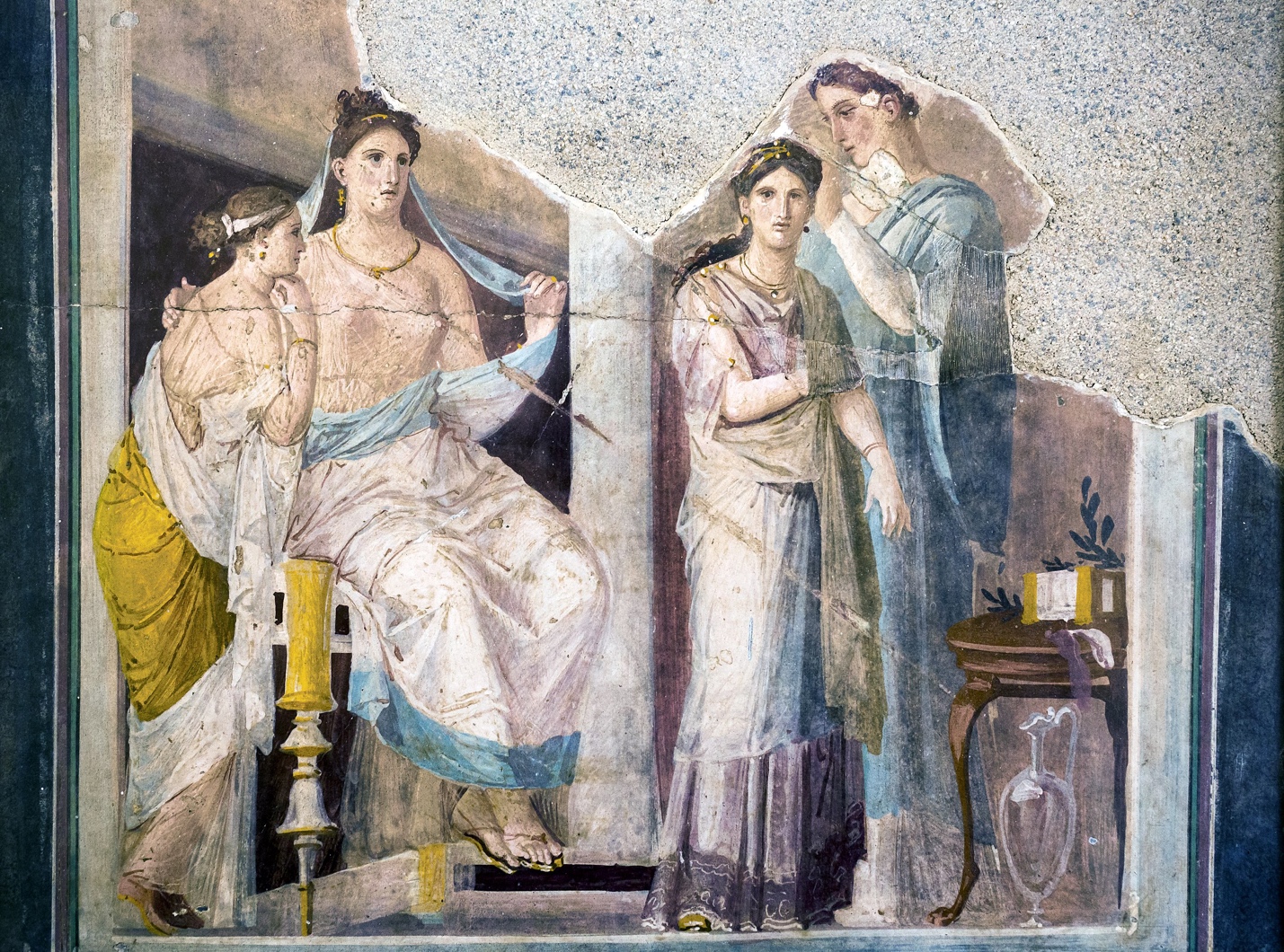
46. Haec est Herculāneī pictūra quae quattuor mulierēs refert, duās mātrēs, ut vidētur, atque fīliās duās comā pulchrē ōrnātā. This is a painting from Herculaneum which represents four women: two mothers, so it seems, and two daughters, their hair beautifully arranged.