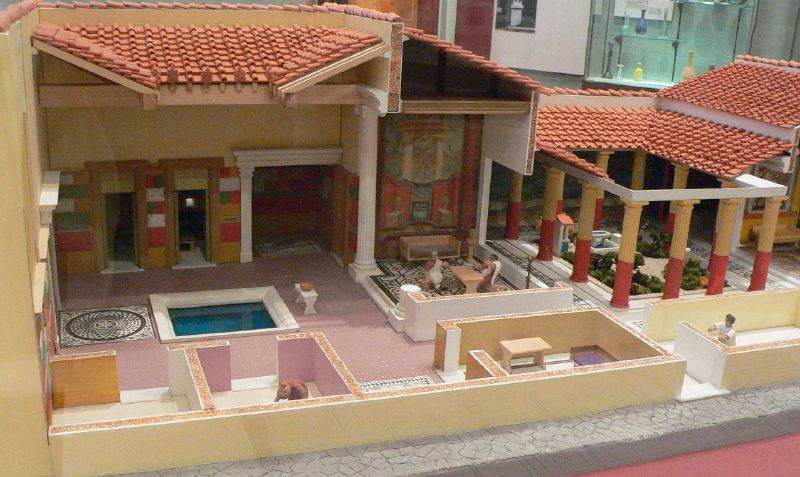
55. A cut-away model of a typical Roman urban villa. The entrance is on the left, leading into an atrium with a square pool. Further in lay an office, bedrooms, kitchen, a dining room, and often an enclosed garden. Pars anterior ad ūsum pūblicum, posterior ad prīvātum. The front part of the house was for public use, the rear for private.
Explōrātiō Vīcēnsima Quīnta (XXV) Adventure Twenty-Five
The Irregular Verbs volō, nōlō, mālō
Conjugation of volō, velle, voluī
Conjugation of nōlō, nōlle, nōluī
Conjugation of mālō, mālle, māluī
Present Infinitive and Present Active Participle of volō, nōlō, mālō
Imperatives of nōlō: Forms and Use as Negative Imperative
Martial’s Epigrams: Selection 1
Martial’s Epigrams: Selection 2
Martial’s Epigrams: Selection 3
Martial’s Epigrams: Selection 4
Juvenal’s Satires: Selection 1
Juvenal’s Satires: Selection 2
Where and When Are We Today?
Subūra, Rōma
Mēnsis Māia
Imp. Caesare Domitiānō Augustō T. Aurēliō Fulvō cōnsulibus
Subura, Rome
May, 85 C.E.
It was night when we arrived in Rome, and the dark air was full of the sound of people celebrating the festival of the Bona Dea, the Good Goddess. The nocturnal ceremonies, held every year on May 1st, involved a good deal of drinking, dancing, music, and sacrifices to the goddess; and it was celebrated almost exclusively by women. Standing outside one house, we watched a line of matrons inside hold hands and step-dance back and forth, accompanied by the music of a pipe and drum. Out in the alley we could see several enslaved women in a group whispering to each other, sharing gossip about things I could only imagine.
My attention turned back to the dancing within. Latinitas saw me wiggle my shoulders in unconscious imitation, and she tried to teach me the step: right foot in front of left, left behind right, and so on, with further stylings. I picked it up, but the ground was too uneven to dance on. Once I gave up, we sat down below a pair of blazing pine torches.
“Well, if you don’t master Latin you can try Latin dancing,” she said, and made me roll my eyes. “First we are going to go over some new grammar and vocabulary; later we’ll visit the house across the street. There the poet Martial is throwing a convīvium, or party, for the men who are without their wives tonight.”
The Irregular Verbs volō, nōlō, mālō
“Now to the main lesson for this evening. Latin has three common irregular verbs that are closely related to each other. The first, volō, means ‘to want’, or ‘to be willing’. The second is volō plus a preceding nōn; this shortens to nōlō, ‘to not want, to not be willing’. The third is also a combination: magis plus volō, which shortens to mālō, ‘to want more’, i.e. ‘to prefer’.”
Vocabulary
Irregular Verbs
| Latin Verb | English Meaning |
|---|---|
| volō, velle, voluī | to want; to be willing |
| nōlō, nōlle, nōluī | to not want |
| mālō, mālle, māluī | to prefer |
“The meaning of these verbs is often completed by an infinitive, just as their equivalents do in English:”
| Amārī volō. | I want to be loved. |
| Morī nōlō. | I do not want to die. |
| Malō spērāre. | I prefer to hope. |
“Each of these verbs has irregular forms in the present tense. As you can see from the second principal parts, velle, nōlle, mālle, the present infinitive forms are also irregular. All of the other tenses are formed regularly, and there are no passive forms to worry about.”
Conjugation of volō, velle, voluī
“Let’s start with the first verb, volō. Here are the irregular present tense forms:”
Present Tense Conjugation of volō, velle, voluī
| Present Tense Forms | English Translation | |||
|---|---|---|---|---|
| Person | Singular | Plural | Singular | Plural |
| 1st | volō | volumus | I want | we want |
| 2nd | vīs | vultis | you want | you all want |
| 3rd | vult | volunt | he/she/it wants | they want |
“But volō, velle, voluī is a completely regular I-verb (third conjugation) in the imperfect, future, perfect, and pluperfect tenses, like the verb dīcō, dīcere dīxī, dictus:”
Imperfect Tense Conjugation of volō, velle, voluī
| Imperfect Tense Forms | English Translation | |||
|---|---|---|---|---|
| Person | Singular | Plural | Singular | Plural |
| 1st | volēbam | volēbāmus | I was wanting | we were wanting |
| 2nd | volēbās | volēbātis | you were wanting | you all were wanting |
| 3rd | volēbat | volēbant | he/she/it was wanting | they were wanting |
Future Tense Conjugation of volō, velle, voluī
| Future Tense Forms | English Translation | |||
|---|---|---|---|---|
| Person | Singular | Plural | Singular | Plural |
| 1st | volam | volēmus | I will want | we will wat |
| 2nd | volēs | volētis | you will want | you all will want |
| 3rd | volet | volent | he/she/it will want | they will want |
Perfect Tense Conjugation of volō, velle, voluī
| Perfect Tense Forms | English Translation | |||
|---|---|---|---|---|
| Person | Singular | Plural | Singular | Plural |
| 1st | voluī | voluimus | I wanted / have wanted | we wanted / have wanted |
| 2nd | voluistī | voluistis | you wanted / have wanted | you all wanted / have wanted |
| 3rd | voluit | voluērunt/ēre | he/she/it wanted / has wanted | they wanted / have wanted |
Pluperfect Tense Conjugation of volō, velle, voluī
| Pluperfect Tense Forms | English Translation | |||
|---|---|---|---|---|
| Person | Singular | Plural | Singular | Plural |
| 1st | volueram | voluerāmus | I had wanted | we had wanted |
| 2nd | voluerās | voluerātis | you had wanted | you all had wanted |
| 3rd | voluerat | voluerant | he/she/it had wanted | they had wanted |
Conjugation of nōlō, nōlle, nōluī
“The verb nōlō is also irregular in the present tense. Before vi- and vu-, the negative nōn remains a separate word. Before vo-, the nōn merges with it, so that nō- replaces vo-:”
Present Tense Conjugation of nōlō, nōlle, nōluī
| Present Tense Forms | English Translation | |||
|---|---|---|---|---|
| Person | Singular | Plural | Singular | Plural |
| 1st | nōlō | nōlumus | I do not want | we do not want |
| 2nd | nōn vīs | nōn vultis | you do not want | you all do not want |
| 3rd | nōn vult | nōlunt | he/she/it does not want | they do not want |
“Like volō, nōlō is completely regular in the other tenses: imperfect nōlēbam, etc.; future nōlam, etc.; perfect nōluī, etc.; pluperfect nōlueram, etc.”
Conjugation of mālō, mālle, māluī
“The verb mālō is like nōlō in the present tense, except the prefix mā- is used instead of negative nō- or nōn, and the prefix always attaches to the verb:”
Present Tense Conjugation of mālō, mālle, māluī
| Present Tense Forms | English Translation | |||
|---|---|---|---|---|
| Person | Singular | Plural | Singular | Plural |
| 1st | mālō | mālumus | I prefer | we prefer |
| 2nd | māvīs | māvultis | you prefer | you all prefer |
| 3rd | māvult | mālunt | he/she/it prefers | they prefer |
“Like volō and nōlō, mālō is regular in the other tenses: imperfect mālēbam, etc.; future mālam, etc.; perfect māluī, etc.; pluperfect mālueram, etc.”
Present Infinitive and Present Active Participle of volō, nōlō, mālō
“The present infinitives of these verbs all have the irregular ending -lle: velle, nōlle, mālle. But their present active participles are formed regularly: volēns, volentis ‘wanting’; nōlēns, nolentis ‘not wanting’; and mālēns, mālentis ‘prefering’.”
Imperatives of nōlō: Forms and Use as Negative Imperative
“The two imperatives of nōlō, nōlle, noluī are nōlī (singular) and nōlīte (plural). These imperatives pair with an infinitive to make a negative imperative, commanding one or more people not to do something. Translate nōlī and nōlīte into English as ‘don’t’, and drop the ‘to’ when you translate the infinitive:”
Negative Imperative Examples
| nōlī / nōlīte + Infinitive | English Translation |
|---|---|
| Nōlī quaerere. | Don’t ask! |
| Nōlīte dīcere. | Don’t speak, (you all)! |
“Now try these sentences:”
Exercises 1-7
1. Vīsne ergō Rōmam īre?
2. Amārī mālunt, sed sī nōn fiērī potest, vidērī amārī volunt.
3. Nīl volō aliud nisi Philūmenam. “Philūmena, -ae, f. is a woman’s name.”
4. Nunc iam illa nōn vult: tū quoque impotēns nōlī. “The nominative adjective impotēns means ‘powerless’; the speaker addresses himself, tū.”
5. Malum facere quī vult, numquam nōn causam invenit.
6. Don’t flee! The sweet dog only wants to play. “Use lūdere for ‘to play’.”
7. You then wanted me to die, but now you want me to live.
Impersonal Verbs
“I want to teach you about another group of verbs called impersonal verbs. What makes these verbs special is that they are not normally used with a personal subject such as ego ‘I’, tū ‘you’, illa fēmina ‘that woman’, hī geminī ‘these twins’, and so forth. Instead, the subject is an impersonal ‘it’, which means these verbs only need third-person singular forms. Let me give you two examples:”
Vocabulary
Impersonal E-Verbs (Second Conjugation)
| Latin Verb | English Meaning |
|---|---|
| licet, licēre, licuit / lictum est + dat. + inf. | it is allowed, to allow, it was allowed |
| placet, placēre, placuit / placitum est + dat. + inf. | it is pleasing, to please, it was pleasing |
“Each of these impersonal verbs typically has a dative word specifying to whom something is allowed, to whom something is pleasing, as well as an infinitive specifying what it is allowed to do, what it is pleasing to do. Latin uses such impersonal verbs more often than English does, and you can often reword a literal English translation by treating the dative word like it is the subject:”
Impersonal Verb with Dative and Infinitive: Examples
| Licet tibi haec discere. | It is allowed to you to learn these (things). i.e., You are allowed to learn these (things). |
| Placet mihi Rōmam īre. | It is pleasing to me to go to Rome. i.e., I intend to go to Rome. |
“Try these sentences featuring impersonal verbs:”
Exercises 8-10
8. Dē hōc facinore tacēre mihi nōn placuit.
9. Licetne utrīque cōnsulum bellum gerere eōdem tempore?
10. Quis enim placēre populō potest cui placet virtūs? “Seneca the Younger to Lucilius.”
“Good. Now let’s add a little more vocabulary.”
Vocabulary
E-Verbs (Second Conjugation)
| Latin Verb | English Meaning |
|---|---|
| ārdeō, ārdēre, ārsī, ārsus | to burn |
| pāreō, pārēre, pāruī, pāritus + dat. | to obey “The person the subject obeys is in the dative.” |
I-Verbs (Third Conjugation)
| Latin Verb | English Meaning |
|---|---|
| colō, colere, coluī, cultus | to cultivate; worship; inhabit |
| legō, legere, lēgī, lēctus | to read; collect; select |
| nōscō, nōscere, nōvī, nōtus | to get to know; know (perfect tense) |
| poscō, poscere, poposcī | to demand |
| reddō, reddere, reddidī, redditus | to return (i.e. to give back, not go back); render |
Long I-Verb (Fourth Conjugation)
| Latin Verb | English Meaning |
|---|---|
| dormiō, dormīre, dormīvī, dormītus | to sleep |
Deponent Long I-Verb (Fourth Conjugation)
| Latin Verb | English Meaning |
|---|---|
| mentior, mentīrī, mentītussum | to lie (i.e., to tell a lie) |
Exercises 11-14
11. Deōs et Rōmae et rūre colere dēbēmus.
12. Pārēte mihi: nōn licet vōbīs adhūc dormīre! Ex urbe ārdentī discēdēmus.
13. Īra habet aliquam voluptātem et dulce est dolōrem reddere. “Seneca the Younger, again.”
14. I do not want to lie: I know the dangers, and I prefer the safer road.
Vocabulary
Second Declension Noun
| Latin Noun | Noun Gender | English Meaning |
|---|---|---|
| liber, librī | m. | book “Contrast līber, ḹībera, līberum ‘free’ and līberī, līberōrum, m. ‘children’.” |
Third Declension Nouns
| Latin Noun | Noun Gender | English Meaning |
|---|---|---|
| carmen, carminis | n. | song; poem |
| fūnus, fūneris | n. | funeral; death |
Pronoun
| Latin Pronoun | Pronoun Gender | English Meaning |
|---|---|---|
| nēmō, nēminis | m. / f. | no one; nobody “This pronoun is only singular and declines like a third declension noun.” |
Adverbs
| Latin Adverb | English Meaning |
|---|---|
| hīc | here; in this place |
| illīc | there; in that place |
Conjunction
| Latin Conjunction | English Meaning |
|---|---|
| quod | because; as; that |
Exercises 15-17
15. Illīc liber hic ab omnibus lēctus est, sed hīc eum nēmō nōvit.
16. Aurea et argentea sūmpsērunt et rapuērunt quod, āmissīs suīs bonīs, aliēna cupiēbant.
17. No one here demands a poem about the funeral, because we are sad.
Martial
Once I finished copying out the vocabulary, we walked across the street and slipped inside a fashionable townhouse by the front gate, which the doorman had gone and left unattended. In the dining room we saw a group of men reclining on couches. They were listening to a man in the central couch read out poems from a little pamphlet. He had curly hair with a touch of red in it, and a lively face, full of winks, twitches, and quick sneers.
“The man who is reading,” Latinitas said, “is Martial: Marcus Valerius Martiālis. Like Seneca, he grew up in Spain and moved to Rome. His main talent is hobnobbing with the rich and famous, and his claim to fame is his poetry. Instead of writing dramas or epics, he writes short little poems, epigrams, that are like tweets, full of gossip. Tonight he’s reading from some of his current efforts:”
We paid attention and heard this recited first:
Martial’s Epigrams: Selection 1
“Translate the epigram; use the notes for help:”
Vīs tē, Sexte, colī: volēbam amāre.
Pārendum est tibi: quod iubēs, colēris;
sed sī tē colō, Sexte, nōn amābō.
Sextus, Sextī, m. a man’s name
pārendum est ‘one must obey’ (another kind of impersonal verb)
The next poem he recited received more laughs:
Martial’s Epigrams: Selection 2
“Answer the questions below the epigram:”
Laudās balnea versibus trecentīs
cēnantis bene Ponticī, Sabelle:
vīs cēnāre, Sabelle, nōn lavārī.
You praise the baths, in three-hundred verses,
of Ponticus, (who’s) dining well, Sabellus:
you want to dine, Sabellus, not to bathe.
Questions
balnea: Case and number?
versibus trecentīs: Case and number?
cēnantis: What form of the verb is this?
Ponticī: Case and number?
vīs: Person, number, and tense?
Martial’s Epigrams: Selection 3
“Match the Latin words in bold to the English translation:”
1) Occurrit tibi nēmo quod libenter
quod, quacumque venis, fuga est et ingēns
circā tē, Ligurīne, sōlitūdō,
quid sit, scīre cupis? Nimis poēta es.
Hoc valdē vitium perīculōsum est.
Do you desire to know what is (the reason)
that nobody cheerfully meets you,
that, wherever you come, there is flight and a huge
solitude around you, Ligurinus? You are too much a poet.
This is a very dangerous fault.
2) Et stantī legis et legis sedentī,
currentī legis et legis cacantī.
In thermās fugiō: sonās ad aurem.
Piscīnam petō: nōn licet natāre.
To (me) standing you read, and you read to (me) sitting,
to (me) running you read, and you read to (me) crapping.
I flee into the baths: you resound in my ear.
I seek out the pool: I’m not allowed to swim.
3) Ad cēnam properō: tenēs euntem.
Ad cēnam veniō: fugās edentem.
Lassus dormiō: suscitās iacentem.
I hasten to dinner: you hold me up as I go.
I arrive at dinner: you make me flee as I eat.
Wearied I sleep: you wake me as I lie.
4) Vīs, quantum faciās malī, vidēre?
Vir iustus, probus, innocēns timēris.
Do you want to see how much evil you do?
A just man, honest, innocent, you are feared.
We stayed to hear about the dozen more epigrams after that. I think the best poem we heard while we were there was this one:
Martial’s Epigrams: Selection 4
“Translate each of the couplets in this next epigram; use the vocabulary notes below:”
1) Mentīris, crēdō: recitās mala carmina, laudō:
cantās, cantō: bibis, Pontiliāne, bibō:
crēdō I believe
recitās you recite
cantās you sing
bibis you drink
2) Pēdis, dissimulō: gemmā vīs lūdere, vincor:
rēs ūna est, sine mē quam facis, et taceō.
pēdis you fart
dissimulō I pretend
gemmā with game piece(s)
lūdere to play
3) Nīl tamen omnīnō praestās mihi. 'Mortuus,' inquis,
'accipiam bene tē.' Nīl volo: sed morere.
tamen yet
omnīnō whatsoever
praestās you give
At a break in the reading we saw one of the guests, who did not appear to be enjoying himself, sneak out and walk home with an attendant who was carrying an oil lamp to guide them through the dark. We followed them. It was a rather treacherous walk, through one of Rome’s poorer neighborhoods, on a narrow street winding between apartment buildings. At one point someone threw a pot out of a window which just missed landing on their heads. A drunken person sprawled across the entrance of his apartment accosted him quite belligerently. Once he found the key and safely entered (with a wave of her hand Latinitas kept the door open just enough for us to follow), my teacher told me who we were stalking.
Juvenal
“That is the young poet Juvenal, Decimus Iūnius Iuvenālis. He was born in Assisi, in Italy, and moved to Rome when his father died. He quickly lost a lot of money in bad investments, which is why he lives here and not in a nice house like Martial’s. He is trying his hand at becoming a professional gossip-poet, but he hates the people he writes about too much. He is good at writing poetry, though, and in a few years his first book of Satires will make him famous.”
We snuck inside and climbed up to the third floor, where we listened at the door as Juvenal dictated poetry to his secretary. Latinitas took out a modern copy of Juvenal’s Satires so I could follow along with a text. This is what we heard:
Juvenal’s Satires: Selection 1
“Translate the first part of this selection; use the notes below for help:”
1) Quid Rōmae faciam? Mentīrī nescio; librum,
sī malus est, nequeō laudāre et poscere; mōtūs
astrōrum ignōrō; fūnus prōmittere patris
nec volo nec possum; ...
nequeō I am not able
mōtūs movements (acc. pl.)
astrōrum of the stars
ignōrō I am ignorant of
prōmittere to promise
2) ... rānārum vīscera numquam
īnspexī; ferre ad nūptam quae mittit adulter,
quae mandat, nōrunt aliī; mē nēmo ministrō
fūr erit, atque ideō nūllī comes exeō tamquam
mancus et extīnctae corpus nōn ūtile dextrae.
I have never inspected the entrails of frogs.
To bring things to a married woman that her adulterer sends,
that he entrusts, others know how; no one will be a thief with me as helper,
and for this reason I go out a companion to no one, like
I am infirm, the non-functioning body of a lifeless right hand.
Here is another selection of poetry he composed while we were listening. The whole poem was about the difficulties of scraping by in Rome. This particular part described the poor condition of the apartments, in contrast to the fancy villas out in Latium and up the Tiber:
Juvenal’s Satires: Selection 2
“Match the Latin words in bold to the English:”
1) Quis timet aut timuit gelidā Praeneste ruīnam
aut positīs nemorōsa inter iuga Volsiniīs aut
simplicibus Gabiīs aut prōnī Tīburis arce?
Who fears or has feared falling objects at cool Praeneste,
or at Volsinium, established on wooded ridges,
or in uncomplicated Gabii, or the citadel of sloping Tibur?
2) Nōs urbem colimus tenuī tībīcine fultam
magnā parte suī; nam sīc lābentibus obstat
vīlicus et, veteris rīmae cum tēxit hiātum,
sēcūrōs pendente iubet dormīre ruīnā.
We inhabit a city propped up by thin scaffolding
in large part; for that is how the manager stops things from falling
and, once he’s covered the gaping old crack,
he orders (us) to sleep without care as falling objects hang over us
3) vīvendum est illīc, ubi nūlla incendia, nūllī
nocte metūs. Iam poscit aquam, iam frīvola trānsfert
Ūcalegōn, tabulāta tibī iam tertia fūmant:
One must live in that place, where (there are) no fires, no
fears at night. Now he demands water, now Ucalegon moves his knickknacks,
now your third floor is already smoking –
4) tū nescīs; nam sī gradibus trepidātur ab īmīs,
ultimus ārdēbit quem tēgula sōla tuētur
ā pluviā, mollēs ubi reddunt ōva columbae.
and you don’t know it; for if there’s an emergency on the bottom steps,
the last one to burn will be the man whom a rooftile alone protects
from the rain, where soft pigeons render him eggs.
Wait, I said; is this place going to catch on fire?
“No, no fire here. But look over there.”
I went over to the window. In the moonlight I could see a gap in the rowhouses across the street – a place where three buildings in a row must have burned down not too long ago. In their charred ruins we could hear three women talking to each other and dancing now and then, putting on their own little Bona Dea celebration.
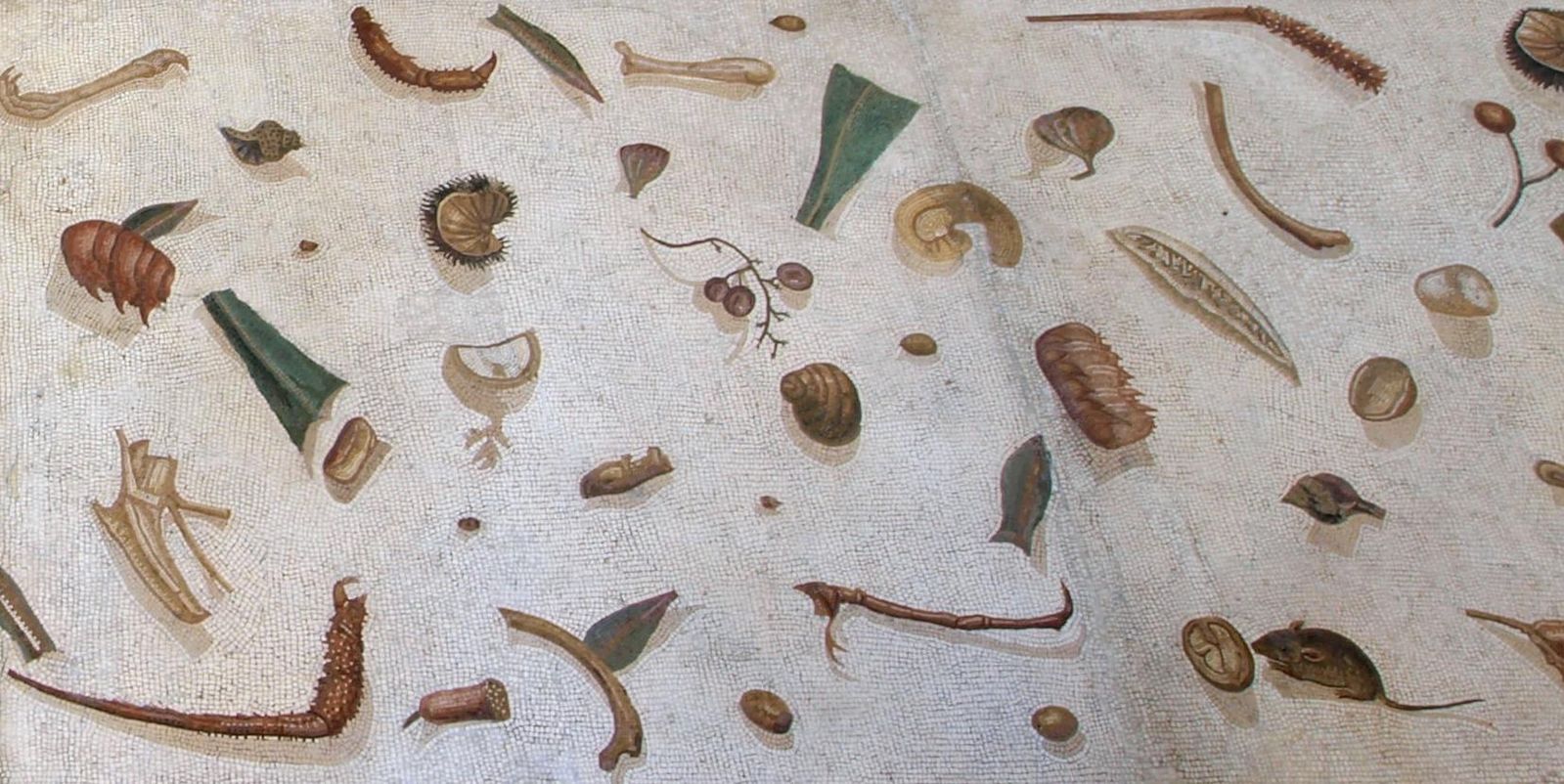
56. Floor mosaic from Rome, representing the trash from a fancy meal. This mosaic would have been placed on the floor of a trīclīnium or dining room, as an amusement. Notā bene mūrem reliquiās cēnae rōdentem; notice the mouse nibbling at a meal scrap.