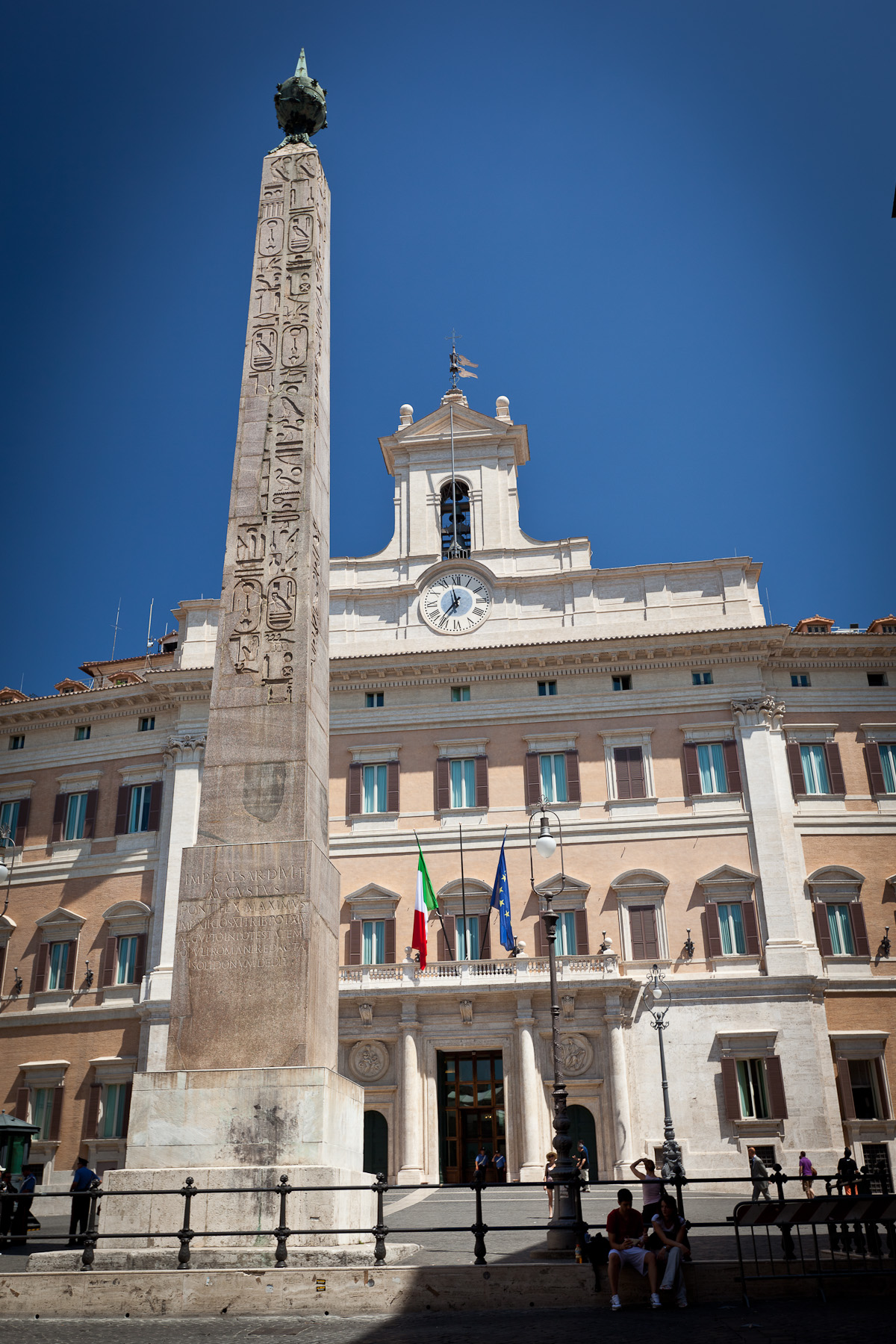
47. The obelisk of Montecitorio, monumentum Aegyptum Rōmam ab Augustō principe portātum, an Egyptian monument transported to Rome by Augustus the princeps. It was used as the pointer for a giant hōrologium or sundial.
Explōrātiō Vīcēnsima Secunda (XXII) Adventure Twenty-Two
Formation of the Pluperfect Active Tense
Formation of the Perfect Passive Tense
The Perfect Tense of Deponent Verbs
Ablative of Means, Ablative of Personal Agent with a Perfect Passive Verb
Augustus’ Gift: The Obelisk of Montecitorio
Where and When Are We Today?
Campus Mārtius, Rōma
Mēnsis Augustus
Cn. Domitiō Ahēnobarbō L. Arruntiō Camillō Scrībōniānō cōnsulibus
Campus Martius, Rome
August, 32 CE
“Today is my diēs nātālis, my birthday,” Latinitas announced as she marched into my apartment.
Happy birthday!, I replied.
“Fēlīx nātālis, yes. I am, if I remember right, 2,417 years old this year. I thought we should go to the City today because the Romans are celebrating the festival of Volcanalia, which is always fun; there will be many bonfires blazing in honor of my cousin Vulcan, the god of fire. We’ll go to the Campus Martius,” she added as she prepared the magic drink. “Think how much it has changed from the time of our first visit, when Plautus was staging his plays on a muddy field.”
When we arrived, I was just as surprised as she predicted. I spotted the Theater of Pompey just south of us, and I used it to get my bearings. Much of the open ground that used to lie north of the theater was now occupied by buildings. There was a giant bathhouse right next to us, the Thermae Agrippae, the Hot Baths of Agrippa. We walked north from there across a broad plaza covered in lawn and cobblestones, and a swarm of statues. We were heading in the direction of a huge stone pillar with a metal ball on the top that, once we got closer, appeared to be covered in Egyptian hieroglyphs. There was an inscription at the bottom that Latinitas wanted to show me, but I was too distracted by the people of the city, who were in a loud mood, to pay attention. We would come back to it later.
Pleasure boats full of partiers were anchored in the middle of the Tiber; in the park, a dozen colorfully dressed trumpeters were blowing long horns in alternating sequence. There were worshippers of the goddesses Isis and Cybele dancing and drumming, dressed in their bright orange robes. I saw a pair of swordsmen fighting – whether it was a duel or entertainment, I couldn’t say – and a wild-looking clown whose face was painted red driving a chariot pulled by baby goats. And everywhere we looked there were bonfires burning, large ones and small ones, for Vulcan; several fire-eaters were also performing, busking for coins. A brief summer storm had passed through just before we arrived, dropping enough rain to wet the pavement but not to extinguish any of the blazes. Steam rising from the ground mingled with the smoke of the fires to create a wild effect like a smoke machine; everything was blanketed in haze.
To our right, from the third floor of an apartment building, a woman was singing from her window. She had a beautiful, operatic voice, and a crowd of young men were gathered below to watch; some were singing along with her, while a few were asking their friends whether she was advertising sexual services; Latinitas smacked one of them in the back of the head, then led me away. Further up the street we encountered a storefront covered by a bright red curtain. Painted over it in red-and-white letters were the words SCHOLA HYGINII GRAMMATICI, ‘The School of Hyginus the Grammarian’. The space was unoccupied today, so we went in where we could study without being distracted by the noise.
I sat down on one of benches and massaged my right ankle, which I had twisted on a cobblestone. Latinitas stood behind the lectern and asked me questions.
Pluperfect Active Verb Tense
“What is the difference between saying, ‘I visited Rome’ and ‘I had visited Rome’ in English?”
I’m not sure, I answered honestly.
“If you say ‘I visited Rome’, you’re telling me a simple story about a visit you made in the past. Whereas, if you say, ‘I had visited Rome’, you’re giving me the backstory for another story set in the past; for example, ‘I had visited Rome before’ – that’s the backstory, visit number one, – ‘but never saw as many fires as I did this time’ – that’s the main story, visit number two.”
“This verb form we are using to describe the backstory for a past story is called the pluperfect tense. Today we are going to study the active voice forms of the pluperfect tense. Sit up now. Put this on your ankle.” She threw me a damp compress that smelled like roses, and when I applied to my ankle, it suddenly felt much better.
She went on, clearly enjoying her position behind the lectern.
“In English the pluperfect active tense is formed by adding ‘had’ before the past tense form of the verb. For example: I had loved; you had thought; she had placed; we had sensed; you all had sought; they had given.
Formation of the Pluperfect Active Tense
In Latin, to form the pluperfect active tense, you start with the perfect stem, to which you add as personal endings the imperfect forms of the verb sum: -eram, -erās, -erat, and so on. Remember that the perfect stem comes from the third principal part of the verb such as:”
Review: Identifying the Perfect Stem of the Verb
| Principal Parts of the Verb | Perfect Stem |
|---|---|
| amō, amāre, amāvī, amātus | amāv- |
| habeō, habēre, habuī, habitus | habu- |
| dūcō, dūcere, dūxī, ductus | dūx- |
| faciō, facere, fēcī, factus | fēc- |
| audiō, audīre, audīvī, audītus | audīv- |
| sum, esse, fuī | fu- |
| possum, posse, potuī | potu- |
| eō, īre, iī / īvī, itus | i- / īv- |
“The endings for the Pluperfect are:”
Pluperfect Active Endings
| Person | Singular | Plural |
|---|---|---|
| 1st | -eram | -erāmus |
| 2nd | -erās | -erātis |
| 3rd | -erat | -erant |
“And here is an example of a verb conjugated in the pluperfect active tense, with the perfect stem and pluperfect active endings:”
Conjugation of amō, amāre, amāvī, amātus (‘to love’), in the Pluperfect Active Tense
| Pluperfect Active Forms | English Translation | |||
|---|---|---|---|---|
| Person | Singular | Plural | Singular | Plural |
| 1st | amāv-eram | amāv-erāmus | I had loved | we had loved |
| 2nd | amāv-erās | amāv-erātis | you had loved | you all had loved |
| 3rd | amāv-erat | amāv-erant | he/she/it had loved | they had loved |
Drill
“Now try to translate these examples, first from Latin into English, then vice-versa:”
| Latin | English |
|---|---|
| steteram | |
| they had made | |
| dīxerās | |
| we had released | |
| posuerātis | |
| you had taken | |
| tulerat | |
| I had seen |
Exercises 1-3
1. Illa mulier amātō cum virō vīxerat.
2. Omnia spectantēs, perīculum magnum sēnserāmus.
3. Cēterum ego ipse patriam perdidī cui vītam dederam.
Perfect Passive Verb Tense
“Let’s study one more thing before we do vocabulary. Tell me: if you say ‘Rome was visited’ or ‘Rome has been visited’, are those two sentences active or passive voice?”
I think passive.
“Passive, yes. And are they present or past?”
Past?
“That’s right too. Both are past. The first – ‘Rome was visited’ – is simple past, and the second – ‘Rome has been visited’ – says that the visit is complete, or over: you could say ‘Rome has been visited!’ at the end of a trip. Both of these English verb forms – ‘was visited’ and ‘has been visited’ would be conveyed in Latin by the perfect passive tense. So now let me tell you the perfect passive forms of the verb in Latin.”
Formation of the Perfect Passive Tense
“The perfect passive is made up of two words in Latin. One word is a present tense form of the verb sum. This word conveys the person and number.”
Review: Present Tense Forms of sum, esse, fuī
| Person | Singular | Plural |
|---|---|---|
| 1st | sum | sumus |
| 2nd | es | estis |
| 3rd | est | sunt |
“The other word is a nominative form of the perfect passive participle of the verb you want to make perfect passive. For example, for the verb amō, amāre, amāvī, amātus you would use amātus, amāta, amātum, amātī, amātae, or amāta.”
How do you know which nominative form of the perfect passive participle to use?
“The participle must agree with the subject of the sentence in gender and number. For example, if the subject is a girl, puella, then you would use amāta (feminine, nominative, singular); if the subject is a group of men, then you would use amātī (masculine, nominative, plural).”
Conjugation of amō, amāre, amāvī, amātus (‘to love’), in the Perfect Passive Tense
| Perfect Passive Forms | English Translation | |||
|---|---|---|---|---|
| Person | Singular | Plural | Singular | Plural |
| 1st | amātus/a/um sum | amātī/ae/a sumus | I was loved / I have been loved | we were loved / we have been loved |
| 2nd | amātus/a/um es | amātī/ae/a estis | you were loved / you have been loved | you all were loved / you all have been loved |
| 3rd | amātus/a/um est | amātī/ae/a sunt | he/she/it was loved / he/she/it has been loved | they were loved / they have been loved |
“Every verb with a fourth principal part forms the perfect passive tense this way, regardless of their verb family:”
| Perfect Passive Forms | English Translation |
|---|---|
| mōtus/a/um sum | I was moved / I have been moved |
| ductus/a/um sum | I was led / I have been led |
| audītus/a/um sum | I was heard / I have been heard |
| captus/a/um sum | I was taken / I have been taken |
The Perfect Tense of Deponent Verbs
“Recall that deponent verbs form their perfect participle from the third principal part, and that the perfect participle is passive in form but active in meaning. Deponent verbs form their perfect tense the same as other verbs form the perfect passive tense – a nominative perfect passive participle plus a present form of sum – but this form is active in meaning for a deponent. The third principal part of a deponent verb will (from now on) be shown in the vocabulary as the masculine first person singular perfect tense form:”
Deponent Verbs
| Principal Parts | English Meaning of the Third Principal Part (Perfect Tense) |
|---|---|
| mīror, mīrārī, mīrātus sum | I admired / I have admired |
| precor, precārī, precātus sum | I prayed / I have prayed |
| sequor, sequī, secūtus sum | I followed / I have followed |
| morior, morī, mortuus sum | I died / I have died |
Drill
“Now try to translate these examples, first from Latin into English, then vice-versa:”
| English | Latin |
|---|---|
| vocātus sum | |
| you (fem.) have been sought | |
| līberātae estis | |
| we (masc.) were pressed | |
| audita sunt | |
| they (masc.) were led | |
| docta es | |
| it has been said | |
| secūtī sumus |
Ablative of Means, Ablative of Personal Agent with a Perfect Passive Verb
“Because the perfect passive tense is passive voice, it sometimes will include an ablative of means or ablative of personal agent (ā/ab + ablative). For example: Mīles ā rēge missus est. ‘The soldier was sent / has been sent by the king.’ Nōs timōre victī sumus. ‘We were conquered / have been conquered by fear’.”
Exercises 4-11
4. Hostēs ab equitibus victī sunt.
5. Tū ā mātre ipsā manēre iussa es.
6. Vestēs pulchrās quās illa mulier nōbīs dederat mīrātae sumus.
7. Trīstis eram, nam faciēs eius locī mūtāta est.
8. Cum illa pudīca hoc audīverat, mortem precāta est.
9. Her mind has been changed by the words which were heard.
10. We (masc.) seemed to that (man) to be shameful.
11. With the city (having been) captured, those soldiers admired the leader whom they followed.
Synopsis of Verb Forms
“Let’s go over the verb forms in terms of tense and voice that you have learned so far; we’ll list only the first-person singular forms. This is called a synopsis. We will use the verb amō, amāre, amāvī, amātus as our example:
Synopsis of amō, amāre, amāvī, amātus
| Latin Form | English Translation | |||
|---|---|---|---|---|
| Active | Passive | Active | Passive | |
| Present | amō | amor | I love | I am loved |
| Imperfect | amābam | amābar | I was loving | I was being loved |
| Future | amābō | amābor | I will love | I will be loved |
| Perfect | amāvī | amātus/a/um sum | I loved/have loved | I was loved/have been loved |
| Pluperfect | amāveram | [not yet learned] | I had loved | [not yet learned] |
“Tomorrow,” she concluded, “we will go over the pluperfect passive, which is missing from this list. But let’s do – no, we can do vocabulary later. Let’s go out and join the crowd now.”
We spent the rest of the afternoon outside, walking about and enjoying the holiday spectacle. Porters were carrying wood up from boats on the Tiber to make a giant nighttime bonfire. It was lit shortly after sundown; it took a long time to catch because the wood was damp, but once it got going it threw off waves of light that filled the whole park. A group of celebrants marched in a procession carrying a straw effigy of what looked to me like a Roman soldier. The straw figure, Latinitas told me, represented the much-hated praetorian prefect Aelius Sejanus, who had recently terrorized the Romans as mayor of the city while his boss, the emperor Tiberius, was living in semi-retirement in the south of Italy. Sejanus had been murdered, but Sejanus-hatred lived on. A great shout rose from the crowds as his effigy was thrown into the pyre, where it was quickly engulfed in flames and turned to ash.
For dinner we bought some bean soup from a vendor, and a piece of fruit, a quince or cotōneum; it looked and smelled like a pear, but was much harder, and I had trouble finishing it. When we were done, we sat near the river and Latinitas had me copy out the following vocabulary:
Vocabulary
A-Verb (First Conjugation)
| Latin Verb | English Meaning |
|---|---|
| appellō,appellāre,appellāvī,appellātus | to call; name |
I-Verbs (Third Conjugation)
| Latin Verb | English Meaning |
|---|---|
| scrībō, scrībere, scrīpsī, scrīptus | to write |
| sūmō, sūmere, sūmpsī, sūmptus | to take up; assume |
| trādō, trādere, trādidī, trāditus | to hand over; hand down |
Second Declension Nouns
| Latin Noun | Noun Gender | English Meaning |
|---|---|---|
| dominus, dominī | m. | master; owner |
| servus, servī | m. | slave |
Third Declension Nouns
| Latin Noun | Noun Gender | English Meaning |
|---|---|---|
| sōl, sōlis | m. | sun |
| potestās, potestātis | f. | power |
| princeps, principis | m. | leader; chief |
| victor, victōris | m. | conqueror; victor |
Neuter Third Declension Nouns
| Latin Noun | Noun Gender | English Meaning |
|---|---|---|
| facinus, facinoris | n. | crime; misdeed |
| opus, operis | n. | work |
Fourth Declension Noun
| Latin Noun | Noun Gender | English Meaning |
|---|---|---|
| currus, currūs | m. | chariot |
US-A-UM Adjectives (First and Second Declension Adjectives)
| Latin Adjective | English Meaning |
|---|---|
| līber, lībera, līberum | free “The masc. pl., līberī, līberōrum, is used substantively, meaning ‘children’.” |
| nātus, nāta, nātum | born “The masc. and fem., nātus, nātī and nāta, nātae, are often used substantively, meaning ‘child’. The adjective plus a numeral and annōs means ‘N years of age’.” |
| uterque, utraque, utrumque (gen. sg. utriusque; dat. sg. utrīque) | each (of two); either; both “The element -que is a suffix, so the case ‘ending’ is in middle of this word.” |
Adverbs
| Latin Adverb | English Meaning |
|---|---|
| ferē | almost; about |
| saepe | often |
| usque | all the way; up to; continually |
Number
| Latin Numeral | English Meaning |
|---|---|
| mīlle; pl. mīlia | a thousand (sg.), thousands (pl.) |
Exercises 12-20
12. Utrāque manū pondus ingēns nātus sūmpserat.
13. Tē ūnum sapientem appellāmus.
14. Armīs trāditīs, hostēs principī nostrō cessērunt.
15. Sōl, ut ferunt, currum agit usque ad noctem.
16. Dominus malus facinora et peccāta sua ipse laudat.
17. Ferē mīlle parentēs, līberī atque servī mediō in oppidō stābant.
18. Quī saepe scrībit opus magnum scrībere potest.
19. Etsī victor potestātem habeō, iam satis suppliciī sūmpsī.
20. Ōs opprime! Facinus est, inquam, capere aliena bona.
Memorials of Augustus
When darkness fell, we set out once again. Latinitas grabbed a torch and led me back to the square pillar with the Egyptian hieroglyphs. The torch cast enough light to make the Latin inscription easily legible.
Augustus’ Gift: The Obelisk of Montecitorio
“Let’s read Augustus’ inscription on the obelisk together:”
IMP. CAESAR DIVI F.
AVGVSTVS
PONTIFEX MAXIMVS
IMP. XII COS. XI TRIB. POT. XIV
AEGVPTO IN POTESTATEM
POPVLI ROMANI REDACTA
SOLI DONVM DEDIT
IMP. CAESAR DIVI F.
AVGVSTVS
“IMP. stands for Imperātor; imperātor, imperātōris, m. means ‘victorious general’. But it is also an official title, ‘emperor’. F. stands for fīlius. DIVI refers to Julius Caesar, who was recognized as a dīvus, dīvī, m., ‘divinity’, after his death.”
PONTIFEX MAXIMVS
“The Pontifex Maximus is the ‘Greatest Priest’ or ‘High Priest’ of Rome; that is another of Augustus’ titles.”
IMP. XII COS. XI TRIB. POT. XIV
“This states that Augustus was Imperātor XII (duodecim) times, Cōnsul XI (ūndecim) times, and was endowed with tribūnīciā potestāte, meaning the potestās of a Tribūnus, Tribūnī, m., ‘Tribune’, or ‘Defender of the People’, XIV (quattuordecim) times.”
AEGVPTO IN POTESTATEM
POPVLI ROMANI REDACTA
“This whole phrase is an ablative absolute: Aegyptō (fem. abl. sg.) in potestātem Populī Rōmānī redāctā; redāctā, from redigō, redigere, redēgī, redāctus means ‘having been reduced’ or ‘having been subjugated’. This column is an obelisk that was dedicated by the Egyptian Pharaoh Psammetichus II six centuries ago; Augustus looted it from Egypt while Gallus was leading his army there and set it up here as a trophy.”
SOLI DONVM DEDIT
“The noun dōnum, dōnī, n. is a ‘gift’.”
“So now you translate the whole inscription for me.”
Which I did, more or less accurately.
“You can’t see it now, but this obelisk forms the pointer for a giant sundial – there are bronze markers on the pavement. That’s why Augustus says sōlī dōnum dedit at the end.”
Next, we walked further north to visit a large, cake-shaped building that I had seen earlier. This was the Mausoleum of Augustus, the place where Augustus and members of the imperial family were buried. Set up on either side of its entrance were two bronze pillars, engraved with the words of Augustus’ Rēs Gestae. This text was a kind of royal autobiography, listing the achievements in his life of which he was most proud. Latinitas pointed out some of the sentences and asked me to write them down. The writing was very clear and easy to transcribe. She clarified a few words for me. I could translate these sentences! The first one was quite hard, but the others were less so. I will give you the same help she gave me. Most of the new vocabulary words were in this text.
The Rēs Gestae of Augustus
1) Rērum gestārum dīvī Augustī, quibus orbem terrārum imperiō populī Rōmānī subiēcit, et impēnsārum quās in rem pūblicam populumque Rōmānum fēcit, incīsārum in duābus ahēneīs pīlīs, quae Rōmae positae sunt, exemplar subiectum est.
“The verb subiciō, subicere, subiēcī, subiectus means ‘to subjugate’ the first time it is used here, but ‘to place below’ the second time it appears. The noun imperiō is dative, meaning ‘to the power’. The noun impēnsa, impēnsae, f. means ‘expense’. The phrase incīsārum in duābus ahēneīs pīlīs means ‘inscribed on two bronze pillars’. The relative quae refers back to pīlīs, ‘pillars’. Rōmae means ‘in Rome’. The noun exemplar, exemplāris, n. means ‘copy’ and it goes with the genitive at the very beginning: ‘a copy of…’.”
2) Annōs ūndēvīgintī nātus exercitum prīvātō cōnsiliō et prīvātā impēnsā comparāvī, per quem rem pūblicam ā dominātiōne factiōnis oppressam in lībertātem vindicāvī.
“The numeral ūndēvīgintī literally means ‘one removed from twenty’. The verb comparō, compāre, comparāvī, comparātus means ‘to make ready’, ‘to muster’. The noun dominātiō, dominātiōnis, f. means ‘tyranny’. The noun factiō, factiōnis, f. means ‘faction’, and here alludes to Augustus’ rival Mark Antony. The verb vindicō, vindicāre, vindicāvī, vindicātus is here used in an idiom with in lībertātem: ‘to emancipate’, ‘to set free’.”
3) Quī parentem meum trucīdāvērunt, eōs in exilium expulī, iūdiciīs lēgitimīs ultus eōrum facinus.
“The verb trucīdō, trucīdāre, trucīdāvī, trucīdātus means ‘to butcher’; expello, expellere, expulī, expulsus means ‘to drive’. The nouns exilium and lēgitimīs can be translated with the English words they resemble. The adjective ultus, ulta, ultum means ‘avenging’. Augustus is referring to Brutus and Cassius, who assassinated Julius Caesar, Augustus’ adoptive father.”
4) Bella terrā et marī cīvīlia externaque tōtō in orbe terrārum saepe gessī, victorque omnibus veniam petentibus cīvibus pepercī.
“The adjective externus, externa, externum means ‘external’, or ‘foreign’; it is here paired in contrast with the adjective cīvīlis, cīvīle. The noun venia, veniae, f. means ‘mercy’, ‘pardon’. What is the present active participle in this sentence?”
5) In triumphīs meīs ductī sunt ante currum meum rēgēs aut rēgum līberī novem.
“The noun triumphus, triumphī, m. refers to the procession of a general reentering Rome after an important victory. The numeral novem means ‘nine’; it does not decline.”
6) Cōnsul fueram terdeciēns, cum scrībēbam haec.
“The adverb terdeciēns means ‘thirteen times’.”
7) Princeps Senātūs fuī usque ad eum diem quō scrīpseram haec, per annōs quadrāgintā.
“The numeral quadrāgintā means ‘forty’.”
8) Capitōlium et Pompēium theātrum utrumque opus impēnsā grandī refēcī sine ūllā īnscrīptiōne nōminis meī.
“Augustus is referring to the temple of Capitoline Jupiter and the theater of Pompey; the noun phrase utrumque opus refers to these buildings. The adjective grandis, grande means ‘great’. The verb reficiō, reficere, refēcī, refectus means ‘to restore’. Translate īnscriptiōne with the English word it resembles.”
9) Eō bellō servōrum quī fūgerant ā dominīs suīs et arma contrā rem pūblicam cēperant trīgintā ferē mīlia capta dominīs ad supplicium sūmendum trādidī.
“The word eō is the demonstrative adjective ‘that’ in the ablative case (not the verb eō ‘I go’). The phrase ad supplicium sūmendum means ‘for punishment to be exacted’ or ‘to receive punishment’. Augustus is talking about the army led by the son of Pompey the Great that opposed him in the civil war, describing it as if it were a slave rebellion because former enslaved persons fought for Pompey.”
10) In cōnsulātū sextō et septimō, postquam bella cīvīlia exstīnxeram, per cōnsēnsum ūniversōrum potītus rērum omnium, rem pūblicam ex meā potestāte in senātūs populīque Rōmānī arbitrium trānstulī.
“The noun cōnsulātus, cōnsulātūs, m. means ‘consulship’. The numerals sextō et septimō are ‘sixth and seventh’. The verb exstinguō, exstinguere, exstīnxī, exstīnctus means ‘to put out’, like a fire. Translate the noun cōnsēnsum with the English word it resembles; ūniversōrum (m. gen. pl.) refers to the Roman citizenry ‘all together’. The adjective potītus, potīta, potītum means ‘in control’, ‘being master’, and it governs a genitive. The verb transferō, transferre, transtulī, translātus means ‘to transfer’.”
11) Tertium decimum cōnsulātum cum gerēbam, senātus et equester ōrdō populusque Rōmānus ūniversus appellāvit mē patrem patriae.
“The numeral tertium decimum means ‘thirteenth’. The phrase equester ōrdō refers to the equitēs.”
The original inscription of the Rēs Gestae in Rome did not survive, but archaeologists uncovered a copy carved in stone in Turkey, and that is where the text of this comes from.
We would have stayed longer and read more of the inscription, but two people ran over to the monument with the apparent intention to make love in its darkness. So we left the space to them and returned home in the usual way. That night, in my dreams, the fires of the Volcanalia continued to burn like so many candles on a cake.
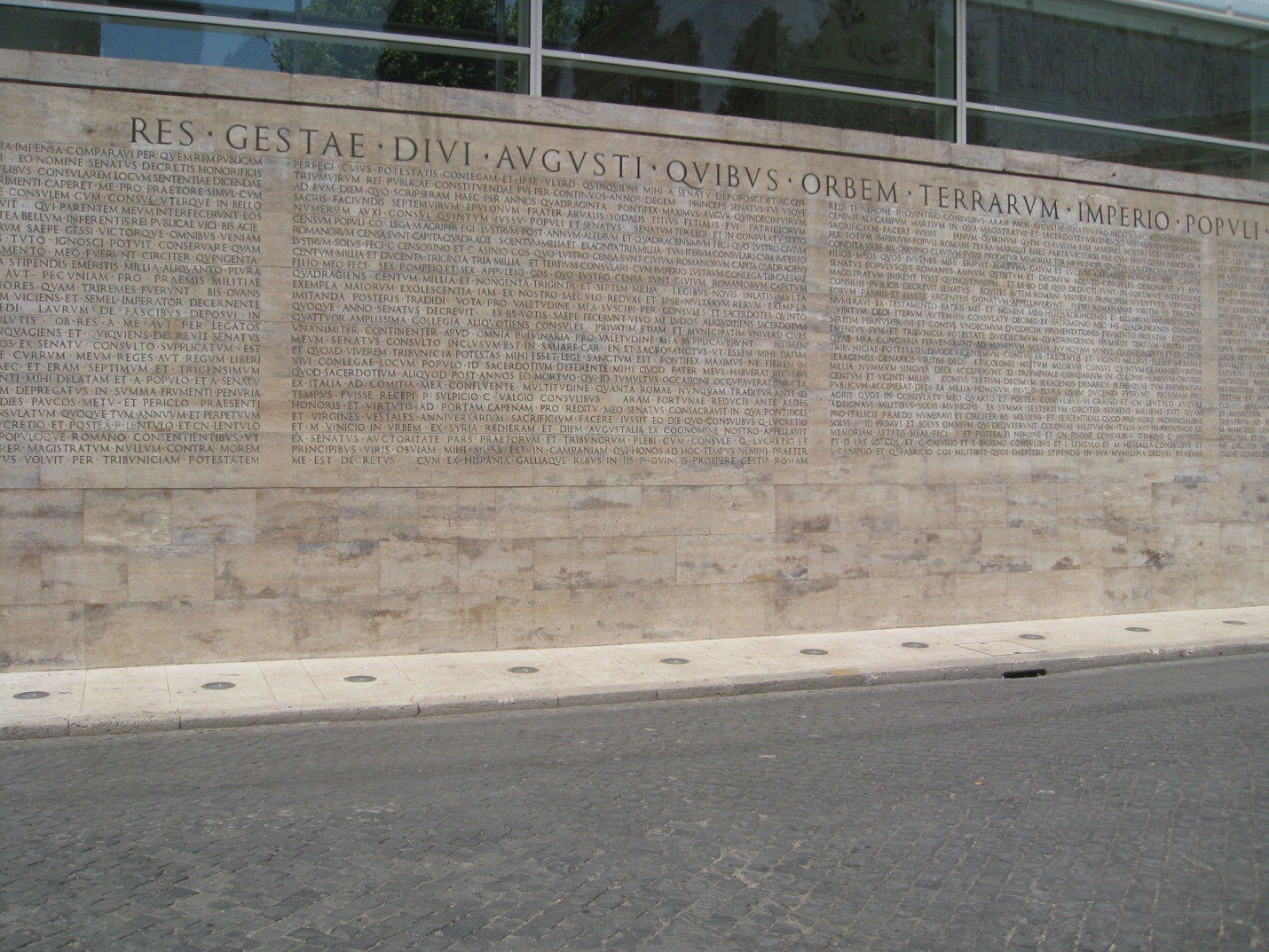
48. Augustī Dīvī Rēs Gestae īnscrīptae in aedem novam Rōmae quae Āram Pācis continet. The Rēs Gestae of the divine Augustus, inscribed on the modern building in Rome that contains the Altar of Peace. There are several typos.