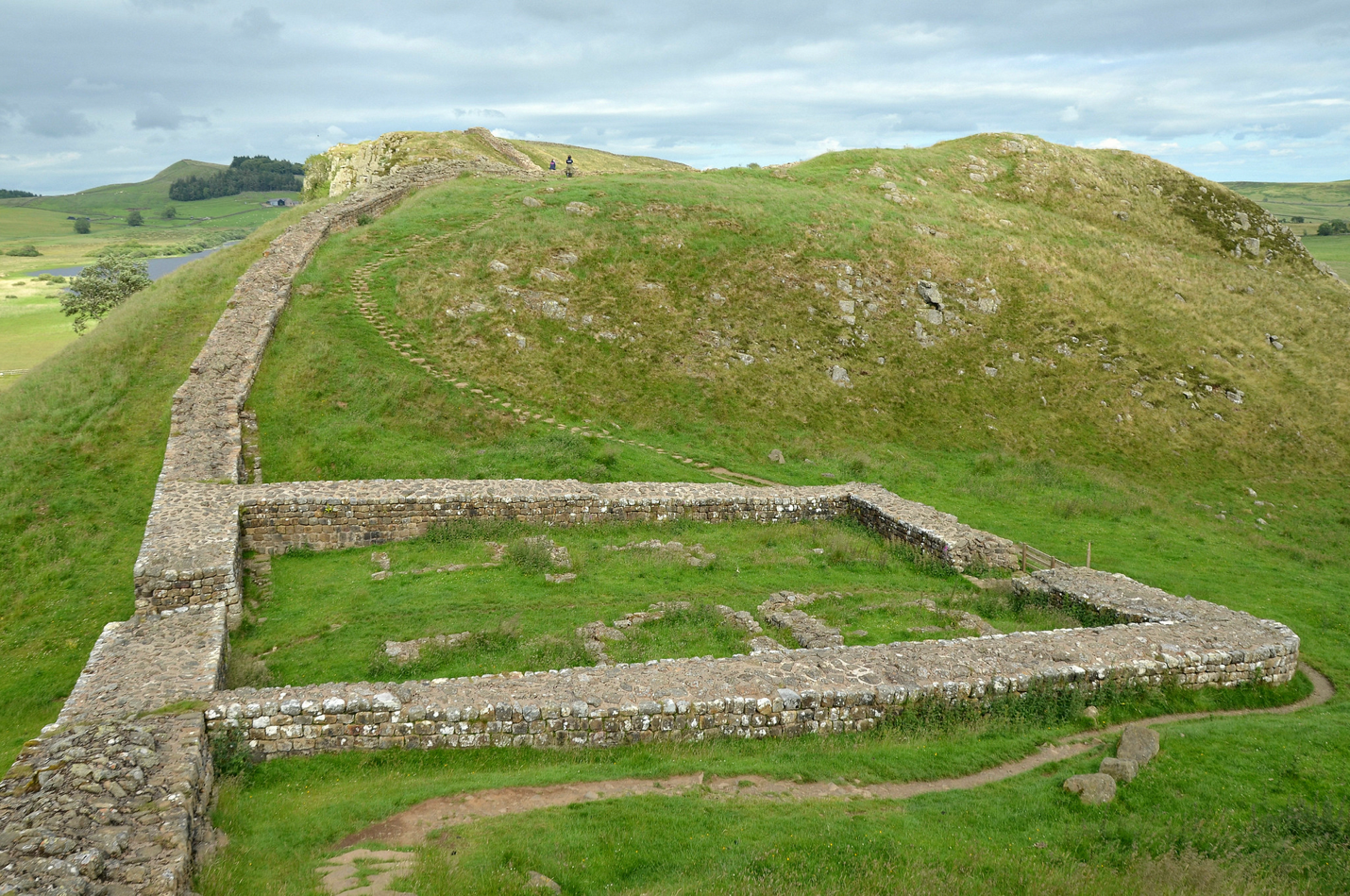
 59. A portion of Vāllum Hadriānī, Hadrian’s Wall, running through Steel Rigg Car Park in Henshaw, England. The square represents the foundations of what would have been a fort, now known as Milecastle 39. The diminutive castellum, meaning ‘fort’, derives from the word castra, the term for a Roman army camp. From these words come English town names that end in ‘-chester’ – Manchester, Winchester, and so on – and the English word ‘castle’, all legacies of the Roman occupation of Britain.
Explōrātiō Vīcēnsima Septima (XXVII) Adventure Twenty-Seven
Formation of the Future Active Participle
Translating the Future Active Participle
Irregular Comparatives and Superlatives
Tacitus’ Agricola: Calgacus’ Speech to his Troops
Tacitus’ Agricola: Calgacus’ Speech to his Troops, Excerpt
Where and When Are We Today?
Vāllum Hadriānī, Britānnia
Mēnsis Februārius
M’. Acīliō Aviolā L. Corelliō Nerātiō Pānsā cōnsulibus
Hadrian’s Wall, Britain
February, 122 CE
It was a sweltering hot afternoon when Latinitas came to my apartment, and I told her I hoped we were going somewhere nice and cool – a wish I soon came to regret. Our visit took us to a place just south of what today is the border of the countries Scotland and England, and it was winter there, damp and biting cold. “Welcome to the northernmost point of the Roman imperium!” she exclaimed. Under grey skies a steady wind swept over the heath, disturbing little pockets of snow that hid beneath the bushes. I pulled my bathrobe tight and rolled up my socks to my calves to keep the air off my skin; Latinitas, as usual, seemed impervious to the weather.
Immediately in front of us was a large wall of black stone, nearly 20 feet high, that was under construction; the finished part stretched off to the right as far as the eye could see. Several teams of workmen were laboring at it, each with a few dozen men, some digging ditches, some piling up soil and preparing the foundations, some hauling heavy stones on sleds, others sliding them into place with impressive skill, their hands thick and calloused by the work. There was much talk, low-voiced discussion, barked commands, an occasional wince of pain; and in the midst of this difficult work, someone, for some reason, was whistling. The language they spoke was Latin, but it sounded odd, like a dialect, and I could not make out much.
“That right there,” she said, pointing to the deep trench on the other side of the wall, “is the edge of the Roman empire. You are looking at the building of Hadrian’s Wall. In Latin it is called the Vāllum Hadriānī; your English word ‘wall’ comes from vāllum. It is named after the emperor Hadrian, who ordered it built to consolidate Roman territorial conquests in Britain. He also wanted to intimidate the Picts, the peoples off to the north,” she said, gesturing into the distance, “in the land of Caledonia.”
Scotland?
“Modern day Scotland, yes. When it is finished it will stretch 72 miles from the Irish to the North Sea. Work on it began late last year. And oh, I almost forgot to mention: the emperor Hadrian is visiting today, to see what progress is being made. That’s him up there.”
We turned around. A Roman army camp crowned the hill behind us, and just outside its gates, a large group of Roman officers and military types were watching the work. I could tell who Hadrian was by his purple cloak and the attention being paid to him; the various officers were lined up on his left and right like they were waiting to have a group picture taken. Latinitas told me some of their names, which I do not remember. The only names that stuck with me were those of Hadrian and the governor of Britain. Believe it or not, the governor’s real name was Quīntus Roscius Coelius Mūrēna Sīlius Deciānus Vībullius Pius Iūlius Euryclēs Herculānus Pompēius Falcō. I will just call him Falco, for short.
We made our way to the camp, taking a roundabout route to avoid the crowd of dignitaries. Guardsmen were watching the gates, but Latinitas threw some kind of magic dust in their faces which allowed us to walk through unopposed. Inside the fort were row after row of soldiers’ tents, most of them empty; the legion – the Ninth Legion, I believe it was – had marched out into the field earlier in the day to intimidate any Picts who might try to interfere with the construction crew. At the center of the camp was a larger tent and some recently-finished wooden buildings; this was where the dux, the legion’s commanding general, had his quarters. On display were four soldiers being punished for some kind of infraction; they were locked in wooden stocks and shivering violently. One of them threw me such a mean look that it sent me running to catch up with Latinitas.
We entered the general’s tent and found a niche which appeared to be his bedroom – it contained a wood-framed bed inlaid with ivory. A brazier made it tolerably warm inside, and we sat down to study.
“We have studied two participles already,” Latinitas reminded me, as she threw an extra blanket over my shoulders, “such as dīcēns, dīcentis, ‘saying’, and dictus, dicta, dictum, ‘(having been) said’. What do you call those?”
The present active participles, and the perfect passive participle.
“Good. We’re going to study a third participle today, the future active participle.”
The Future Active Participle
“The future active participle is translated into English as ‘(being) about to verb’ or ‘who/that is/are about to verb’. It describes a person or thing that is going to do something, in the future. To take the example of dīco, dīcere, dīxī, dictus, the future active participle is dictūrus, dictūra, dictūrum, meaning ‘(being) about to say’, ‘who is/are about to say’.”
Formation of the Future Active Participle
“The formation of the future active participle is straightforward: start with the perfect passive participle (from the fourth principal part of the verb), and insert –ūr- before the -us, -a, -um ending. Here is an example from each of the regular verb conjugations, plus one irregular verb:”
Formation of the Future Active Participle: Examples
| Principal Parts of the Verb | Perfect Passive Participle | Future Active Participle | English Translation |
|---|---|---|---|
| amō, amāre, amāvī, amātus | amātus, -a, -um | amātūrus, -a, -um | (being) about to love |
| moveō, movēre, mōvī, mōtus | mōtus, -a, -um | mōtūrus, -a, -um | (being) about to move |
| dūcō, dūcere, dūxī, ductus | ductus, -a, -um | ductūrus, -a, -um | (being) about to lead |
| audio, audīre, audīvī, audītus | audītus, -a, -um | audītūrus, -a, -um | (being) about to hear |
| capiō, capere, cēpī, captus | captus, -a, -um | captūrus, -a, -um | (being) about to take |
| eō, īre, īvī/iī, itus | itus, -a, -um | itūrus, -a, -um | (being) about to go |
“The verb sum does not have a perfect passive participle, but it does have a future active participle, futūrus, -a, -um, from which the English word ‘future’ derives:”
| Principal Parts of the Verb | Perfect Passive Participle | Future Active Participle | English Translation |
|---|---|---|---|
| sum, esse, fuī | ––––––––––––– | futūrus, -a, -um | (being) about to be |
Translating the Future Active Participle
“Often it works best in English to translate the future active participle with a short relative clause, adding ‘who is’, ‘who are’, ‘that is’, or ‘that are’ before ‘about to’. Use ‘who’ if the noun is a person, ‘that’ if it is a thing:”
Translating the Future Active Participle: Examples
| Noun/Pronoun + Future Active Participle | Literal Translation | Translation with ‘who’, ‘that’ |
|---|---|---|
| fēmina ductūra | the woman (being) about to lead | the woman who is about to lead |
| nōs secūtūrī | we (being) about to follow | we who are about to follow |
| imperium cāsurum | the empire (being) about to fall | the empire that is about to fall |
| dolōrēs ventūrī | pains (being) about to come | pains that are about to come |
“Alternatively, you can even leave out everything except the word ‘to’ when you translate:”
Translating the Future Active Participle: Example
| Noun/Pronoun + Future Active Participle | Literal Translation | ‘to verb’ Translation |
|---|---|---|
| dolōrēs ventūrī | pains (being) about to come | pains to come |
Drill
“First translate the Latin noun/pronoun-participle pairs, and identify their case and number (more than one identification may be possible), then translate the English phrases into the specified case and number:”
| Latin | Case and Number | English |
|---|---|---|
| tū perditūrus | ||
| nom. sg. | the leader (being) about to conquer | |
| cōnsulem solūtūrum | ||
| acc. sg. | the woman (being) about to smile | |
| soror datūra | ||
| dat. pl. | the young women (being) about to encourage | |
| hostēs pressūrōs | ||
| acc. pl. | the dogs (being) about to seize |
Exercises 1-6
1. Cave bellum ventūrum.
2. Spectāsne saxa dē caelō cāsūra?
3. Servī fugitūrī tacēre voluērunt.
4. Caesar currum per moenia āctūrus mīlitēs suōs mīrābātur.
5. Hostēs ad altissimum flūmen adventūrōs capiēmus.
6. Therefore, (the men) (who were) about to save the country demanded a golden crown.
“Use corona, coronae, f. for ‘crown’.”
Tacitus’ Agricola
Latinitas asked me to pick up a papyrus scroll on Falco’s bed. It had a tag at the end that said TACITI AGRICOLA. I had seen these words elsewhere and thought I knew what they meant: the Silent Farmer, I told her.
“Very close,” she said, responding kindly to my mistake. “Let me explain the title of the book to you. The governor of the Roman province of Britain several decades ago was a man named Gnaeus Iūlius Agricola. During his time on this island he led Roman armies much further north than they had ever gone, well into Caledonia. Although Julius Caesar had invaded Britain earlier, and the emperor Claudius established a permanent Roman presence here, it was Agricola who was responsible for pushing the Roman presence as far north as it would go.”
“Agricola had a son-in-law, a young Roman senator named Pūblius Cornēlius Tacitus, who in your day is usually just called Tacitus. After Agricola’s death Tacitus wrote his biography. In addition to being a loving tribute to his father-in-law, it also serves as a detailed account of his campaigns, and a handbook on how to practice imperialism. That is why governor Falco keeps a copy of it next to his bed. The writing on the title tag says ‘The Agricola, of Tacitus’. The noun agricola does mean ‘farmer’, yes, and tacitus means ‘quiet’, but these are proper names.”
Sorry! I said, embarrassed at my mistake.
“No worries. Now I want to show you a famous passage from this book which describes the Caledonian resistance to Rome, and the Caledonian general Calgacus. It’s famous because of a speech Calgacus makes describing the dark heart of Roman imperialism. But before we do that, we should cover one more thing…”
Irregular Comparatives and Superlatives
“We have recently studied the regular formation of comparative and superlative adjectives and the formation of adverbs. But some of the most common adjectives are irregular in that they have different stems in the comparative and superlative than in the positive; they also form some of their adverbs irregularly. The endings, however, mostly follow the rules you know; only the stem is different. Look over these and enter them in your vocabulary:”
Vocabulary
“The vocabulary words in bold are new.”
Irregular Adjectives and Adverbs
| Latin Adjective | Adjective Degree | English Meaning |
|---|---|---|
| bonus, -a, -um | positive | good |
| melior, melius | comparative | better |
| optimus, -a, -um | superlative | best |
| Latin Adverb | Adverb Degree | English Meaning |
|---|---|---|
| bene | positive | well |
| melius | comparative | better |
| optimē | superlative | best |
| Latin Adjective | Adjective Degree | English Meaning |
|---|---|---|
| malus, -a, -um | positive | bad |
| pēior, pēius | comparative | worse |
| pessimus, -a, -um | superlative | worst |
| Latin Adverb | Adverb Degree | English Meaning |
|---|---|---|
| male | positive | badly “The -e ending is short.” |
| pēius | comparative | worse |
| pessimē | superlative | worst |
| Latin Adjective | Adjective Degree | English Meaning |
|---|---|---|
| magnus, -a, -um | positive | great |
| māior, māius | comparative | greater |
| maximus, -a, -um | superlative | greatest |
| Latin Adverb | Adverb Degree | English Meaning |
|---|---|---|
| magnopere | positive | greatly “The -eending is short.” |
| māius | comparative | more (greatly) |
| maximē | superlative | especially “It rarely means ‘most greatly’.” |
| Latin Adjective | Adjective Degree | English Meaning |
|---|---|---|
| parvus, -a, -um | positive | small |
| minor, minus | comparative | smaller; lesser |
| minimus, -a, -um | superlative | least |
| Latin Adverb | Adverb Degree | English Meaning |
|---|---|---|
| parum | positive | little; not enough |
| minus | comparative | less |
| minimē | superlative | least |
| Latin Adjective | Adjective Degree | English Meaning |
|---|---|---|
| multus, -a, -um | positive | much (sg.), many (pl.) |
| plūs, plūris | comparative | more “The singular is neuter only.” |
| plūrimus, -a, -um | superlative | most |
| Latin Adverb | Adverb Degree | English Meaning |
|---|---|---|
| multum | positive | much |
| plūs | comparative | more |
| plūrimum | superlative | most |
| Latin Adjective | Adjective Degree | English Meaning |
|---|---|---|
| superus, -a, -um | positive | high; above |
| superior, superius | comparative | higher |
| suprēmus, -a, -um | superlative | highest; last |
| summus, -a, -um | superlative | highest |
Drill
“Put these English phrases into Latin:”
| English | Latin |
|---|---|
| less than | |
| the least city (nom. sg.) | |
| badly taught youth (acc. sg.) | |
| the most stars (acc. pl.) | |
| especially huge rock (nom. sg.) | |
| lesser fears (nom. pl.) | |
| best and greatest god (nom. sg.) |
Exercises 7-12
7. Aliī optima, aliī pessima, aliī maxima, aliī minima fēcērunt.
8. Plūrimam glōriam in bellīs Rōmānī cēpērunt quae minimē gerere voluēre.
9. Ut ex parvīs maxima fīunt perīcula! Ut minōra mala in māiōra mūtantur!
10. Minimē hoc audīre volō: optimī duo hī virī eōdem diē mortuī.
11. Nōn modo locum superiōrem tenuērunt, sed etiam cōpiās plūrimās dūxērunt.
12. Suprēmō vītae diē, librum legere ea mulier poposcit, quod discere maximē volēbat.
When I finished the sentences I had a question.
“What’s that?”
Were they speaking Latin? The workers at the wall.
“The Roman soldiers were, yes. But some of the stone masons were Brigantes, a British people, with their own language.”
“The Brigantes are an interesting story. They fought stubbornly against the Romans, and they had a queen, Cartimandua, who led them to several surprising victories. But, ultimately, they did not have the right kind of equipment to win every battle or enough focus to follow up on their successes. As part of the peace agreement, they were required to send men to work on the wall during the winter months, as a kind of labor tax. They are happy to keep their enemies to the north from invading, but they hate working for the Romans, too.”
That made sense to me. There were many redheads and blonds working there that looked like they came from northern Europe. The rest were Roman soldiers, drawn from all over the Mediterranean region and sent out here to serve.
“Now here are a few more words for you to learn:”
Vocabulary
A-Verb (First Conjugation)
| Latin Verb | English Meaning |
|---|---|
| pugnō, pugnāre, pugnāvī, pugnātus | to fight |
I-Verb (Third Conjugation)
| Latin Verb | English Meaning |
|---|---|
| tollō, tollere, sustulī, sublātus | to elevate; eliminate; destroy |
Long I-Verb (Fourth Conjugation)
| Latin Verb | English Meaning |
|---|---|
| serviō, servīre, servīvī/serviī, servītus | to serve; be a slave |
First Declension Noun
| Latin Noun | Noun Gender | English Meaning |
|---|---|---|
| silva, silvae | f. | forest; wood |
Second Declension Nouns
| Latin Noun | Noun Gender | English Meaning |
|---|---|---|
| frūmentum, frūmentī | n. | grain |
| iugum, iugī | n. | yoke; ridge |
Third Declension Nouns
| Latin Noun | Noun Gender | English Meaning |
|---|---|---|
| libīdō, libī dinis | f. | desire; whim; lust |
| ops, opis | f. | resources; means; power |
US-A-UM Adjective (First and Second Declension Adjective)
| Latin Adjective | English Meaning |
|---|---|
| integer, integra, integrum | whole; untouched |
Third Declension Adjective
| Latin Adjective | English Meaning |
|---|---|
| pār, paris | equal “This adjective has only one nominative form for all three genders, likeingēns,ingentis.” |
Adverb
| Latin Adverb | English Meaning |
|---|---|
| tandem | finally; at last |
Exercises 13-18
13. Itaque iugum fātī nōs oppressit.
14. Mīlitēs suōs hortātus, ex silvīs cucurrit et omnibus vīribus atque opibus pugnāvit. “Translate cucurrit ‘he ran’.”
15. Frūmentō captō, domibus sublātīs, virī, fēminae atque līberī abdūcēbantur servitūrī.
16. Ubi tandem bonīs sub iūribus vīvere poterimus ut amīcī et parēs?
17. Lūce dēficiente, hominēs recentēs et integrī ad castra advēnērunt.
18. Sua cuique rēs est cārissima, ut ferunt. Immō sua libīdō, sua vitia cuique sunt!
Tacitus’ Agricola: Calgacus’ Speech to his Troops
“Now it is time to look at the famous speech by Calgacus that I mentioned before, or at least a part of it. When the Romans under Agricola advanced into Caledonia, they were confronted by an army that Calgacus led. At a place called Mons Graupius, Mount Graupius, they faced off. Tacitus records a speech which the chieftain supposedly made to his soldiers before the battle, and that is what we will look at. Tacitus writes a very compressed Latin, not easy, but very powerful.”
Tacitus’ Agricola: Calgacus’ Speech to his Troops, Excerpt
“Working with a partner, practice reading the Latin aloud and then answer the questions below each selection:”
1) Raptōrēs orbis, postquam cūncta vastantibus dēfuēre terrae, mare scrūtantur. Sī locuplēs hostis est, avārī, sī pauper, ambitiōsī, quōs nōn Oriēns, nōn Occidēns satiāverit: sōlī omnium opēs atque inopiam parī adfectū concupīscunt. Auferre trucīdāre rapere, falsīs nōminibus, imperium, atque ubi sōlitūdinem faciunt, pācem appellant…
Robbers of the world, after the lands have run out for them, men who devastate all things, they now scrutinize the sea. If the enemy is wealthy, they are greedy; if poor, they are power-hungry – men whom the East cannot satisfy, nor the West; they alone of all desire wealth and impoverishment with equal passion. To carry away, to butcher, to steal – with these words falsified, they call this Empire, and where they make a desert, they call it ‘peace’…
Questions
Identify the present active participle in the first sentence.
orbis: What case? How translated?
mare: Case and number?
scrūtantur: Is the verb deponent or not? What person and number is it?
What is the Latin corresponding to ‘rich’ and ‘poor’?
parī adfectū: Case and number?
concupīscunt: What Latin words do you know that are related?
sōlitūdinem: How translated?
2) Līberōs cuique ac propinquōs suōs nātūra cārissimōs esse voluit: hī per dīlēctūs alibī servītūrī auferuntur; coniugēs sorōrēsque etiam sī hostīlem libīdinem effūgērunt, nōmine amīcōrum atque hospitum polluuntur. Bona fortūnaeque in tribūtum, ager atque annus in frūmentum, corpora ipsa ac manūs silvīs ac palūdibus ēmūniendīs inter verbera et contumēliās conteruntur…
Nature wished each man’s children and his own relatives to be his most precious ones; these, through conscriptions, are carried away, to be slaves elsewhere; wives and sisters, even if they escape the enemy’s lust, are polluted by the name of ‘friends’ and ‘guests’. Our goods and fortunes are exhausted on tribute, our land and life-years on grain, our very bodies and hands on clearing out woods and swamps amidst whips and insults.
Questions
Identify the future active participle and its translation.
cuique: How translated?
cārissimōs: What form is this in terms of case, gender, number, and degree?
voluit: Person, number, and tense?
nōmine: Case and number? How translated?
Bona fortūnaeque: What case and number is each?
inter: How translated?
3) Ita sublātā spē veniae tandem sūmite animum, tam quibus salūs quam quibus glōria cārissima est. Brigantēs fēminā duce exūrere colōniam, expūgnāre castra, ac, nisi fēlīcitās in socordiam vertisset, exuere iugum potuēre: nōs integrī et indomitī et in lībertātem, nōn in paenitentiam bellātūrī; prīmō statim congressū ostendāmus, quōs sibi Calēdonia virōs sēposuerit.
So, with hope of forgiveness eliminated, at long last take heart, as much [you] for whom security is most precious, as [those of you] for whom glory is so. The Brigantes, with a woman their leader, burned down a colony, stormed a camp, and, if their good luck had not turned into laziness, would have been able to take off their yoke. We are untouched and unmastered and about to fight a war for freedom, not regret. In the first encounter let us show at once what sort of men Caledonia has laid aside for herself!
Questions
Identify the ablative absolute in the first sentence.
sūmite: What form of the verb is this?
castra: Case and number?
potuēre: What is the subject of this verb?
nōs integrī: What verb form must be understood here?
I had another question for Latinitas. Why did Tacitus write down bad publicity about the Romans here?
“Because it is true,” Latinitas replied. “And because it was a Roman belief that it was better to win wars against worthy opponents – peoples who were especially noble, or especially dangerous. Tacitus wrote about Calgacus like this because his father-in-law, when he told him stories about his campaigns, used to describe him as a worthy opponent.”
Was he?
“After the battle at Mons Graupius nearly 10,000 Caledonians were reportedly left dead on the field, versus 360 Romans. Perhaps they were disorganized or outmatched in their armor or weaponry. But if you were there, you would probably call it, not a fair fight, but a massacre.”
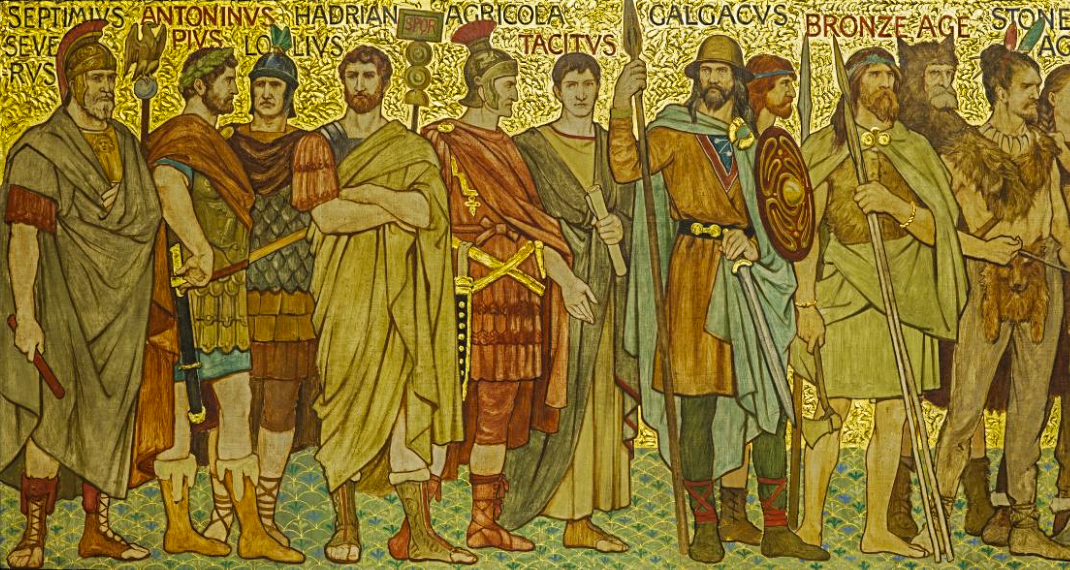
60. A nineteenth-century frieze from the Great Hall of the National Galleries of Scotland showing early residents of the area and various Roman generals and emperors who attempted to incorporate Scottish lands into the empire. Notā bene Calgācum, Tacitum, Agricolam.