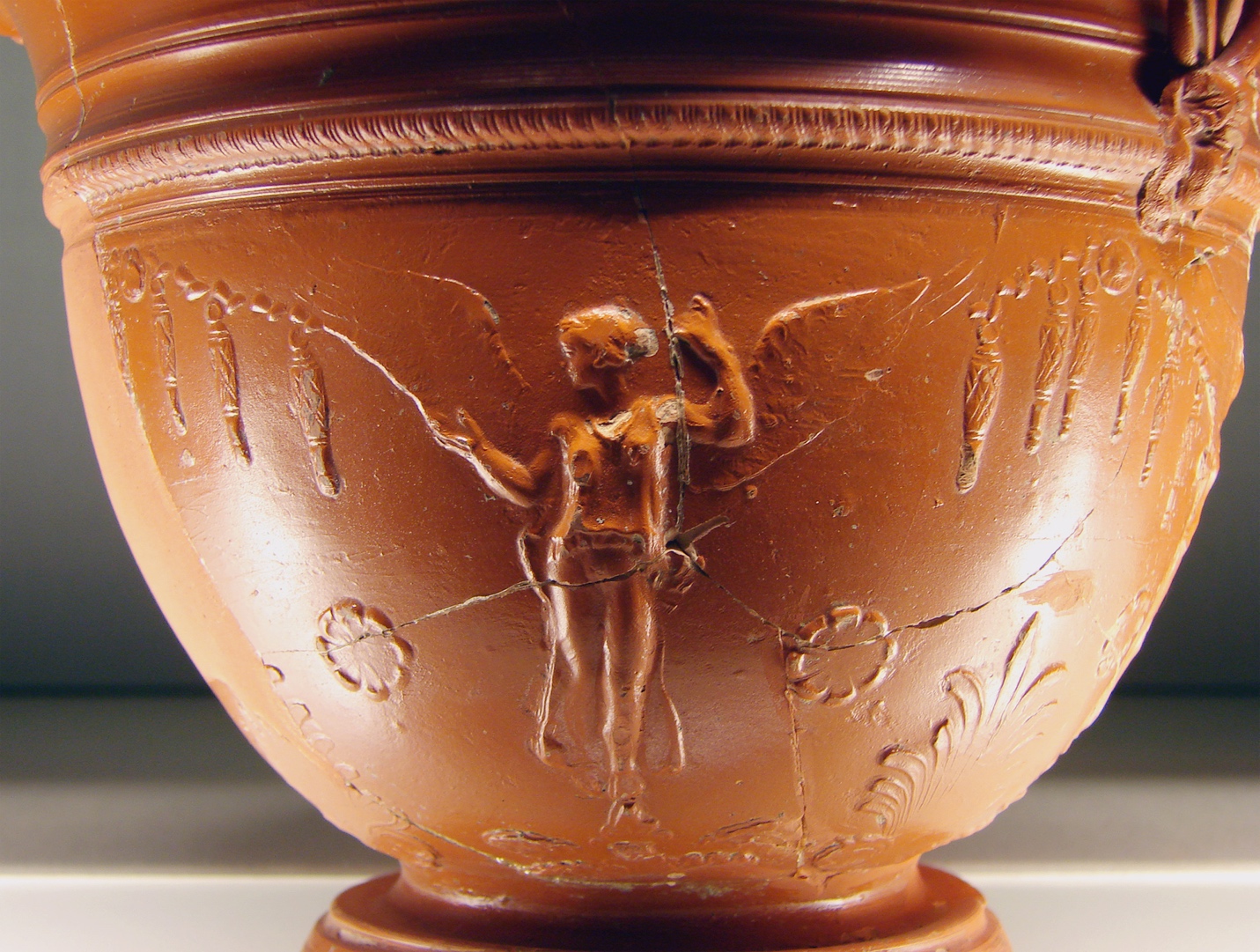
57. A piece of serving ware made from red clay with an application of glaze. Plūrimae testae eius modī – terra sigillāta, ut dictum est. Most Roman pottery was of this sort, terra sigillata, as it was called.
Explōrātiō Vīcēnsima Sexta (XXVI) Adventure Twenty-Six
Formation of the Superlative Adjective
Positive, Comparative, and Superlative Adverbs
Formation of Positive, Comparative, and Superlative Adverbs
Comparatives with Ablative of Comparison or quam
The Interrogative Adjective quī, quae, quod
Pliny the Younger’s Letter to Aefulanus Marcellinus
The Gravestone of Minicia Marcella
Where and When Are We Today?
Etrūria, Ītalia
Mēnsis Octōber
Ti. Iūliō Candidō Mariō Celsō C. Antiō A. Iūliō Quadrātō cōnsulibus
Etruria, Italy
October, 105 C.E.
Quō hodiē? Where today? I asked Latinitas. Apud Aefulānum Mārcellīnum erimus, quamquam Aefulānus nōn aderit, “We will be at the house of Aefulanus Marcellinus, although Aefulanus will not be there.” “Instead,” she continued, “we will see his wife and some of his familia.”
His family?
“His household; that includes his relatives, along with enslaved persons.”
Aefulanus’ villa, which had been built along a small river in Etruria, was buzzing with activity; it was not just a residence, but an industrial site. We were standing close to clay pits that lined the riverbank. Dozens of workers were busy hauling baskets of reddish-brown clay out of a pit nearly a hundred feet across that cut a large scar into the landscape. Another team further upstream was busy pulling pebbles, leaves, roots, and other materials from the clay, some working with their bare hands, others using wicker filters. The purified clay was then piled in large rusty mounds near the entrance of a building where potters were turning out bowls and amphoras and other pieces on fast turning wheels. Each wheel was operated by two workers, one to shape the pot, the other providing power for the rotation. Next, there was a team working on the fine details, adding stamps and signatures to the shaped clay; these workers appeared older than the rest, and, it seemed to me, had the most ‘artistic’ job. At the far end of the factory there was a massive firing kiln. Easily the size of a living room, it was full of pieces of various kinds stacked carefully in rows, like a giant dishwasher. Outside under a shelter stood a huge pile of charcoal that would feed the fire for the kiln.
Watching all this activity going on, I wondered out loud, are they all enslaved?
“Some of the workers belong to Aefulanus,” Latinitas said, “and some are hired laborers, brought in for seasonal work. Most of the men in the clay pit are free persons, in fact; what they are doing, excavating soil, is unskilled labor. Their overseer is a freedman of Aefulanus – a lībertus or slave who was recently manumitted, that is, given his freedom.”
She pointed to an older man watching over the pit; he wore a conical felt pīleus or ‘freedom cap’ on his head.
We then walked to the slave quarters, which formed a wing at the back of the villa. They were as grim as you might imagine. Each slave had a cubicle about the size of a walk-in closet where he kept his bed and personal effects: an extra pair of shoes, blankets, a few cups or plates, and the ubiquitous statuettes. Each cubicle was individualized in subtle ways; some were more tidy, some messy, some cluttered, some minimalist. Some had more possessions than the rest, and I realized that these must have been occupied by slave couples.
A pair of graffiti caught my eye. One read MISER ES, LIBER ESTO: You are miserable; be free. The other was a drawing that was instantly recognizable: the seven-branched stems of a Jewish menorah. Latinitas told me the story.
“Thirty-five years ago, the emperor Titus crushed the Jewish revolt and sacked the city of Jerusalem. This unfortunate soul, who was a child at the time, was sold into slavery and ended up here in Italy, a thousand miles away from home.”
I don’t know how long it was until a welcome sight brought back my spirits. A beautiful white stallion was being led into the stables, covered in sweat from a recent ride. We joined the stable boy who was taking care of him and helped him to rub down the animal and feed him hay.
Pulcher equus, I blurted out, using some words I remembered.
He glanced at me funny, like I was crazy, then looked away again. Latinitas told me later that pulcher and equus were both old-fashioned words now, like ‘noble steed’ in English. Maybe a minute later, he responded, in a low voice: vērē, caballus bellissimus, caballus bellissimus, truly, a most pretty horse, most pretty horse.
And that was my first Latin conversation with someone other than Latinitas.
When we finished caring for the horse, we went back to the hay and Latinitas had me take out my notebook and write.
Superlative Adjectives
“The adjective bellissimus that you heard just now is an example of a superlative. A superlative adjective is a degree above the comparative adjective: pretty (positive degree), prettier (comparative degree), most pretty, prettiest (superlative degree.).
Formation of the Superlative Adjective
“In Latin, the superlative form for most adjectives is made by adding the US-A-UM (first and second declension) endings -issimus, -issima, -issimum to the adjective stem. This applies whether the positive adjective is originally US-A-UM, like cārus, cāra, cārum, or third declension, like fortis, forte. The superlative adjective is translated as ‘most’ plus the adjective, or [adjective]-est:”
Superlative Adjective Forms
| Adjective Stem | Superlative Form: Adj. Stem + Superlative Ending-issimus, -a, -um | English Translation |
|---|---|---|
| cār- (from cārus, cār-a, cārum) | cār-issimus, cār-issima, cār-issimum | most dear; dearest |
| fort- (from fort-is, forte) | fort-issimus, fort-issima, fort-issmum | most brave; bravest |
“For adjectives like miser and pulcher that end with -er in the nominative masculine singular, the final -r of that form is doubled and -imus, -ima, -imum is added to form the superlative:”
Superlative Adjective Forms for -er, -a, um Adjectives
| -er, -a, -um Adjective | Superlative Form: Nom. Masc. Sg. +r+ Superlative Ending -imus, -a, -um | English Translation |
|---|---|---|
| miser, misera, miserum | miser-r-imus, miser-r-ima, miser-r-imum | most miserable |
Drill
“Translate first the Latin noun and superlative adjective pairs, and identify their case and number (more than one identification may be possible). Then translate the English phrases into the specified case and number:”
| Latin | Case and Number | English |
|---|---|---|
| cārissimōs līberōs | ||
| acc. pl. | most convenient plans | |
| carmen pulcherrimum | ||
| abl. sg. | the safest road | |
| bella dūrissima | ||
| for the bravest soldiers | ||
| trīstissimīs virīs | nom. pl. | |
| most famous kings |
Exercises 1-3
1. Currus levissimus aliōs vincet.
2. Dē turpissimīs facinoribus et peccātīs ille impudīcissimus mentītus est.
3. Trīstia vīdī. Numquam trīstiōra vīderam; hoc trīstissimum omnium fuit.
Positive, Comparative, and Superlative Adverbs
“Another word you heard from the stableboy, vērē, ‘truly’, is an adverb. An adverb is a word that qualifies a verb, an adjective, or another adverb. So, in English, you could say:”
| I truly helped him. | adverb + verb |
| The clay was truly red. | adverb + adjective |
| The pot was truly well made. | adverb + adverb + adjective |
“Most adverbs in English are made by taking an adjective and adding the ending –ly to it; but many adverbs in English are irregular, and don’t have this form.”
| Regular English Adverbs: | truly, superbly, awfully, simply |
| Irregular English Adverbs: | well, never, not, often |
“Like adjectives, adverbs come in three degrees: positive, comparative, and superlative:”
Three Degrees of Adverbs
| Positive | Comparative | Superlative |
|---|---|---|
| truly | more truly | most truly |
| sweetly | more sweetly | most sweetly |
| bravely | more bravely | most bravely |
Formation of Positive, Comparative, and Superlative Adverbs
“In Latin, regular adverbs are formed by adding to an adjective stem -ē or -iter/-er (depending on the type of adjective) for the positive degree, -ius for the comparative degree, or -issimē for the superlative degree:”
Formation of Adverbs Derived from US-A-UM (First and Second Declension) Adjectives
| Latin Adverbs | English Translation | ||||
|---|---|---|---|---|---|
| Positive | Comparative | Superlative | Positive | Comparative | Superlative |
| Adj. Stem + -ē | Adj. Stem + -ius | Adj. Stem + -issimē | -ly | more -ly | most -ly |
| cār-ē | cār-ius | cār-issimē | dearly | more dearly | most dearly |
| Adverb Degree | Latin Formation | English Formation | Latin Adverb | English Translation |
|---|---|---|---|---|
| Positive | Adj. Stem + -ē | -ly | cār-ē | dearly |
| Comparative | Adj. Stem + -ius | more -ly | cār-ius | more dearly |
| Superlative | Adj. Stem + -issimē | most -ly | cār-issimē | most dearly |
Formation of Adverbs Derived from Third Declension Adjectives
| Latin Adverbs Positive | Latin Adverbs Comparative | Latin Adverbs Superlative | English Translation Positive | English Translation Comparative | English Translation Superlative |
|---|---|---|---|---|---|
| Adj. Stem + -iter/ -er | Adj. Stem + -ius | Adj. Stem + -issimē | -ly | more -ly | most -ly |
| fort-iter | fort-ius | fort-issimē | bravely | more bravely | most bravely |
| amant-er | amant-ius | amant-issimē | lovingly | more lovingly | most lovingly |
“Most positive adverbs from third declension adjectives form like fortiter, with the ending -iter. If the adjective ends -ns, -ntis, like the present active participle amāns, amantis, then the positive adverb ends -er.”
Drill
“Translate the Latin adverb forms into English, then translate the English adverbs into Latin:”
| Latin | English |
|---|---|
| dulcissimē | |
| more sweetly | |
| facilius | |
| most easily | |
| sapienter | |
| clearly | |
| clārissimē | |
| more wisely | |
| tūtē | |
| more safely |
Exercises 4-5
4. Sī vērē volumus dīcere, omnēs gentēs lībertātem petunt.
5. Ego miserē patior, immō vērō paucī miserius passī sunt.
Comparatives with Ablative of Comparison or quam
“One way of expressing ‘than X’ with a comparative adjective or comparative adverb is to use a noun or pronoun in the ablative case. This is called the ablative of comparison. Such an ablative word should be translated ‘than [ablative word]’.”
Ablative of Comparison: Example
| Nēmō est fortior patre meō. |
| Nobody is braver than my father. |
“Another way of expressing ‘than X’ is to use the adverb quam, meaning ‘than’. When using quam, the two nouns or pronouns compared will be in the same case as one another:”
Comparative with quam: Examples
| Nēmō est fortior quam pater meus. “Nēmō and pater meus are both nominative.” |
| Nobody is braver than my father. |
| Quem mīrāris magis quam Catullum? “Quem and Catullum are both accusative.” |
| Whom do you admire more than Catullus? |
Vocabulary
Adverb
| Latin Adverb | English Meaning |
|---|---|
| quam | than “With a comparative word.” |
Exercises 6-9
6. Vītam faciliōrem agēs quam ego.
7. Hoc carmen dulcius est illō.
8. Quid Rōmā nōbilius est? Nūlla urbs clāriōrem fāmam habet quam ea.
9. No one lived more bravely than this girl.
The Interrogative Adjective quī, quae, quod
“Let’s now consider one more bit of grammar. Do you recall the relative pronoun? Let’s review the forms.”
Review: Relative Pronoun Forms = Interrogative Adjective Forms
| Singular | Masc. | Fem. | Ntr. |
|---|---|---|---|
| Nom. | quī | quae | quod |
| Gen. | cuius | cuius | cuius |
| Dat. | cui | cui | cui |
| Acc. | quem | quam | quod |
| Abl. | quō | quā | quō |
| Plural | |||
| Nom. | quī | quae | quae |
| Gen. | quōrum | quārum | quōrum |
| Dat. | quibus | quibus | quibus |
| Acc. | quōs | quās | quae |
| Abl. | quibus | quibus | quibus |
“Good. Usually these forms function as pronouns that introduce relative clauses, as we have seen. However, each of these forms can also be used as an interrogative adjective, in agreement with a noun in the same gender, case, and number, which normally comes right after it. The interrogative adjective is a question word, and it should be translated as ‘which?’ or ‘what?’. The interrogative adjective can be distinguished from the relative pronoun because it does not have an antecedent but is instead followed by a noun in the same gender, case, and number.”
Vocabulary
Interrogative Adjective
| Latin Adjective | English Meaning |
|---|---|
| quī, quae, quod | which?; what? “Identical in form with the relative pronoun.” |
Interrogative Adjectives, Illustrated
| Cui virō imperium maximum dedistī? |
| To which (masc. dat. sg.) man (masc. dat. sg.) did you give the greatest power? |
| Quae vestigia hīc vidēs? |
| What (ntr. acc. pl.) footprints (ntr. acc. pl.) do you see here? |
Exercises 10-13
10. Quem cāsum flēs? Quī dolor in tē cecidit?
11. Quōs librōs ille sapiēns nōn lēgit? Quās rēs nōn intellēxit?
12. Quī amīcus vērior invenīrī potest?
13. Quam viam māvultis: haec quae ad dulciōra ducit, aut illa quae ad mortem nōs rapit?
“Now let’s study the rest of your vocabulary for today.”
Vocabulary
Deponent A-Verb (First Conjugation)
| Latin Verb | English Meaning |
|---|---|
| hortor, hortārī, hortātus sum | to encourage |
E-Verb (Second Conjugation)
| Latin Verb | English Meaning |
|---|---|
| impleō, implēre, implēvī, implētus | to complete; fill |
I-Verbs (Third Conjugation)
| Latin Verb | English Meaning |
|---|---|
| lūdō, lūdere, lūsī, lūsus | to play |
| referō, referre, rettulī, relātus | to repeat; report; refer; carry back |
Second Declension Nouns
| Latin Noun | Noun Gender | English Meaning |
|---|---|---|
| spatium, spatiī | n. | space; span |
| verbum, verbī | n. | word |
Third Declension Noun
| Latin Noun | Noun Gender | English Meaning |
|---|---|---|
| soror, sorōris | f. | sister |
Fourth Declension Noun
| Latin Noun | Noun Gender | English Meaning |
|---|---|---|
| metus, metūs | m. | fear |
Exercises 14-17
14. Tōtum per spatium caelī sōl currum agit.
15. Eadem verba referēs quae audīvistī?
16. Puer es, nec tibi quicquam nisi lūdere licet.
17. Vōs hortor: vīvere placet ubi nūllī sunt metūs mortis, ubi annōs vestrōs implēre tūtissimē poteritis.
Vocabulary
US-A-UM Adjectives (First and Second Declension Adjectives)
| Latin Adjective | English Meaning |
|---|---|
| altus, alta, altum | tall; deep |
| dignus, digna, dignum + abl. | worthy.“ An ablative word specifies what one is worthy of; e.g.,Catilīna morte dignus, ‘Catiline, worthy of death’.” |
| longus, longa, longum | long; far |
| novus, nova, novum | new; recent |
Third Declension Adjectives
| Latin Adjective | English Meaning |
|---|---|
| gravis, grave | heavy; serious |
| recēns, recentis | fresh; recent “Like ingēns, this adjective has one nominative singular form for all three genders.” |
Irregular Adjective
| Latin Adjective | English Meaning |
|---|---|
| quisque, quaeque, quidque | each; every “This declines like quis, quid plus -que for the masculine and neuter, like relative quae plus -que for the feminine.” |
Adverbs
| Latin Adverb | English Meaning |
|---|---|
| prope | near; nearly |
| nōndum | not yet |
| umquam | ever |
| ut | how! “You previously learned (Ex.13) the meanings ‘as’, ‘when’, ‘so that’.” |
Conjunctions
| Latin Conjunction | English Meaning |
|---|---|
| tamen | nevertheless; yet; however |
| nōn modo / sōlum / tantum ... sed etiam / et | not only… but also |
Exercises 18-25
18. Placet mihi longā sine morā Rōmam īre.
19. Nēmō umquam graviōra passus est.
20. Suam quisque homō rem meminit.
21. Recēns exemplum fortissimī virī cernō et nunc sūmō.
22. Corpus cūrīs dēfectum altior somnus premit.
23. Etsī hic vir laude dignus est, tamen nōndum multī facta eius nōscunt.
24. Iam per annōs prope centum līberī vīximus. Ut cāra est lībertās!
25. Your sister is not only more serious than we, but also more worthy of fame.
Pliny the Younger
As soon as I was finished a woman in the courtyard let out a shriek. We rushed to see what was going on, and saw her surrounded by family members. She was in tears and explained why she was upset: Litterās ab Plīniō accēpī, nūntium trīstissimum; Minicia Mārcella mortua est! ‘I have received a letter from Pliny, the saddest news: Minicia Marcella has died!’
What had happened was this. Atilia, the wife of Aefulanus, had just opened a letter delivered by a mounted courier from Rome. The letter was addressed to her husband by Pliny the Younger, Gāius Caecilius Plīnius Secundus. He was a Roman senator whose main claim to fame is that his correspondence still survives today. In this particular letter Pliny reported the distressing news that the daughter of a mutual friend, Gaius Minicius Fundanus, had passed away – and just before she was supposed to be married. The daughter’s name was Minicia Marcella. She died from an undiagnosed illness.
Atilia read the letter aloud to the assembled members of the familia. What we overheard was this:
Pliny the Younger’s Letter to Aefulanus Marcellinus
“Working with a partner, read the Latin of Pliny’s letter aloud and complete the identifications and questions below each section:”
1) Gāius Plīnius Aefulānō Mārcellīnō suō salūtem.
Trīstissimus haec tibi scrībō, Fundānī nostrī fīliā minōre dēfūnctā, quā puellā nihil umquam fēstīvius, amābilius, nec modo longiōre vītā sed prope immortālitāte dignius vīdī. Nōndum annōs xiiii implēverat, et iam illī anīlis prūdentia, mātrōnālis gravitās erat et tamen suāvitās puellāris cum virginālī verēcundiā.
Gaius Pliny to his own Aefulanus Marcellinus: greetings.
I write these things to you most sad, with the younger daughter of our own Fundanus deceased, a girl than (compared to) whom I have not ever seen anything more festive, more lovable, more worthy, not just of a longer life, but, nearly, of immortality. She had not yet completed 14 years, and to her there was already an old woman’s prudence, a matronly seriousness, and yet a girlish sweetness with a young woman’s modesty.
Questions
Identify the four comparative adjectives.
Trīstissimus: What form is this adjective, and what does it modify?
quā puellā: What case is this phrase and why?
implēverat: Person, number, tense, and voice?
illī: Case and number?
2) Ut illa patris cervīcibus inhaerēbat! Ut nōs amīcōs paternōs et amanter et modestē complectēbātur! Ut nūtrīcēs, ut paedagōgōs, ut praeceptōrēs prō suō quemque officiō dīligēbat! Quam studiōsē, quam intellegenter lēctitābat! Ut parcē cūstōdītēque lūdēbat! Quā illa temperantiā, quā patientiā, quā etiam cōnstantiā novissimam valētūdinem tulit!
How she clung to the neck of her father! How lovingly and modestly she embraced us, her father’s friends! How she loved her nurses, how she loved her tutors, how she loved her teachers each in proportion to her duty! How studiously, how intelligently she would read! How sparingly and carefully she played! With what temperance, with what patience, with what constancy even did she bear her most recent illness!
Questions
This passage exhibits the rhetorical device anaphora, the repetition of one or more words at the beginning of successive clauses. Identify two examples of anaphora and consider why Pliny uses this device here.
amanter ... modestē: Identify these forms.
quemque: Case and number?
studiōsē ... intellegenter: Identify these forms.
lūdēbat: How translated?
novissimam valētūdinem: How translated?
3) Medicīs obsequēbātur, sorōrem patrem adhortābātur ipsamque sē dēstitūtam corporis vīribus vigōre animī sustinēbat. Dūrāvit hic illī usque ad extrēmum, nec aut spatiō valētūdinis aut metū mortis īnfrāctus est, quō plūrēs graviōrēsque nōbīs causās relinqueret et dēsīderiī et dolōris.
She obeyed her doctors, she encouraged her sister and father, she sustained her very self, deserted by strength of body, with the vigor of her mind. This endured in her all the way to the end, nor was it broken either by the length of her illness or by fear of death, whereby she left behind for us more and more serious reasons for longing and pain.
Questions
corporis vīribus: How translated?
usque ad extrēmum: How translated?
spatiō ... metū: What case is each word and how translated?
graviōrēsque: What noun does this modify?
4) Ō trīste plānē acerbumque fūnus! Ō morte ipsā mortis tempus indignius! Iam dēstināta erat ēgregiō iuvenī, iam ēlēctus nūptiārum diēs, iam nōs vocātī. Quod gaudium quō maerōre mūtātum est!
O, plainly, a sad and bitter death! O time of death, more unworthy than the death itself! She had already been betrothed to an outstanding youth, the day of the wedding had already been chosen, we had already been invited. What joy was changed by what grief!
Questions
trīste: What noun does this modify?
indignius: What noun does this modify?
iuvenī: Case and number?
nōs vocātī: What form of sum must be understood from the context?
5) Nōn possum exprimere verbīs quantum animō vulnus accēperim, cum audīvī Fundānum ipsum, ut multa lūctuōsa dolor invenit, praecipientem, quod in vestēs margarīta gemmās fuerat ērogātūrus, hoc in tūs et unguenta et odōrēs impendērētur… Āmīsit fīliam, quae nōn minus mōrēs eius quam ōs vultumque referēbat, tōtumque patrem mīrā similitūdine exscrīpserat… Valē.
I am not able to express in words how great a wound I received in my mind when I heard Fundanus himself – since pain discovers many things full of grief – instructing that what he had been going to budget for clothing, pearls, and gems, that this should be expended on incense and ointments and perfumes… He lost a daughter who repeated his character no less than his face and expression, and had copied her whole father with a wonderful likeness… Farewell.
Questions
vulnus: Nominative or accusative?
Āmīsit: Person, number, tense, and voice?
quae: What is the antecedent?
mōrēs ... ōs: What case is each noun?
The Gravestone of Minicia Marcella
I visited Rome a few years ago, after our travels had ended and my time with Latinitas was only a memory. While I was there I made a special effort to visit a tombstone I had read about. Located in the Gabinetto delle Maschere of the Vatican Museums, it would not strike you as anything special, but for me it was.
It was the tombstone of Minicia Marcella.
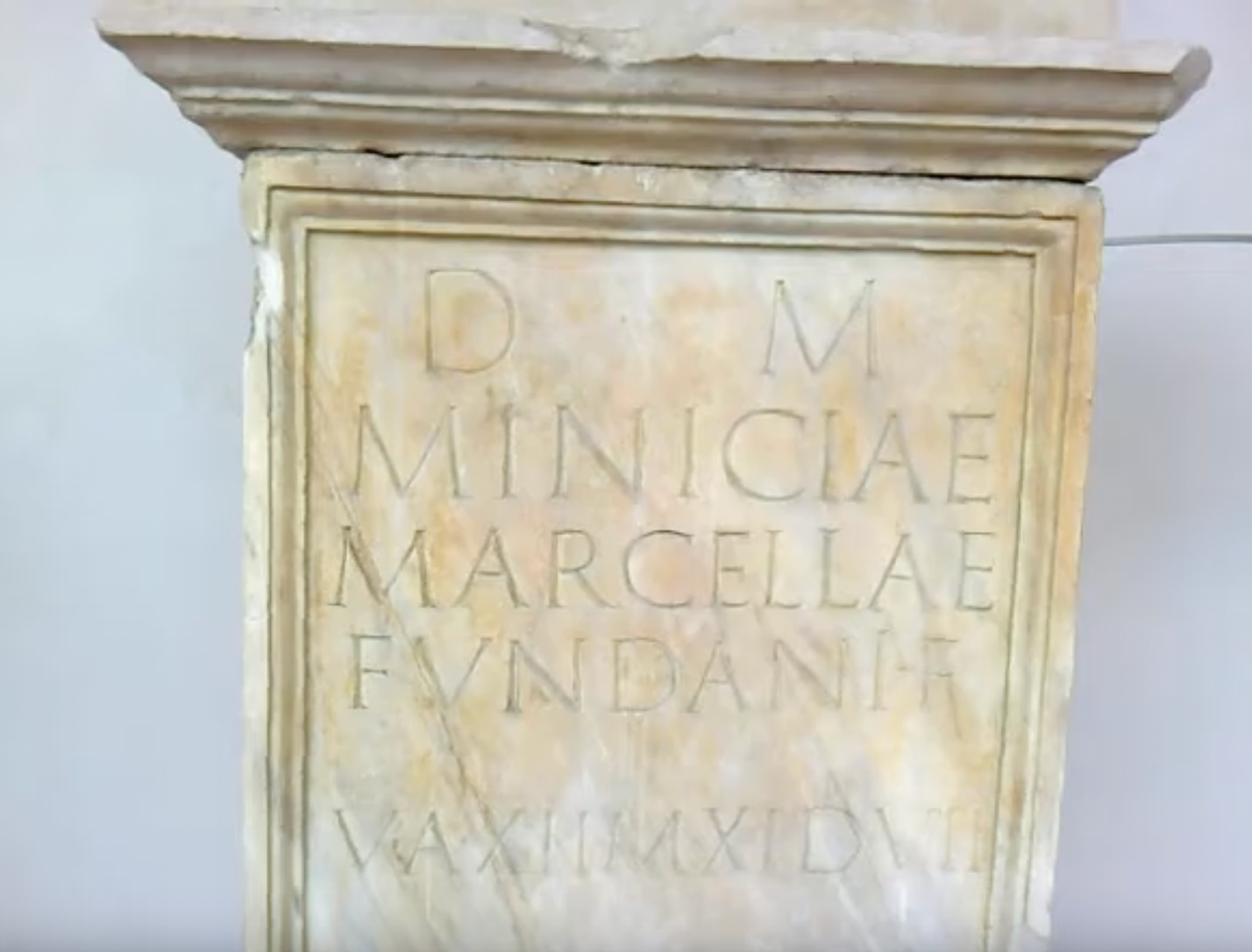
58. The tombstone of Minicia Marcella. It reads Dīs mānibus Miniciae Mārcellae Fundānī f(īliae). V(īxit) a(nnōs) XII, m(ēnsēs) XI, d(iēs) VII. ‘To the departed spirits of Minicia Marcella, daughter of Fundanus. She lived 12 years, 11 months, 7 days.’