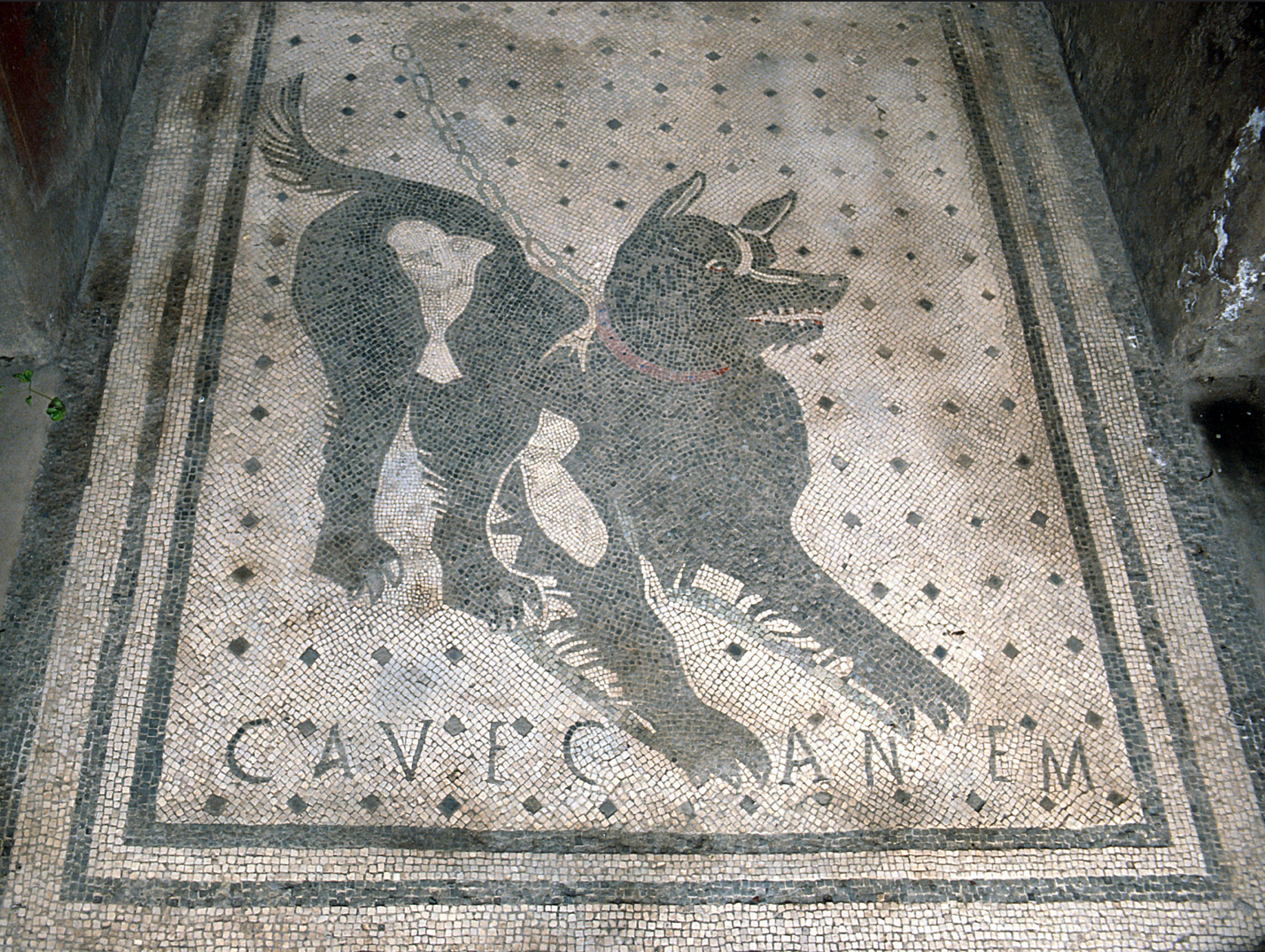
50. Pavīmentum Pompēiīs circā aditum Domūs Poētae Tragoediārum quod canem catēnātum cum īnscrīptiōne CAVE CANEM refert. A floor mosaic near the entrance to the House of the Tragic Poet in Pompeii, which represents a chained dog with the inscription, BEWARE OF DOG.
Explōrātiō Vīcēnsima Tertia (XXIII) Adventure Twenty-Three
Formation of the Pluperfect Passive Tense
The Pluperfect Tense of Deponent Verbs
Ablative of Means, Ablative of Personal Agent with a Pluperfect Passive Verb
Review of the Perfect Verb System
Displaced sum in the Perfect Passive System
Expressions of Place without a Preposition
Fourth Declension Nouns Derived from the Fourth Principal Part of the Verb
First Declension Nouns Derived from the Fourth Principal Part of the Verb
Third Declension Agent Nouns Derived from the Fourth Principal Part of the Verb
Where and When Are We Today?
Bāiae, Ītalia
Mēnsis September
Nerōne Claudiō Caesare Augustō Germānicō L. Calpurniō Pīsōne cōnsulibus
Baiae, Italy
September, 57 CE
There was not a soul in sight on the beach. Gazing out at the sand and the sea and the endless waves, I wondered for a moment whether we were really in the past, or whether Latinitas was pulling a trick on me. I turned around to look for signs of the ancient world and was surprised at how few I could see. The various donkeys tied up here and there, waiting to serve as rides, were the most obvious indicator, along with the bits of classical ornamentation on the beach villas stacked on the steep hill rising behind us. All the other clues were absences: there was not a flicker of metal anywhere, no wire, plastic, or clear glass, no bright paints, no motor vehicles, no bicycles, no signage. But the walls surrounding the villas could have been built yesterday or a thousand years ago, and the roofs, with their distinctively scalloped roof tiles, were another almost timeless feature.
We moved toward the hill. One of the aftereffects of my illness was trouble climbing stairs, so I groaned when Latinitas pointed to the steep path she wanted us to take to the villas. To make the climb easier, she had me take a break every twenty gradūs, every twenty steps. Ūnus, duo, trēs, quattuor, quīnque, sex, septem, octō, novem, decem, ūndecim, duodecim, tredecim, quattuordecim, quīndecim, sēdecim, septendecim, duodēvīgintī, ūndēvīgintī, vīgintī, she said, then, pausa, and she waited for me to get my breath. Reader, I would appreciate it if you could recite these numbers a few times in memory of my struggle.
After a few cycles of climb and rest we reached the lowest villa on the path. The gate was unlocked, and we went in; a guard dog put its tail between its legs and ran away as soon as it saw Latinitas. We sat down in the portico on a pair of wooden stools, shaded by a massive grape-vine that suspended dark, ripe clusters of fruit over our heads.
“This villa used to belong to the famous doctor Cornelius Celsus, whose work Dē Medicīnā can still be found in any good library. Celsus left the villa in his will to his nephew, and his nephew is spending the day with his family in Neapolis – the city you call Naples – just a few miles from here, beyond this ridge. The only human beings on the property right now are the vīlicus, the house manager, and the ancilla, the maid, who are out in the garden, sleeping. They are, by the way, enslaved persons, and they are doing what any human being in similar circumstances would do: enjoy the blessing of sleep whenever the opportunity arises.”
Pluperfect Passive Verb Tense
“Now take out your book,” she said, with that tone of voice that always meant incoming grammar. “Today we are going to study one more set of verb forms, those of the pluperfect passive tense. If you remember the perfect passive and the pluperfect active, you will have no trouble learning these forms. The English pluperfect passive always contains the words ‘had been’, as in ‘Rome had been visited’, ‘the job had been done’; ‘had’ indicates pluperfect, ‘been verbed’ indicates passive voice. The Latin Pluperfect Passive is a two-word form which consists of the perfect passive participle plus the imperfect tense forms of sum. It looks like this:”
Formation of the Pluperfect Passive Tense
Conjugation of amō, amāre, amāvī, amātus (‘to love’), in the Pluperfect Passive Tense
| Perfect Passive Forms | English Translation | |||
|---|---|---|---|---|
| Person | Singular | Plural | Singular | Plural |
| 1st | amātus/a/um eram | amātī/ae/a erāmus | I had been loved | we had been loved |
| 2nd | amātus/a/um erās | amātī/ae/a erātis | you had been loved | you all had been loved |
| 3rd | amātus/a/um erat | amātī/ae/a erant | he/she/it had been loved | they had been loved |
“Remember: the participle must agree with the subject of the sentence in gender and number. For example, if the subject is a girl, puella, then you would use amāta (feminine, nominative, singular); if the subject is a group of men, then you would use amātī (masculine, nominative, plural).”
“All verbs with a fourth principal part follow the same pattern. So that you can distinguish them, let’s compare the pluperfect active and passive:”
Pluperfect Active and Pluperfect Passive, Compared
| Pluperfect Active | English Meaning | Pluperfect Passive | English Meaning |
|---|---|---|---|
| amāveram | I had loved | amātus/a/um eram | I had been loved |
| mōveram | I had moved | mōtus/a/um eram | I had been moved |
| dūxeram | I had led | ductus/a/um eram | I had been led |
| audīveram | I had heard | audītus/a/um eram | I had been heard |
| cēperam | I had taken | captus/a/um eram | I had been taken |
The Pluperfect Tense of Deponent Verbs
“Deponent verbs form their pluperfect tense the same as other verbs form the pluperfect passive tense – a nominative perfect passive participle plus an imperfect form of sum – but this form is active in meaning for a deponent:”
Pluperfect Tense of Deponent Verbs
| Pluperfect Form | English Meaning |
|---|---|
| mīrātus/a/um eram | I had admired |
| mortuus/a/um eram | I had died |
| precātus/a/um eram | I had prayed |
| secūtus/a/um eram | I had followed |
Drill
“Now try to translate these examples, first from Latin into English, then vice-versa:”
| Latin | English Translation |
|---|---|
| vocātus eram; līberātae erātis; audīta erant; docta erās; secūtī erāmus | |
| you (fem.) had been sought; we (masc.) had been pressed; they (masc.) had been led; it had been said |
Ablative of Means, Ablative of Personal Agent with a Pluperfect Passive Verb
“Because the pluperfect passive tense is passive voice, it sometimes will include an ablative of means or ablative of personal agent (ā/ab + ablative). For example: Mīles ā rēge missus erat. ‘The soldier had been sent by the king.’ Nōs timōre victī erāmus. ‘We had been conquered by fear’.”
Exercises 1-5
1. Haec nāta ā parentibus manēre iussa erat.
2. Exercitus ille victus erat potestāte populī Rōmānī.
3. Bella terrā et marī ab Augustō saepe gesta erant.
4. Moenia in quibus multa scrīpta erant usque ad noctem spectābāmus.
5. A chariot had come to the city and an army had been prepared by our chief.
Review of the Perfect Verb System
“So now you know the perfect active and perfect passive and the pluperfect active and pluperfect passive. Let’s review the formation and translation of each:”
Drill
Perfect Active: Perfect Stem + Perfect Active Endings; ‘I verbed / I have verbed’
| Latin | English |
|---|---|
| posuēre; iussit; I have moved; we heard |
Pluperfect Active: Perfect Stem + Imperfect Forms of sum as Endings; ‘I had verbed’
| posuerant; iusserat; I had moved; we had heard |
Perfect Passive: Nom. Perfect Passive Participle + Present Forms of sum; ‘I was verbed / I have been verbed’
| positī sunt; iussa est; I have been moved; we were heard |
Pluperfect Passive: Nom. Perfect Passive Participle + Imperfect Forms of sum; ‘I had been verbed’
| positī erant; iussa erat; I had been moved; we had been heard |
Displaced sum in the Perfect Passive System
“There is one more thing you need to know about perfect and pluperfect passive verbs in Latin. Romans did not always put the form of sum right after the nominative perfect passive participle. Sometimes it came before the participle, sometimes it came even earlier or later in the sentence. When this happens, you must mentally put the two words together before you can translate the verb.”
Examples of Displaced sum in the Perfect Passive System
“In the following examples, the nominative participle and form of sum are in bold:”
Trāditī cīvēs hostibus sunt.
The citizens were handed over / have been handed over to the enemy.
Litterae erant in moenibus scrīptae.
Letters had been written on the walls.
Exercises 6-8
6. Saepe nōs ductī usque ad mare sumus.
7. Mē dē bellīs quae erant ab Caesare gessa docuērunt.
8. Parum pudīcus esse nōbīs vīsus hic iuvenis est.
Expressions of Place without a Preposition
“As you know, expressions of place often require a preposition: in + acc. ‘into’, per + acc. ‘through’, in + abl. ‘in’, ‘on’, ē / ex + abl. ‘out of’, and so forth. With a few words, such as domus ‘house’, rūs ‘countryside’, and the names of cities like Rōma ‘Rome’ the preposition is typically omitted.”
Vocabulary
First Declension Noun
| Latin Noun | Noun Gender | English Meaning |
|---|---|---|
| Rōma, Rōmae (locative Rōmae) | f. | Rome “No preposition needed.” |
Third Declension Noun
| Latin Noun | Noun Gender | English Meaning |
|---|---|---|
| rūs, rūris (locative rūrī or rūre) | n. | countryside “No preposition needed.” |
Fourth /Second Declension Noun
| Latin Noun | Noun Gender | English Meaning |
|---|---|---|
| domus, domūs or domī (locative domī) | f. | house; home “No preposition needed. This noun sometimes has second declension forms: e.g. domō ‘from home’.” |
Expressions of Place without a Preposition: Examples
Rūre rediimus.
We returned from the countryside.
Domum Cicerōnis veniō.
I come to the house of Cicero.
Virgō Rōmā discēdet.
The young woman will depart from Rome.
The Locative Case
“There are a few common nouns in Latin, as well as many city names, that have a special case form called the locative. This form expresses location: ‘at’ or ‘in’ the place named by the locative word. The three words you just learned each have a vocative form: Rōmae ‘at/in Rome’, rūrī or rūre ‘at/in the countryside’, and domī ‘at home / in the house’.”
Locative Case Forms
“The locative case form is identical with either the genitive or the ablative form, as follows:”
First Declension
Locative Singular Form = Genitive Singular Form: -ae
Locative Plural Form = Ablative Plural Form: -īs
Example: Rōmae ‘at/in Rome’ from the noun Rōma, Rōmae, f.
Second Declension
Locative Singular Form = Genitive Singular Form: -ī
Locative Plural Form = Ablative Plural Form: -īs
Example: Pompēiīs ‘at/in Pompeii’ from the noun Pompēiī, Pompēiōrum, m.
Third Declension
Locative Singular Form = Ablative Singular Form: -e, -ī
Locative Plural Form = Ablative Plural Form: -ibus
Example: Carthāgine ‘at/in Carthage’ from the noun Carthāgō, Carthāginis, f.
Exercises 9-13
9. Hunc diem rūre agam trīstis et sine amātō meō.
10. Rōmae beneficium hoc habēbis; difficile est Pompēiīs.
11. Negōtiō gestō, uterque domum suam discessit.
12. The youth desired to go to Rome.
13. Children, women, and slaves fled from the houses.
“Now let us work on some more vocabulary:”
Vocabulary
A-Verb (First Conjugation)
| Latin Verb | English Meaning |
|---|---|
| intrō, intrāre, intrāvī, intrātus | to enter |
E-Verbs (Second Conjugation)
| Latin Verb | English Meaning |
|---|---|
| caveō, cavēre, cāvī, cautus | to beware of “The imperative is often spelledcave.” |
| fleō, flēre, flēvī, flētus | to weep; weep for |
| rīdeō, rīdēre, rīsī, rīsus | to laugh; smile; laugh at |
| teneō, tenēre, tenuī, tentus | to hold; occupy; control |
I-Verbs (Third Conjugation)
| Latin Verb | English Meaning |
|---|---|
| frangō, frangere, frēgī, frāctus | to break |
| pingō, pingere, pinxī, pictus | to paint |
Mixed I-Verb (Third Conjugation -iō)
| Latin Verb | English Meaning |
|---|---|
| rapiō, rapere, rapuī, raptus | to seize; to hurry along |
Fourth Declension Nouns Derived from the Fourth Principal Part of the Verb
“Many Latin nouns are made from the fourth principal part of the verb. For example, some fourth declension nouns take their nominative singular form from the fourth principal part of a verb, like this one:
| Fourth Declension Noun | English Meaning | Verb Derived from |
|---|---|---|
| flētus, flētūs, m. | weeping | fleō, flēre, flēvī, flētus |
“So, if you see these fourth declension nouns, you can readily translate them if you recognize the verb from which they each derive:”
| Fourth Declension Noun | English Meaning | Verb Derived From |
|---|---|---|
| iussus, iussūs, m. | order | iubeō, iubēre, iussī, iussus |
| aditus, aditūs, m. | approach; entrance | adeō, adīre, adiī, aditus |
| exitus, exitūs, m. | departure; exit | exeō, exīre, exiī, exitus |
| sēnsus, sēnsūs, m. | perception; feeling | sentiō, sentīre, sēnsī, sēnsus |
First Declension Nouns Derived from the Fourth Principal Part of the Verb
“Some first declension nouns derive from the stem of the fourth principal part of a verb, with the nominative singular ending -ūra. For example:”
| First Declension Noun | English Meaning | Verb Derived from |
|---|---|---|
| pictūra, pictūrae, f. | picture; painting | pingō, pingere, pinxī, pictus |
| statūra, statūrae, f. | stature | stō, stāre, stetī, status |
Third Declension Agent Nouns Derived from the Fourth Principal Part of the Verb
“Some third declension nouns that describe agents derive from the the stem of the fourth principal part of a verb, with the nominative singular ending -or. For example:”
| Third Declension Noun | English Meaning | Verb Derived from |
|---|---|---|
| pictor, pictōris, m. | painter | pingō, pingere, pinxī, pictus |
| scrīptor, scrīptōris, m. | writer | scrībō, scrībere, scrīpsī, scrīptus |
| victor, victōris, m. | victor | vincō, vincere, vīcī, victus |
Exercises 14-19
14. Iuvenis arma manū rapuit et vestīgia secūtus est.
15. Cave perīcula haec, aut flēbis sine fīne.
16. Nerō princeps iusserat colossēum sē pingī (sed statūra eius media fuit). “The adjective colossēus, -a, -um means ‘colossal’, ‘huge’.”
17. Facinus maximum factum erat: vulnera accepta erant, corpora erant frācta, mortuī multī erant.
18. Mulierem illam nesciō, sed mē rīsit sine pudōre.
19. Both the painter and the writer, fearing the orders of the leader, were silent.
Vocabulary
Third Declension Nouns
| Latin Noun | Noun Gender | English Meaning |
|---|---|---|
| canis, canis “I-stem.” | m./f. | dog |
| līmen, līminis | n. | threshold |
US-A-UM Adjectives (First and Second Declension Adjectives)
| Latin Adjective | English Meaning |
|---|---|
| argenteus, argentea, argenteum | (made of) silver “Derived from the nounargentum, argent-ī, n. ‘silver’.” |
| aureus, aurea, aureum | (made of) gold; golden “Derived from the nounaurum,aur-ī, n. ‘gold’.” |
| varius, varia, varium | various; multicolored |
Numeral
| Latin Numeral | English Meaning |
|---|---|
| centum | one hundred |
Conjunction
| Latin Conjunction | English Meaning |
|---|---|
| autem | however; moreover “Never the first word in a clause.” |
Adverbs
| Latin Adverb | English Meaning |
|---|---|
| longē | far; by far |
| paene | almost |
| quidem | indeed “Usually placed after the word it emphasizes.” |
Prepositions
| Latin Preposition + Case | English Meaning |
|---|---|
| ob + acc. | facing; in front of; because of |
| super + acc. | above; over “Also used as an adverb, meaning ‘overhead’, ‘above’.” |
Exercises 20-24
20. Varia est fortūna bellī, ut ferunt.
21. Ob eam rem, inquam, līberāvit paene centum servōs quōs tenuerat.
22. Sī quisquam domum intrat sine iussū dominī, cave canem in līmine.
23. Ego autem relictus nōn longē ab marī eram, cum vīsus Apollō super caput meum est. “The name of the Greek god is Apollō, Apollinis, m. in Latin.”
24. With silver and golden (things) (having been) seized, the leader returned home a victor.
“Now let’s check out another villa. Venī!”
Petronius
We walked a few hundred feet to another villa maritima. From a distance it looked a lot like Celsus’; but what we saw inside it was, to say the least, very different. The owner was Titus Petrōnius – you might generously call him a collector, or, more honestly, a hoarder. The villa was stuffed with statuary: countless portrait busts, some groups of figures, and hundreds and hundreds of little figurines in wooden cabinets. There were also thousands of little frīvola, or tchotchkes: glass bottle and vases, cameos, seashells, stones, wooden statues, gems, and paintings.
A lot of the figures were erotic or pornographic; they included single figures, pairs, and groups in suggestive poses. The next room we entered – I don’t know what to call it exactly, other than to say it was a sex room. There was a giant mosaic on the floor that showed a goat-footed Pan having intercourse with a Nymph. On the walls there were paintings of the twelve Olympian gods, all in pairs, all having sex: Jupiter and Juno, Mars and Venus, Hermes and Leto, even Neptune and Apollo! It seemed completely blasphemous to me, but we couldn’t help but laugh, it was so over the top. There were couches and blankets and drinking cups everywhere, and on the ceiling, a large silver mirror flecked with black tarnish spots, which could clearly use a good cleaning.
From there we passed into the dining room. There were eight people there, all sound asleep. I panicked when I almost knocked a statue over, but not one of them stirred at the noise. Latinitas pointed to the man on the head couch, who was sleeping there with his lover, and whispered, Ecce, Petrōnius, scrīptor fābulārum, behold, Petronius, the writer of tales.
Petronius’ Satyrica
Petronius was wrapped up in his toga, but he seemed to be in his late 30s, very tall, with a heavy five-o’clock shadow, heavy-set eyes, and a big mass of hair; he had something of a pirate look about him. He is remembered now as the oldest Roman novelist whose work survives – though only part of it does. The Satyrica (or Satyricōn), as it called, narrates the adventures of a man named Encolpius and his slave Giton, who is also his teenage lover. The most famous part of the novel describes their visit to the house of a wealthy freedman named Trimalchio. Trimalchio was supposedly the model for F. Scott Fitzgerald’s Gatsby in the novel of that name, though personally I don’t see a strong resemblance, other than the fact that both are ostentatiously rich. It’s an amazing story, nevertheless, and reading it really makes you feel like you are in the ancient world.
Latinitas next led me to the library where Petronius worked. It too was full of books and statues, but was much more organized, and without any obviously sexual materials. In fact, there was a statue of a very modest-looking Muse overlooking the room, with a pile of burnt incense at her feet. Latinitas went through Petronius’ scrolls until she found what she was looking for: his own manuscript of the Satyrica. She took out one roll and opened it for me to read. It was the description of Encolpius and Giton entering Trimalchio’s house, along with another guest named Agamemnon. With her help I finished a translation of this passage, which I have copied for you below.
Petronius’ Satyrica: Excerpt
“Identify the English translation of the Latin words in bold. If you are feeling brave, you can probably figure out all of the words.”
1) Sequimur nōs admīrātiōne iam satūrī et cum Agamemnōne ad iānuam pervenimus, in cuius poste libellus erat cum hāc īnscrīptiōne fīxus: Quisquis servus sine dominicō iussū forās exierit accipiet plāgās centum.
We follow, already full of admiration, and with Agamemnon we come to the door, on whose post a note had been fixed with this inscription: ‘Whatever slave goes outside without the master’s orders will receive one hundred lashes’.
2) In aditū autem ipsō stābat ōstiārius prasinātus, cerasīnō succīnctus cingulō, atque in lance argenteā pīsum pūrgābat. Super līmen autem cavea pendēbat aurea in quā pīca varia intrantēs salūtābat.
And in the entrance itself a doorkeeper was standing dressed in green, wearing a cherry-colored belt, and shelling peas on a silver platter. Over the threshold a golden cage was hanging in which a multicolored mockingbird was greeting (people) entering.
3) Cēterum ego dum omnia stupeō, paene resupīnātus crūra mea frēgī. Ad sinistram enim intrantibus nōn longē ab ōstiāriī cellā canis ingēns, catēnā vīnctus, in pariete erat pictus superque quadrātā litterā scrīptum CAVE CANEM. Et collēgae quidem meī rīsērunt.
However, while I was stunned at everything, I almost broke my leg falling backwards. For on the left for (people) entering, not far from the room of the doorkeeper, a huge dog, bound by a chain, had been painted on the wall, and over it, in bold letters, had been written, ‘Beware the dog!’. And indeed my colleagues laughed.
4) Ego autem collēctō spīritū nōn dēstitī tōtum parietem persequī. Erat autem vēnālicium cum titulīs pictīs, et ipse Trimalchiō capillātus cādūceum tenēbat Minervāque dūcente Rōmam intrābat.
I, however, collecting my breath, did not stop inspecting the whole wall. There was a slave-market with painted titles, and Trimalchio himself, long-haired, was holding a wand and entering Rome with Minerva leading.
5) Hinc quemadmodum ratiōcinārī didicisset, deinque dispēnsātor factus esset, omnia dīligenter cūriōsus pictor cum īnscrīptiōne reddiderat. In dēficiente vērō iam porticū levātum mentō in tribūnal excelsum Mercurius rapiēbat. Praestō erat Fortūna cornū abundantī cōpiōsa et trēs Parcae aurea pēnsa torquentēs.
Next, how he had learned to do accounts and then been made a manager, all this the careful painter had diligently shown with inscriptions. At the end of the portico Mercury was hurrying him along, lifting him up by the chin onto a high judge’s chair. Right there was a well-provisioned Fortune with a horn of abundance, and three Fates twisting golden wool.
6) Notāvī etiam in porticū gregem cursōrum cum magistrō sē exercentem. Praetereā grande armārium in angulō vīdī, in cuius aediculā erant Larēs argenteī positī Venerisque signum marmoreum et pyxis aurea nōn pusilla, in quā barbam ipsīus condītam esse dīcēbant. Interrogāre ergō ātriēnsem coepī, quās in mediō pictūrās habērent. ‘Īliada et Odyssian, inquit, ac Laenātis gladiātōrium mūnus.’
I also noticed in the portico a gang of runners working out with their trainer. Beyond that I saw a large cabinet in the corner, in whose shrine had been placed silver Lares and a marble statue of Venus and a golden box, not small, in which they said the beard of the master was stored. So, I began to ask the atrium manager what kind of paintings they had on display. ‘The Iliad and the Odyssey’, he said, ‘and Laenas’ gladiatorial show.’
I highly recommend reading the rest of this story; some parts of it are horrifying, some are quite funny. Petronius was in real life a friend of the emperor Nero, and gave him advice about his art collection, among other things. In 65 CE he was suspected of disloyalty, and Nero ordered him to commit suicide. He did so – but not before compiling a list of the emperor’s lovers, and making sure it circulated.
It was nerve-racking, tiptoeing around someone’s house, so I was glad to get back home. And now, reader, I must confess to a crime. While we were exploring Petronius’ house, I took one of the figurines – a small grinning Cupid riding on a rooster – and hid it in the pocket of my robe. There were so many of them I didn’t think anyone would notice the absence of one.
But when I returned to my apartment and held it up to the light, I found the look on the Cupid’s face to be rather sinister, almost devilish. Maybe because it spooked me, or maybe because I felt guilty, I took it down to the river and threw it in the water, where I hope no one ever finds it. You really shouldn’t steal physical objects that come from the ancient world. Ancient stories, however, are different – they belong to everyone.
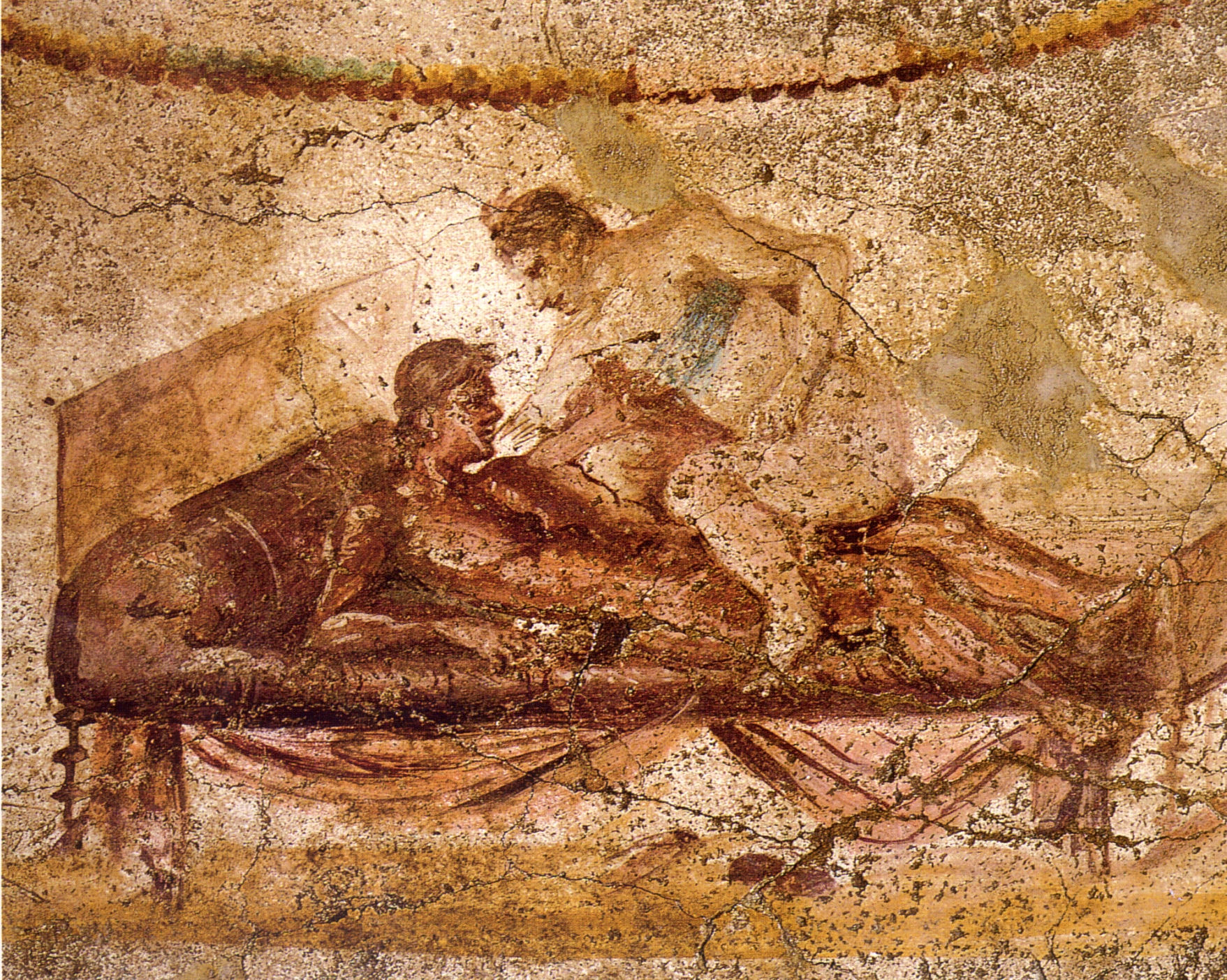
51. Fresco painting from the wall of a lupānar or brothel in Pompeii depicting a couple having sex.