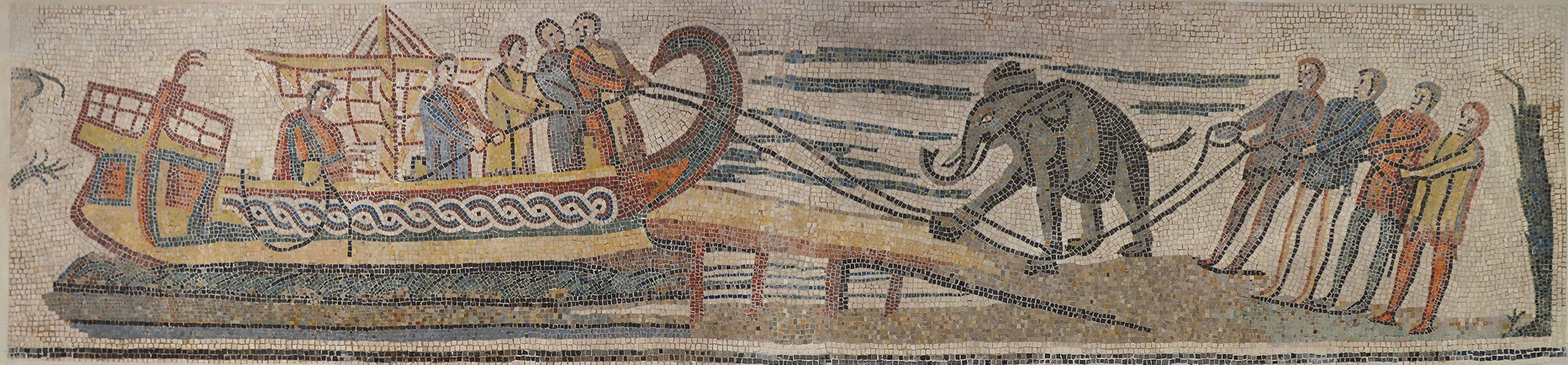
43. A Roman mosaic, circa 300 CE, from Veii, Italy, showing an elephant being loaded onto a ship. Elephantus in nāvem ab plūribus dūcitur, the elephant is being led onto the ship by several (men).
Explōrātiō Vīcēnsima (XX) Adventure Twenty
Third Declension Adjectives, Continued
Third Declension Adjectives with One Nominative Singular Form
Present Active Participle Forms
Present Active Participle Examples
Present Active Participles from Deponent Verbs
Drill: Participles: Nominative and Genitive
Drill: Translating Participles
Ablative Absolute with a Present Active Participle
Translating an Ablative Absolute with a Present Active Participle
Reading: The Signs of the Zodiac
Manilius, Astronomica: The Influence of Ursa Major
Manilius, Astronomica: The Influence of Pisces
Manilius, Astronomica: The Influence of the Hare
Where and When Are We Today?
Ōstia, Ītalia
Mēnsis Augustus
Drūsō Iūliō Caesare C. Norbānō Flaccō cōnsulibus
Ostia, Italy
August, 15 CE
Mud, mud, mud. Everywhere we looked, people were shoveling mud out of their houses, shops, and temples. Its flash flood may have receded, but the Tiber river was still running high and frothy, with large tree trunks torn away from hillsides upstream piled all along its shore. Quantum lutī! So much mud! Latinitas gestured as she led me on a path along the riverbank. Normally, when the river was calm, teams of mules and oxen would be using this path to tow barges full of goods from the port behind us – Ostia – upstream to the city of Rome, where those goods would be stored in warehouses before being distributed; but today, because of the flood, there was no traffic. Near a bend in the river, we sat down by a stabulum, a stable full of mules and oxen which were enjoying an unexpected holiday. Latinitas had me open my book. Before she could start with her lesson, I posed a question.
Do you know any fortune tellers?
“I do; why do you ask?”
Ego scīre dē vōcibus puerī cupiō, I want to know about the words of the boy. I want to learn what the words meant. Maybe they were significant. I was thinking an oracle or a fortune teller could interpret them for me.
“Fortune tellers?” she sniffed; “No, they are not very reliable. As for oracles, there are none in the city, if you are thinking of something like the oracle at Delphi. Let me think, though. Could I interest you in an astrologer?”
Do you think one could help?
“Well, they are easy to find. There are quite a few here in Ostia, for example; every so often they get expelled from the city limits of Rome by imperial decree, and when they do they come here. Many are foreigners, from Greece or Asia or Syria, and they tend to reside in Ostia’s immigrant neighborhoods. So it should not be too hard to find one.”
As we talked an ox was slowly chewing hay behind my ear. I then heard another animal sound from the other side of the stable, a more alarming one, what sounded like a lion’s growl. As I craned my neck to peer around the corner, I was surprised to see several wild animals in cages: lions, panthers, tigers, a large cinnamon-colored bear, a flock of ostriches, and an elephant standing morosely on the straw-covered mud, its right foot secured by an iron manacle. Meanwhile, on top of a brick wall some men were doing backflips and gymnastics to pass the time. Is that a circus?, I asked Latinitas.
“Very close. The acrobats and the animal tamers will be performing in the Theater of Marcellus in a few days. Sadly, most of the animals will be killed in beast hunts.”
Can we visit the animals?
“Maybe later. But I’m going to teach you something very useful now: how to use as verb as an adjective!”
I gave her a blank look, and turned back to the animals. She repeated what she said again, and this time offered me some peanuts she had stolen from my apartment to get my attention. She started with a question.
Third Declension Adjectives, Continued
“Do you remember how to interpret the vocabulary entry for an adjective like omn-is, omne or volucer, volucr-is, volucre?”
Yes, I said: third declension adjectives like omn-is, omne use the first form as the masculine and feminine nominative singular, and the second form for the neuter nominative singular. But third declension adjectives like volucer have a separate nominative singular form for each gender.
Third Declension Adjectives with One Nominative Singular Form
“Great. Now I’ll tell you that some third declension adjectives, including present active participles (which we’ll learn about shortly), have only one nominative singular form for all three genders. The most common adjective of this kind is ingēns, which means ‘huge’. In the dictionary entry for it, the first form is the nominative singular (used for all three genders), and the second is the genitive singular:”
Vocabulary
Third Declension Adjective, Single Nominative Form
| Latin Adjective | English Meaning |
|---|---|
| ingēns,ingent-is | huge |
“The rest of the forms use regular third declension adjective endings.”
Third Declension Adjective Forms: Single Nominative Form
| Gender | ||
|---|---|---|
| Singular | Masc./Fem. | Neuter |
| Nom. | ingēns | ingēns |
| Gen. | ingent-is | ingent-is |
| Dat. | ingent-ī | ingent-ī |
| Acc. | ingent-em | ingēns |
| Abl. | ingent-ī | ingent-ī |
| Plural | ||
| Nom. | ingent-ēs | ingent-ia |
| Gen. | ingent-ium | ingent-ium |
| Dat. | ingent-ibus | ingent-ibus |
| Acc. | ingent-īs /-ēs | ingent-ia |
| Abl. | ingent-ibus | ingent-ibus |
Exercises 1-2
1. Spectāte! Unda ingēns ad rēgnum sē fert.
2. He will wage a huge war with (by means of) huge forces. “For ‘forces’, use the appropriate form of the noun cōpia.”
Present Active Participles
“Now let’s learn about participles. How many verbs do you know?”
Fifty, sixty?
“In twenty minutes you’re going to increase your vocabulary by that many words!”
How are you going to do that?
“Every verb can be turned into an adjective. When a verb is turned into an adjective, it is called a participle. The Latin participles I will teach you today are called present active participles. They can be translated with the ‘–ing’ ending in English: watching, eating, throwing, catching, and so on. Like any adjective, these participles modify nouns and pronouns. A participle is also a kind of verb form, so it can, for example, govern an accusative direct object. But a participle will never be the main verb of a sentence; you need a verb with a personal ending to complete a sentence in Latin. Consider these English examples:”
English Present Active Participles, Illustrated
| throwing: ‘the boy throwing the ball...’ the participle ‘throwing’ modifies ‘the boy’ and governs the direct object ‘the ball’ |
| catching: ‘the woman catching it...’ the participle ‘catching’ modifies ‘the woman’ and governs the direct object ‘it’ |
“Notice how these phrases with participles are not yet complete sentences – they lack a main verb.”
Present Active Participle Forms
“Present active participles have third declension adjective endings. They use the same endings as the adjective ingēns, ingent-is starting with the letter -n. Sometimes, however, the ablative singular ends in -e, rather than ī. Before the letter -n- you add the same vowel(s) that you see before the syllable -ba- in the imperfect form of the verb:”
Present Active Participle, Endings with Connecting Vowels
A-Verb (1st Conjugation)
| Gender | ||
|---|---|---|
| Singular | Masc./Fem. | Neuter |
| Nom. | -āns | -āns |
| Gen. | -antis | -antis |
| Dat. | -antī | -antī |
| Acc. | -antem | -āns |
| Abl. | -antī /-ante | -antī /-ante |
| Plural | ||
| Nom. | -antēs | -antia |
| Gen. | -antium | -antium |
| Dat. | -antibus | -antibus |
| Acc. | -antīs /-antēs | -antia |
| Abl. | -antibus | -antibus |
E-Verb (2nd Conjugation) and I-Verb (3rd Conjugation)
| Gender | ||
|---|---|---|
| Singular | Masc./Fem. | Neuter |
| Nom. | -ēns | -ēns |
| Gen. | -entis | -entis |
| Dat. | -entī | -entī |
| Acc. | -entem | -ēns |
| Abl. | -entī /-ente | -entī /-ente |
| Plural | ||
| Nom. | -entēs | -entia |
| Gen. | -entium | -entium |
| Dat. | -entibus | -entibus |
| Acc. | -entīs /-entēs | -entia |
| Abl. | -entibus | -entibus |
Long I-Verb (4th Conjugation) and Mixed I-Verb (3rd Conjugation -iō)
| Gender | ||
|---|---|---|
| Singular | Masc./Fem. | Neuter |
| Nom. | -iēns | -iēns |
| Gen. | -ientis | -ientis |
| Dat. | -ientī | -ientī |
| Acc. | -ientem | -iēns |
| Abl. | -ientī /-iente | -ientī /-iente |
| Plural | ||
| Nom. | -ientēs | -ientia |
| Gen. | -ientium | -ientium |
| Dat. | -ientibus | -ientibus |
| Acc. | -ientīs /-ientēs | -ientia |
| Abl. | -ientibus | -ientibus |
Present Active Participle Examples
“Before the vowel and third declension ending goes the present stem of the verb. This is how you make a present active participle. Here is the present active participle for a sample verb from each conjugation. The first form shown, like vocāns, is the nominative singular (used for all 3 genders), while the second, vocant-is, is the genitive singular, just as we saw with the adjective ingēns, ingent-is:”
Present Active Participle Examples and Translation
| Verb Conjugation | Present Active Participle | English Translation |
|---|---|---|
| A-Verb (1st Conj.) | vocāns, vocant-is | calling |
| E-Verb (2nd Conj.) | movēns, movent-is | moving |
| I-Verb (3rd Conj.) | dūcēns, dūcent-is | leading |
| Long I-Verb (4th Conj.) | sciēns, scient-is | knowing |
| Mixed I-Verb (3rd Conj. -iō) | cupiēns, cupient-is | desiring |
Present Active Participles from Deponent Verbs
“Recall that deponent verbs, like precor, precārī, ‘to pray’, are generally passive in form but active in meaning. I say ‘generally’ because deponent verbs do make present active participles, the same as normal verbs. For example: precāns, precant-is, ‘praying’; sequēns, sequent-is, ‘following’.”
Drill
“Now you practice. Write the nominative singular and genitive singular forms in Latin for these five participles:”
| English | Latin Verb | Present Participle Nom. Sg. | Present Participle Gen. Sg. |
|---|---|---|---|
| giving | |||
| remaining | |||
| driving | |||
| not knowing | |||
| desiring |
Drill
“Now translate these phrases, and state what case(s), gender(s), and number(s) each Latin participial form could be. For example, docentium, ‘teaching’, could be the masculine, feminine, or neuter genitive plural:”
| Case | Gender | Number | Translation | |
|---|---|---|---|---|
| errāns | ||||
| moventia | ||||
| dīcentibus | ||||
| fugientis | ||||
| tibi videntī | ||||
| virōs stantīs | ||||
| elephantus cēdēns | ||||
| I, seeking | ||||
| him fleeing | ||||
| with moving limbs |
Exercises 3-7
“Let’s try some complete sentences now.”
3. Puerōs nūmen illud laudantēs cernō et mīror.
4. Ille dux urbem capere cupiēns nōn cēdet.
5. Errantēs mediam per urbem sapientem multa dīcentem audīvimus.
6. Eandem viam virgō illa sequēns ad hanc sēdem advēnit.
7. Ad tē adveniō spem, salūtem, auxilium, cōnsilium expetēns.
“This is a sentence that you know from Terence. Expetēns is from expetō, expetere, ‘to seek out’; salūtem is from salūs, salūtis, f., ‘safety, salvation’. ”
The ox started licking my neck, so we relocated to the other side of the stable, where we could watch the animals and the performers while we continued.
Ablative Absolute with a Present Active Participle
“Latin speakers can add to a sentence a verbal idea, like the time or context in which something took place, by using two ablative words in agreement. One ablative acts like a subject, and the second like a predicate: ‘(with) [ablative] (being) [ablative]’, or ‘when [ablative] is/was [ablative]’. (Use ‘was’ if the verb of the sentence is past tense, otherwise use ‘is’.) We talked about this on the day we studied Caesar: tē duce, ‘when you are/were the leader’ (more literally, ‘with you (being/as) leader’, nōbīs cōnsulibus ‘when we are/were consuls’ (more literally, ‘with us (being/as) consuls’). Such a pair of ablative words is called an ablative absolute.”
Translating an Ablative Absolute with a Present Active Participle
“A very common form of ablative absolute consists of an ablative noun or pronoun modified by an ablative present active participle in agreement. Such an ablative absolute literally means ‘(with) X (ablative noun/pronoun) verbing (ablative present active participle)’. But you can express this more idiomatically in English: ‘when X verbs’ or ‘when X was verbing’. Use the present tense to translate the participle when the main verb of the sentence is present or future tense; otherwise use the past tense. When translating, you can also infer how the verbal idea of the ablative absolute connects to the rest of the sentence: instead of ‘when’, you can also try ‘while’, ‘because’, or ‘although’.”
“Note that the ablative singular form of the present active participle will usually end with -e instead of -ī when it is used in an ablative absolute.”
Ablative Absolute with a Present Active Participle: Examples
| Gender | ||
|---|---|---|
| Singular | Masc./Fem. | Neuter |
| Nom. | -iēns | -iēns |
| Gen. | -ientis | -ientis |
| Dat. | -ientī | -ientī |
| Acc. | -ientem | -iēns |
| Abl. | -ientī /-iente | -ientī /-iente |
| Plural | ||
| Nom. | -ientēs | -ientia |
| Gen. | -ientium | -ientium |
| Dat. | -ientibus | -ientibus |
| Acc. | -ientīs /-ientēs | -ientia |
| Abl. | -ientibus | -ientibus |
Exercises 8-13
8. Nocte adhūc cadente, ad castra advēnimus.
9. Cōpiīs cēdentibus, dux fugit.
10. Nōbīs iuvantibus, urbem servāre poterātis.
11. Omnibus audientibus dīcere incipiam.
12. Nūllō dūcente, errāmus et viam invenīre nōn possumus.
13. Paucīs mīlitum sequentibus ille rediit.
“Now copy down these vocabulary words:”
Vocabulary
A-Verb (First Conjugation)
| Latin Verb | English Meaning |
|---|---|
| putō,putāre,putāvī | to think; reckon |
I-Verbs (Third Conjugation)
| Latin Verb | English Meaning |
|---|---|
| mittō, mittere, mīsī | to send; let go |
| vincō, vincere, vīcī | to conquer |
| solvō, solvere, solvī | to release; dissolve |
Exercises 14-17
14. Solvite hōs hominēs, nam nōbilēs sunt.
15. Putāns alteram viam malam esse, alterā viā īvit.
16. Omnem timōrem mittēns, ad fēminam illam hās litterās mīsī.
17. Labor conquers all (things).
Vocabulary
Second Declension Noun
| Latin Noun | Noun Gender | English Meaning |
|---|---|---|
| somnus, somn-ī | m. | sleep |
Second Declension Neuter Nouns
| Latin Noun | Noun Gender | English Meaning |
|---|---|---|
| negōtium, negōti-ī | n. | business |
| ōtium, ōti-ī | n. | leisure |
Third Declension Noun
| Latin Noun | Noun Gender | English Meaning |
|---|---|---|
| frōns, front-is | f. | forehead; front |
| orbis, orb-is | m. | circle. “I-stem.” |
Third Declension Neuter Nouns
| Latin Noun | Noun Gender | English Meaning |
|---|---|---|
| aequor, aequor-is | n. | sea; plain |
| animal, animāl-is | n. | animal. “I-stem.” |
| lītus, lītor-is | n. | shore |
| pondus, ponder-is | n. | weight |
Fourth Declension Noun
| Latin Noun | Noun Gender | English Meaning |
|---|---|---|
| fluctus, fluct-ūs | m. | wave |
Exercises 18-21
18. Cūrae et negōtia somnum cōgitantium miscent.
19. Illīs nūllum ōtium est; nam pondere dolōris vincuntur.
20. Animālia saeva in illīs agrīs vīvunt.
21. Aequor in illō lītore spectāns, per fluctūs magnam mīsī vōcem.
Vocabulary
US-A-UM Adjective (First and Second Declension Adjective)
| Latin Adjective | English Meaning |
|---|---|
| aliēnus, aliēn-a, aliēnum | alien; another’s; belonging to another |
Third Declension Adjectives
| Latin Adjective | English Meaning |
|---|---|
| difficil-is, difficile | difficult |
| facil-is, facile | easy |
| fort-is, forte | brave |
| trīst-is, trīste | sad; sorrowful; gloomy; depressing |
| turp-is, turpe | ugly; shameful |
Exercises 22-26
22. Trīstis es. Facile est vidēre ex vultū et oculīs et fronte.
23. Equitēs orbem facientēs sē dēfendere poterant. “The I-verb dēfendō, dēfend-ere, dēfend-ī means ‘to defend’.”
24. Dēficiente spē omnī, iter difficile parō atque turpe.
25. Homō sum; hūmānī nīl ā mē aliēnum putō. “From Terence.”
26. Fortune helps the brave (men).
“Ah, there is your astrologer,” she said, pointing.
Manilius
The man she indicated, who was standing near the circus performers, looked to be in his fifties. He had a long pointed beard, a beautifully carved wooden staff, a broad-brimmed hat, and a vest over his cloak that was decorated with images of seven gods who represented the seven ‘planets’ the Romans knew: Lūna, or the Moon, plus Mars, Mercury, Jupiter, Venus, Saturn, and Sōl, the Sun.
“That is Mārcus Mānīlius. The Roman son of a Syrian immigrant, he is an astrologer and a poet. He makes his living selling astrological forecasts to clients. Today he is out trying to drum up business with free samples – little poems that forecast the personality and careers of people based on the constellations that were rising when they were born. He is currently working on a longer poem, the Astronomica, that will serve as a kind of free sample for clients that outlines his astrological system. You can still read it today.”
The circus performers were listening as he gave them a lecture on astrology. Manilius had what looked like a game board in front of him, covered in mysterious figures that were arranged in concentric circles. There were seven colored stones on it which he would move around from time to time. At one point I heard him say, Stellae orbēs per haec duodecim signa faciunt, ‘The stars make circles through these twelve signs.’ That clue allowed me to figure out what some of the mysterious figures were:
The Zodiac
| Latin (Nom. Form) | English Meaning |
|---|---|
| Ariēs | The Ram |
| Piscēs | The Fishes |
| Aquārius | The Water-Bearer |
| Capricornus | The One with Goat Horns |
| Sagittārius | The Archer |
| Scorpius | The Scorpion |
| Lībra | The Scales |
| Virgō | The Virgin |
| Leō | The Lion |
| Cancer | The Crab |
| Geminī | The Twins |
| Taurus | The Bull |
Reading: The Signs of the Zodiac
- Hoc signum aquam fert et fundit.
- Sīdera haec per aquas natant et in flūminibus et fluctibus vīvunt.
- Signum hoc est animal horribile et saevum; multōs pedēs habet et caudam magnam et acūtam.
- Ea est fēmina quae neque māter neque puella est, sed quae iuvenis est. Nūllum virum habet.
- Aliud animal est hoc signum. Animal est quod semper virīle, numquam muliebre est. Magnus est et cornua habet. Magnam quoque īram habet, nam sagittās Amōris sentit sed vīvit procul ab eīs quās amat.
- Hīs quattuor manūs et quattuor membra pedēsque sunt. Quattuor quoque oculōs et aurēs habent. Duo capita habent, nam duo sunt; sed alterī alter īdem est.
- Hoc signum est animal quod multa membra habet. Dūrum est tergum eius, et manūs magnās atque acūtās habet. Itaque animālia alia hoc nōn vincunt.
- Hic in medium diem dormit (somnum amat), et saepe mollis et dulcis est faciēs eius. Sed eī interdum magna vōx est, et terribile est ōs eius.
- Hoc signum est animal quod semper est virīle, numquam muliebre. In capite magna et flexa cornua fert. Sī sunt duo eōrum animālium, conveniunt et cornibus bellum gerunt.
- Signum hoc est mīles aut vēnātor. Vēnātor est quī animālia petit et ea capere cupit. Sed dīmidium huius vēnātōris est homō, dīmidium alterum equus. Arma quae pharetra habet huic nōmen suum dant.
- Hoc signum pondus fert – vel duo pondera. Habet duo lancēs quae pondera ferunt. In alteram lancem alia ponere potes, in alteram alia. Imāgō iūris est.
- Animal aliud est hoc signum. In capite magna et flexa cornua fert. Sed dīmidium huius animālis est piscis. Dīmidium alterum huic nōmen dat.
At the end of his speech, he asked them, Quis carmen dēsīderat? Who wants a poem? When they nodded, Manilius furrowed his frōns and, after a short interval of deep thought, recited a poem that he scrawled on a piece of parchment and handed to them. (He had composed these poems in advance; a collection of them is included at the end of his Astronomica.) This one said that circus performers are born when the constellation of Ursa Major, the Great Bear, is in the sky.
Manilius, Astronomica: The Influence of Ursa Major
“See how many Latin words you can recognize in this passage – there is one present active participle, too:”
1) Ille manū vastōs poterit frēnāre leōnēs
et palpāre lupōs, panthērīs lūdere captīs,
nec fugiet validās cognātī sīderis ursās
inque artēs hominum perversaque mūnera dūcet.
That man, with his hand, will be able to rein in massive lions,
and to pet wolves, to play with captive panthers,
nor will he flee the strong bears from the constellation that is his relative;
he will lead them to human skills and perverse gifts.
2) Ille elephanta premet dorsō stimulīsque movēbit
turpiter in tantō cēdentem pondere pūnctīs.
Ille tigrim rabiē solvet pācīque domābit,
quaeque alia īnfestant furiīs animālia terrās
iunget amīcitiā sēcum.
That man will stand on the elephant’s back and move him with his prod,
the elephant, with so much weight, yielding shamefully to its point!
That man will free the tiger from madness and tame him with peace;
and the other animals which infest the lands with their fury
he will join to himself in friendship.
Manilius then packed up his board and left. We followed him to a tavern where a group of fishermen were enjoying their holiday and drinking wine. After repeating his lecture and getting what looked like a juicy fish wrapped in paper as a gift, he recited a poem explaining that fishermen are born when Pisces rises.
Manilius, Astronomica: The Influence of Pisces
Manilius’ next stop was an open space across from the tavern where a crowd was watching some young men throw leather balls around, along with a juggler who was the main focus of attention. The astrologer watched him perform for a while, and then recited these verses.
Manilius, Astronomica: The Influence of the Hare
“In this last selection, identify the English translation for the Latin words in bold:”
1) ille potēns turbā perfundere membra pilārum
per tōtumque vagās corpus dispōnere palmās,
That one is capable of covering his limbs with a crowd of balls
and putting ‘hands’ at random all across his body
2) ut teneat tantōs orbēs sibique ipse relūdat
et velut ēdoctōs iubeat volitāre per ipsum.
so that he can keep the big circles up and play on his own against himself
and order them to fly, as if obedient, across his person.
3) invigilat cūrīs, somnōs industria vincit,
ōtia per variōs exercet dulcia lūsūs.
He keeps awake at his concerns; diligence conquers his sleep;
in different kinds of games he employs his sweet free time.
The crowd clapped for him and the juggler took a bow.
I decided, however, that I had gotten a sense of the astrologer’s art, and we departed.
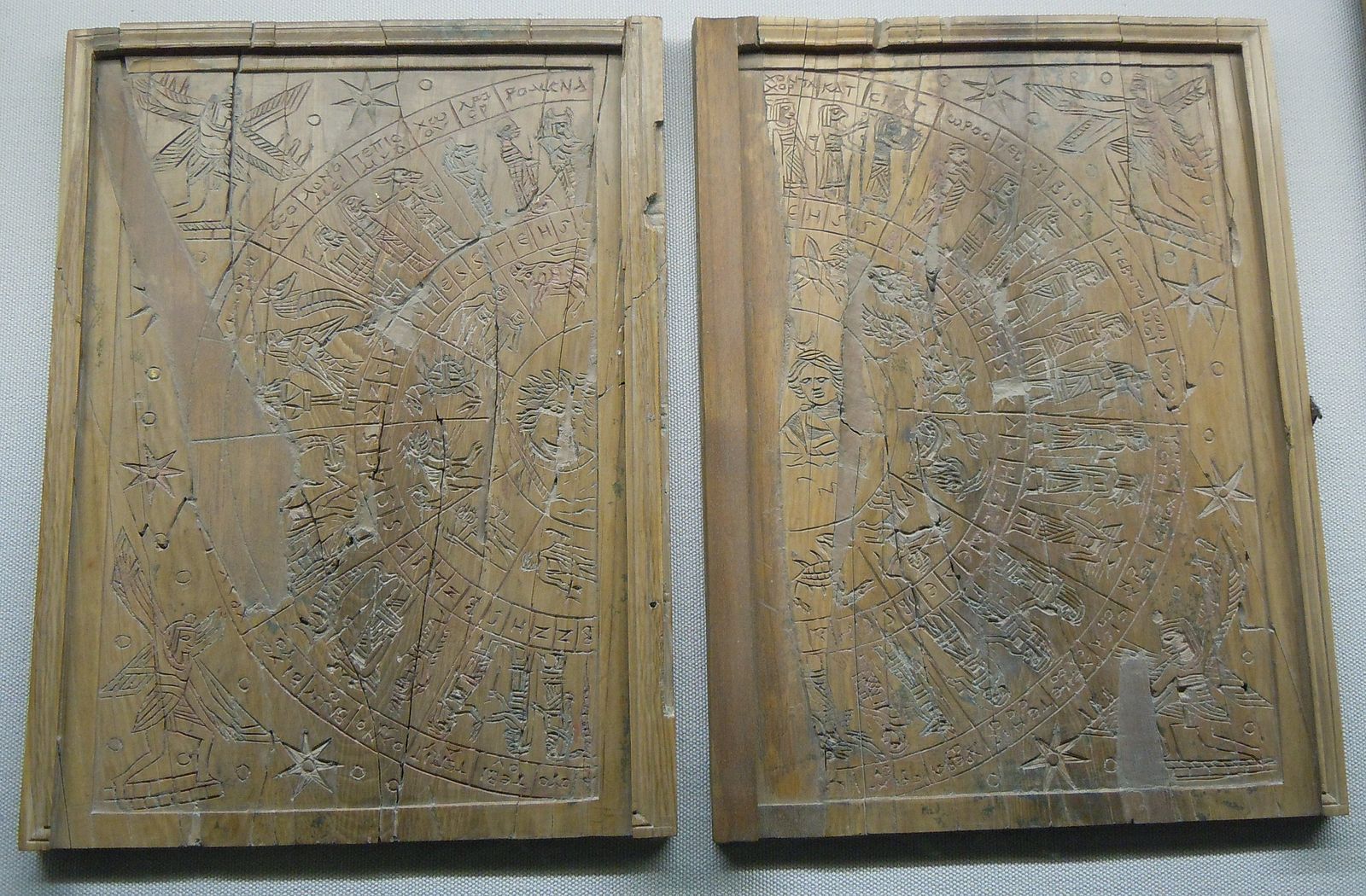
44. Tabula astronomica, an astrologer’s table, dating to the second century CE, from Grand, France. Sōl et lūna in mediō inscrīptī sunt, duodecim signa circa eōs, deinde decānī Aegyptiī sex et trīgintā, the sun and moon are inscribed in the center, the twelve zodiacal signs outside them, then the thirty-six Egyptian decans. Colored stones representing the planets would be placed on the board when casting horoscopes.