Chapter 4: Nurturing the virtues of people

This chapter focuses on engagement with the self in systems analysis by utilizing Bronfenbrenner’s ecological systems model. You are learning about models and theories that prioritize strengths-based, systemic analyses and offer alternative and complementary perspectives of people and communities that have been problematized and labeled “at risk” in the field of psychology. You will reflect on and analyze your relationship with self, family, community, society, and culture during the particular time they exist. Finally, you are introduced to strengths-based assessments and interventions.
Learning Objectives:
- Think critically in your approach to psychological topics in a writing assignment
- Demonstrate knowledge of contextual influences on human behavior and diversity of perspectives, including those related to race, class, gender, sexuality, disability, nationality, and culture.
Key Terms and Concepts:
- Decolonizing
- African Centered Worldview
Workbook:
- Engage in critical self and other reflection on the multiple systems that influence you and your communities lived experiences via a range of written, verbal, multimedia, and arts-based activities and discussions.
.jpg)
Embodiment Practice: This workbook might bring up a variety of thoughts and feelings. You may have well-used and helpful strategies to help you manage whatever comes up for you. We offer an embodiment practice for grounding, being present with the material, and potentially for managing any thoughts or feelings that come up for you.
The following is a stretching exercise. As always, we are extending an invitation for you to engage. We ask that you do not engage in this stretching activity if you have been experiencing joint or back pain (seek guidance from a medical professional before engaging). Also, do not stretch to a point that you feel any pain or tension, especially if it is intense or sharp pain. The invitation is to support relaxation, grounding, and connection to your body. It might be helpful to engage in mindful breathing as you stretch.
Seated Neck Rotation
- If it feels comfortable for you, sit up straight in your chair with your chest lifted, shoulders down and back, with your chin parallel to the floor, and your hands resting on your hips
- Slowly rotate your head to the right. Hold this position for 10-30 seconds. Return your head to your starting position. Engage in 2-5 repetitions of the exercise. Then repeat the rotations to the left.
Seated overhead stretch
- If it feels comfortable to you, sit up straight with your arms at your side.
- Interlace your fingers and rotate your palms so they face downwards. Keep your shoulders down and back. Slowly lift your arms towards the ceiling with your palms now facing up. Hold this position for approximately 10-30 seconds, completing 2-5 repetitions.
The University Health Services at UC Berkeley provides detailed stretching exercises.

History/Context:
Psychology as a field asks students to engage in understanding thoughts, behaviors, and feelings, oftentimes of “other” groups. However, information from textbooks is often presented from a colonized perspective. As Dr. Bryant states in her TED talk, Why We Need to Decolonize Psychology, “a colonized psychology sees you fundamentally as a series of cognitions, for us [mental health professionals] to diagnose, pathologize, control, transform, change, detect, and research. A decolonized psychology recognizes that your social, political, and economic environment and systems affect your mental health.”[1] It affects the way you understand yourself and your individual and cultural identity development. These environments and systems also influence the way you understand other people.
- However, the questions and topics found in textbooks often focus on understanding the “other” and do not always provide space for you to explore and better understand yourself in your multiple contexts.
- Nor does it encourage you to see “others” in their multiple contexts. And oftentimes, if you are the “other,” if you are not the “norm” that theories are based on, or you are the “other” that has been judged as not as good as the “norm,” textbooks reinforce negative stereotypes and tropes about you and your group.
Where is space for you to explore all aspects of your humanity? All the pieces that make you who you are? Free from the underlying message that you have to change, become something better, or do something more? In this workbook, we have identified that people exist in the contexts of multiple oppressions-racism, sexism, ableism, cissexism, transphobia, xenophobia, classism, and so much more. While the impact of oppression on one’s lived experience and mental health is real and necessary to explore, people (and their families, communities, and cultures) also exist in the context of historical and current strengths. For example, Abraham Maslow first coined the term “positive psychology” in the 1950s, emphasizing human growth and self-actualization, but Martin Seligman is widely credited as the founder of positive psychology, officially establishing it as a distinct field in 1998.
Positive psychology has been criticized for focusing too much on the individual and not enough on the big picture. It’s like it’s saying, “Your happiness is all up to you!” This view comes from Western, especially American, ideas about success and happiness. This perspective looks at personal qualities, strengths, and virtues as the keys to a good life. When trying to help people, some approaches aim to change how a person thinks or acts, rather than looking at larger problems in society. It’s as if it’s saying, “Just change your attitude, and everything will get better!” without considering that sometimes, the world around us can make it hard to be happy, no matter how positive we try to be.
This chapter will create space for you to explore your own experiences, histories, cultures, and strengths from holistic frameworks that encourage a focus on relationships and well-being.
How do we understand ourselves and others? What frameworks do we use to experience the world? Are we conscious of what we think influences us and other people? What contributes to and influences our mental health, from a holistic perspective?
- We will highlight three models that provide a broader conceptualization of people than traditional psychological theories that tend to focus on the individual and their immediate setting.
- These models focus on relational connections and highlight the role of the individual in connection to systems.
- We start with an Indigenous framework to understand forces that influence people and their well-being, the Indigenous self as a spiritual web of relations.
- Next, we describe the African-centered worldview and its connection to understanding African/Black wellness.
- Then we review Bronfenbrenner’s ecological model, a framework that is well utilized in American developmental psychology.
We chose to use these models because they allow for complexity in understanding self and others. We use them in an attempt to push back against homogenizing and stereotyping groups of people.
Respect for Culture
If you identify as Black and/or Indigenous, then we invite you to use any of the frameworks that match your identity or identities and answer the associated assessment questions found at the end of the description of each model. If you are not Black and/or Indigenous, we ask that you use the Bronfenbrenner model to engage in a strength-based assessment. Though developed from a Western perspective, its multidimensionality allows for a systemic analysis that includes power, privilege, and oppression. We will use this model in the context of liberation psychology because of the model’s ability to hold space for people to identify their relationships to the world, hold space for a strengths-based understanding of how people operate, and the ability to identify how people influence their contexts (and are not just influenced by them). We do encourage you to review and reflect on the Indigenous and Black Psychology frameworks and identify what aspects speak to you and your worldview.
For example, Bronfenbrenner’s approach does not take into account some Indigenous perspectives that focus on the role of the entire community in child-rearing, rather than just the immediate family. Additionally, Indigenous theories often incorporate the impact of historical trauma on child development, which is not explicitly addressed in Bronfenbrenner’s model
While we respect culture and cultural traditions, it is important to note that we do not view culture as static or perfect. Culture is created by people and can be changed by people when cultural dynamics are harmful or no longer helpful. There are times when an awareness of cultural messages leads to shifting, changing, and challenging cultural messages. However, we believe that this challenge should happen in community conversations, and people outside of a culture should be wary of passing judgment on a culture or cultural perspective that they are not a part of.
Nurturing the virtues of the people: An Indigenous perspective

In psychology, Indigenous people are often described (and stereotyped) by “negative, limiting, and inaccurate representations.”[2] Indigenous people in the United States are portrayed as a group living in poverty, with high levels of substance abuse, physical health problems, and lack of education,[3][4] with all these factors centered outside of the context of colonization and historical trauma.
- Colonization refers to “both formal and informal methods (behavioral, ideological, institutional, political, and economic) that maintain the subjugation and/or exploitation of Indigenous Peoples, lands, and resources.[5]
- These forms of subjugation include broken treatise that led to loss of land via land theft by the American government, the legacies of voting restriction which, characterizations of Native Americans based on perceived deficits, erasure of Native American histories and current realities from textbooks and media (or having the histories only told from the perspective of colonizers), erasure of current resistance work of Native Americans (ie, ongoing Land Back movement), laws that did not allow all Native Americans to vote until the 60’s, and current gender based violence against Native women, the only group of women who are assaulted predominantly from men outside of their cultural group.
- Colonization is also cognitive and emotional-whereby people internalize beliefs about their group as inferior, and the group of the colonizer as superior, leading to negative feelings about self and group.
- Historical trauma refers to a concept developed by Brave Heart and DeBruyn (1998). Historical trauma conceptualizes the current problems experienced by Native Americans as a result of “a legacy of chronic trauma and unresolved grief across generations” enacted on them by the European dominant culture.[6]
While these areas are important and impactful, there is more to Native and Indigenous communities than risk factors, and there is a need to understand these factors in context. While the impacts of colonization and generational trauma can not be understated, it is important to highlight Native and Indigenous people’s responses to the impact of these oppressive dynamics.
- Many people in these communities have engaged in resistance to colonization and support of their communities through the use of traditional models of understanding self, health, and wellness.
- For example, Native people are (re)claiming the term two-spirit (a term reserved for Indigenous people only) in visible ways. “Two-spirit is a modern umbrella term to describe Indigenous people who embody both a feminine and masculine energy and have traditionally held a number of important social and spiritual roles in their tribes.
- ‘As it’s been told to me, if the morning is male and the evening is female, then Two-Spirits are the dusk,’ Cherokee Two-Spirit musician Tony Enos told HuffPost.
- ‘We were then, and are still, the balance-keepers in our living Indigenous cultures.’[9]
- European settler colonizers attempted to eradicate this form of being from many Native cultures.
- “Historically, Two-Spirit people were honored members of their tribes, and occupied roles such as visionary, artist, healer, matchmaker, counselor, and warrior. These individuals often carried out duties that were traditionally assigned to both men and women.”[10]
- People on social media are defining Two-spirit for themselves and directly resisting the cultural appropriation of the term from people who are not a part of Indigenous cultures. In this YouTube video, they are highlighting the term as a form of strength, power, connection to ancestors, culture, and self.
The following is a specific framework that reflects the worldviews, themes, and perspectives of many Indigenous people in the Americas. It is not presented as the framework of Indigenous people, but as a decolonial approach that contradicts Western perspectives and views.

The Indigenous self as a spiritual web of relations
Central to the Indigenous concept of self is how the self is connected to more than the individual. The self “is seen as a spiritual web of relationships with all elements of creation, including all other humans, the land, and the spirit world.”[11] The visual model consists of concentric circles with the center circle representing culture, which informs all levels and layers.
- Culture is understood as “the very core of the Indigenous existence or self.”[12]
- The surrounding circle is that of the individual. The self or individual is understood as reciprocally connected to multiple levels of being, which include the individual, family, community, nation, society, and ecology of all of creation.
- Additionally, each of the previously stated levels of being consists of four dimensions: emotional, mental, physical, and spiritual.
- Each level is surrounded by the environmental contexts of economic, political, historical, and social systems.
- Each of these systems is connected to an element of creation: economic context and air, political context and water, historical context and earth, and social context and sun.
- Levels of being and the contexts are featured as in harmony with the four elements.
- In the model, you will also note eagle feathers. These feathers represent “the spiritual nature of self-relations”.[13]
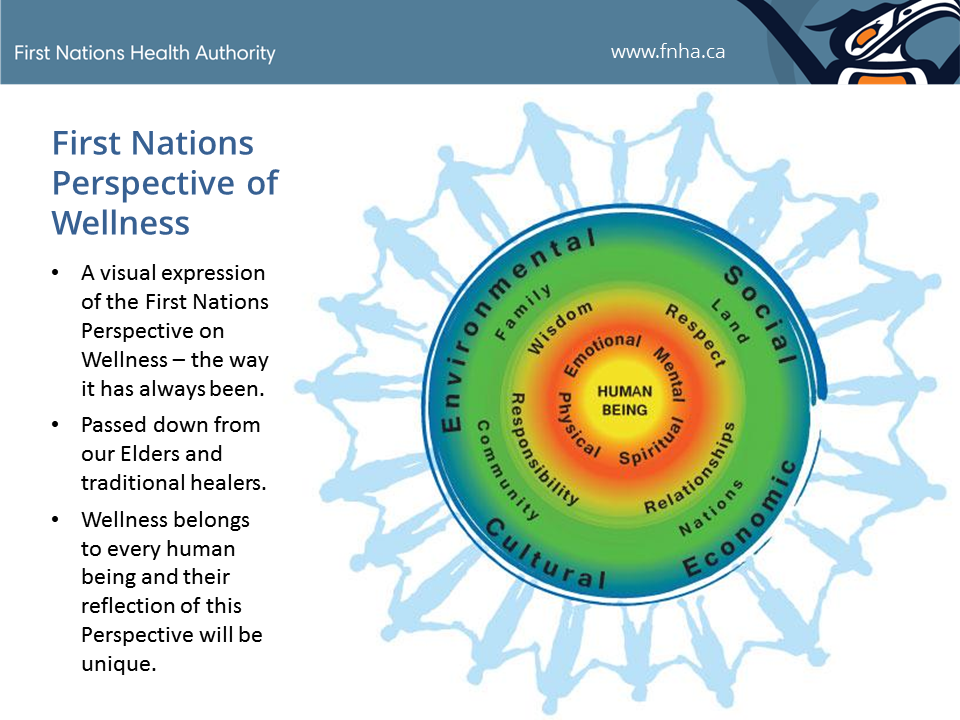
We will take some time to break down some of the terms that are defined differently from what is often found in Western perspectives. This breakdown utilizes word-for-word definitions from The First Nations Perspective on Health and Wellness. The First Nations Perspective on Health and Wellness found in the resource section of this chapter was created with input from multiple sources; feedback from British Columbia First Nations people, traditional teachings and approaches shared by First Nations healers and elders at gatherings that were convened by the First Nations Health Authority (FNHA). It is stated, “This model was created by First Nations people for First Nations People.”[14]
Land
Land is what sustains us physically, emotionally, spiritually, and mentally.
We use the land for hunting, fishing, and gathering. The land is where we come from and is our identity. It is more than just the Earth. It includes the ocean, air, food, medicines, and all of nature.
We have a responsibility to care for the land and to share knowledge of the land with our people. Land and health are closely intertwined because land is the ultimate nurturer of people. It provides not only physical but emotional and spiritual sustenance, because it inspires and provides beauty; it nurtures our souls.
Family
Family is our support base, and is where we come from.
Many different kinds of families surround us, including our immediate and extended families. For First Nations people, family is often seen as much broader than in many Western perspectives. Our immediate and extended families are often interchangeable, so Western descriptions and definitions don’t always apply.
Our families may also include who we care for, support systems, and traditional systems in addition to (or instead of) simply bloodlines. It is important to recognize the diversity that exists across British Columbia, that there are different family systems that exist (e.g., matrilineal).
Community
Community represents the people where we live, where we come from, and where we work.
There are many different communities: communities of place, knowledge, interests, experiences, and values. These all have a role in our health.
Nations
Nations include the broader communities outside of our immediate and extended families and communities. In essence, Nation is an inclusive term representing the various Nations that comprise your world.”
This model directly contrasts the Western individualistic perspective of the individual, often found in psychology textbooks. In this framework, the individual can only be understood in the context of a web of relationships. If you want to understand a specific mental health difficulty or physical illness, you would need to understand cultural messages, individual behaviors, family, community, nation, and societal dynamics and messages, as well as historical factors such as colonialism, all as direct determinants (causes) of the mental health difficulty or physical illness. While also direct determinants, each level is a source of strength, intervention, healing, and resistance. All driven by the culture of Native and Indigenous peoples. Distress is seen as a part of a colonial illness that is addressed by strengthening Indigenous wellness and healing, which is tied to Indigenous culture. What does culture say? Promote? Remind us of what to do? Healing is viewed as a holistic process that is strengths-based and rooted in culture; as such, healing practices can be unique to the different Indigenous cultures and communities.[15]
This model asks these questions:
(4.1) What are your thoughts, feelings, reactions, and questions about this perspective? Reflect on a recent personal experience. “How does the Indigenous perspective of self as a ‘spiritual web of relations’ challenge or complement your current understanding of identity?” “In what ways does the Indigenous model’s holistic approach challenge or expand upon psychological theories you’ve previously studied? Work through a specific theory.”

Different Models and Perspectives to Explore:
Nurturing the virtues of the people: An African-Centered Worldview Perspective
The Ntu Approach to Health and Healing Ntu is a pluralistic approach toward delivering therapeutic services and psycho-educational programs that is framed in an “Africentric” understanding of the world.
African Centered Worldview Many Black psychologists and thinkers have engaged in resistance to colonization and support of their communities. They have done this through the creation of theories, concepts, and interventions that center Black people and Black experiences.
- White (1970), a Black Psychologist, highlights the essential need for Black Psychologists to develop theories that do not pull from deficit-based psychological theories created by White psychologists. Instead, he argues that Black psychologists should create strengths-based, culturally relevant theories that reflect the realities of Black people in America.[16]
One way Black Psychologists have created strengths-based, culturally relevant theories is through the use of African-centered understandings of self, health, and wellness, creating the fields of Black and African-centered psychology.
- Wilson (1998) states: “At the center of African-centered psychology… is a psychology of power. It does not merely describe the traditional nature of African people or their orientations based on traditional African culture. It is a psychology that is both prescriptive and descriptive. It is a psychology of liberation.[17]
- African psychology is based on an African-centered worldview, which in turn is inspired by the African civilizations of Kemet, Nubia, Kush, and Axum.[18][19][20][21]
- This worldview acknowledges that there are differences and cultural variations amongst Africans on the continent of Africa and people of the African diaspora.
- However, it is argued that amongst African and Black people, there are underlying common understandings in thought systems.[22] According to Graham (1999), the commonalities involve a holistic understanding of African/Black people with the following values:
- “the interconnectedness of all things;
- the spiritual nature of human beings;
- collective/individual identity and the collective/inclusive nature of family structure;
- oneness of mind, body, and spirit; and
- the value of interpersonal relationships.”
- The interconnectedness of all things refers to the perspective that all parts of the universe, inclusive of people, animals, and inanimate objects such as the land, are interconnected and interdependent. And because of this interconnectedness, at the very basic levels, all of these elements are one.[23] They are only divided because of the limitations of our current knowledge.
- A quote is used from the Zulu people, found in Asante (1990), “I am river, I am mountain, I am tree, I am love, I am emotions, I am beauty, I am lake, I am cloud, I am sun, I am mind, I am one with one”.[24] This interconnection serves as a powerful reminder that each individual has a purpose and connection found in relation to their families, culture, land, spirituality, and community.
- And with that, a positive sense of self develops when these connections are healthy and harmonious, with problems occurring when people are no longer in connection with the family, culture, and community. “I am, because we are; and since we are, therefore I am.[25] Self-knowledge is gained in connection with others.
- The spiritual nature of human beings refers to the perspective that the essence of humans is their spirituality.
- Spirituality can be understood as “that invisible substance that connects all human beings to a creator.[26]
- Following this perspective asks people to believe and act in ways that value people more than the social and economic statuses that they have been assigned. You are who you are in relation to spirit and community, and this is expressed in rites of passage activities, naming ceremonies, and other rituals.
- The collective/individual identity and the collective/inclusive nature of family structure refer to the perspective that individuals can only be understood in relation to other people, inclusive of family.
- The individual as part of a collective leads to a focus on the similarities and connections across people and less on individual differences.
- This focus on the collective leads to collective responsibility for individuals. “Whatever happens to the individual happens to the whole group, and whatever happens to the whole group happens to the individual (Graham, 1999, p. 115).
- This perspective understands the family to be a collective. Therefore, the individual is understood in relation to their family.
- Family is a general term that encompasses the parent or parents’ family (cousins, aunts, uncles, niblings (gender neutral term for nieces and nephews), pibling (gender neutral term for aunts and uncles – a sibling of one’s parent), grandparents) as well as people who are not biologically connected to the family.
- An example of this perspective is the belief that raising and caring for children is the collective responsibility of the community. A child’s growth and development, as an individual, are shaped by both familial and wider community influences.[27]
- The oneness of mind, body, and spirit refers to the perspective that there is no difference between these three areas. These areas are interconnected and of equal value. To be in a place of optimal emotional, physical, intellectual, and spiritual health means to develop and know “self, mind, body, and spirit.”
- This place of optimal health can be created through harmony with life. “Being in harmony with life means that one is living with life, cooperating with natural forces that influence events and experiences while taking responsibility for one’s life by consciously choosing and negotiating the direction and paths one will follow…The task of all living things is to maintain balance in the face of adverse external forces.”[28]
- The value of interpersonal relationships refers to the importance of nurturing and building.
- Relationships amongst family members, community members, and friends are key in understanding oneself and one’s role in the world.
- There is mutual care and respect in relationships, along with responsibility and accountability for behaviors that can be seen as detrimental. Interpersonal relationships are not romanticized; they are complex and complicated, but they are valued.
(4.2) What are your thoughts, feelings, reactions, and questions about this model? “Reflect on the concept of ‘I am, because we are; and since we are, therefore I am.'” How might this perspective change our understanding of individual identity and mental health?” or “How does the African-centered perspective on family and community differ from individualistic approaches in Western psychology? What implications might this have for therapy and counseling practices?”
Assessment Questions for this model
Nurturing the virtues of the people: Bronfenbrenner’s bioecological framework (1979, 1992)

Urie Bronfenbrenner was a Russian-born, American-raised developmental psychologist. The bioecological theory he developed was notable because it addressed the numerous “layers” that impacted childhood development. Additionally, Bronfenbrenner was able to convey his theories for use in both research models and social policy development. For example, he is considered a significant contributor to the creation of Head Start.[29]
- Bronfenbrenner’s bioecological model (1979, 1992) asserts that a person’s development occurs in the context of cultural, social, economic, and political realities.
- His theory posits a bi-directional relationship that allows for and encourages an understanding of the impact that people have on their social, cultural, and political context.
- This bi-directional relationship creates room to highlight and articulate the strengths of people, families, communities, and culture.
- Authors have expanded this model to include the need to explicitly identify issues of power, privilege, and oppression for each level of Bronfenbrenner’s model.[30]
- This model allows for the full person to be present in the spaces they inhabit. Though many accept this framework now, at the time he proposed the theory, he was considered radical.[31]
- And though the theory is widely accepted, it is not often referenced in non-developmental undergraduate psychology textbooks.
Levels of Bronfenbrenner’s bioecological framework
Bronfenbrenner’s theory conceptualizes one’s environment as composed of embedded environments, each one inside the next, with systems and sub-systems. In the center of Bronfenbrenner’s framework is the individual, which includes factors such as gender, age, health, and personality. The environmental subsystems are 1) microsystem, 2) mesosystem, 3) exosystem, 4) macrosystem, and 5) chronosystem.
- The microsystem refers to the person’s immediate setting, which includes activities, roles, and interpersonal relationships, and the setting where the person lives and engages.
- For many, that can include caretaking roles, roles in the family, relationships with family members and friends, and the home, neighborhood, school, religious community, and workplace the person engages with.
- The mesosystem consists of the interrelationships between two or more spaces/settings that the person actively engages with, for example, the relationship between a student’s college or university and an internship.
- The exosystem refers to settings that the person is not directly a part of but that impact their lives nonetheless-government, economic, political, and mass media.
- Like all systems, the exosystem is bidirectional, and events that occur in the microsystem can have a significant impact on the exosystem.
- For example, many people are not directly a part of city governments. Nevertheless, the laws and policies of local governments can have powerful influences on people’s daily lives.
- So, the city government has a huge impact on funding for CUNY campuses. However, students and faculty can organize and create campaigns via their colleges and schools (microsystems) that influence the city government’s allocation of resources.
- The macrosystem refers to the ideologies, belief systems, norms, and values of a given culture or subculture. The norms, values, and beliefs create the basis of political, economic, social, and cultural systems.
- For example, American culture tends to value independence and productivity. These values can influence a student’s ability to ask for support when overwhelmed academically. These values can also influence which social groups are seen as “worthy” or “valuable” members of society. They can include stereotypes and biases about different social groups, supporting those who are dominant in society and those who are oppressed.
- There is also a need to interrogate the expressed values of a culture and the practice of those values. American society can express the belief and value that all people are treated equally under the law; however, decades of research have shown that class, gender, race, skin color, and more impact treatment, representation, sentencing, and convictions under the law.
- Bronfenbrenner later added the chronosystem to his original theory to include the reality that environments change over time.
- Ways to identify oneself (think of the range of gender and sexuality terms).
- Settings (For example: Policies and procedures of colleges and universities have evolved significantly, from the era of racial segregation 80 years ago, to a few years ago when affirmative action shaped admissions decisions, to the present day following the Supreme Court’s decision to strike down affirmative action).
- The relationship between settings (religious institutions and political institutions), and indirect settings (changes in Chancellors and Presidents of universities and colleges).
- And cultural norms (pre-Internet and post-Internet world). And of course, it must be noted that the global COVID-19 pandemic has impacted lives on every level of the framework.

(4.3) What are your thoughts, feelings, reactions, and questions about this model?

Review Questions for this model
Self-Reflection Questions
(4.4) Students will reflect on and analyze their relationship with self, family, community, society, and culture during the particular time period that they exist.
- What feelings come up for you when you reflect on your family/community/culture?
- What events in your past have shaped who you are and how you see the world? What current events shape who you are and how you see the world?
- What are some of the strengths of your family/culture/community?
- Which of the frameworks most closely reflects how you understand what influences you?
Closing Activity
- What are a few feelings you are experiencing now?
- What is something you can do to transition yourself from this workbook to what you need to do next?
Chapter Resources
Videos:
Healing Justice Lineages: Dreaming at the crossroads of liberation, collective care, and safety
Why we need to decolonize psychology | Thema Bryant | TEDxNashville
Re-thinking Who We Are Through A Decolonizing Lens | Sisa Quispe | TEDxUnionTownshipWomen
What Does “Two-Spirit” Mean? | InQueery | them
Handouts:
Bronfenbrenner’s ecological model version 1
Bronfenbrenner’s ecological model version 2
Framework for Measuring Wellbeing: Aboriginal and Torres Strait Islander Peoples, 2010
First Nations Perspective on Health and Wellness
Depiction of the Indigenous self as a spiritual web of relations
- Bryant, T. Why we need to decolonize psychology [Video recording]. https://www.ted.com/talks/thema_bryant_why_we_need_to_decolonize_psychology ↵
- Eason, A. E., Brady, L. M., & Fryberg, S. A. (2018). Reclaiming representations & interrupting the cycle of bias against Native Americans. Daedalus, 147(2), 70-81. ↵
- Eason, A. E., Brady, L. M., & Fryberg, S. A. (2018). Reclaiming representations & interrupting the cycle of bias against Native Americans. Daedalus, 147(2), 70-81. ↵
- Leavitt, P. A., Covarrubias, R., Perez, Y. A., & Fryberg, S. A. (2015). “Frozen in time”: The impact of Native American media representations on identity and self‐understanding. Journal of Social Issues, 71(1), 39-53. ↵
- McCaslin, W., & Breton, D. (2008). Justice as healing: going outside the colonizers' cage. In N. K. Denzin, Y. S. Lincoln, L. T. Smith (Eds.) Justice as healing: Going outside the colonizers' cage (pp. 511-530). SAGE Publications, Inc., https://doi.org/10.4135/9781483385686.n26 ↵
- Brave Heart, M. Y. H., & DeBruyn, L. M. (1998). The American Indian holocaust: Healing historical unresolved grief. American Indian and Alaska Native Mental Health Research, 8(2), 60–82. ↵
- Brown-Rice, K. (2013). Examining the Theory of Historical Trauma Among Native Americans. Professional Counselor, 3(3). ↵
- Sotero, M. M. (2006). A conceptual model of historical trauma: implications for public health practice and research. Journal of Health Disparities Research and Practice, 1(1), 93–108. ↵
- Here’s what it means to be “two-spirit,” according to native people. (2022, September 8). HuffPost. https://www.huffpost.com/entry/what-two-spirit-means-native_l_62aa0b3ce4b06169ca93c14e ↵
- Here’s what it means to be “two-spirit,” according to native people. (2022, September 8). HuffPost. https://www.huffpost.com/entry/what-two-spirit-means-native_l_62aa0b3ce4b06169ca93c14e ↵
- Fayed, S., King, A., King, M., Macklin, C., Demeria, J., Norma, R., & Healy, B., Gonzalez (Sempulyan), S. (2018). In the eyes of Indigenous people in Canada: exposing the underlying colonial etiology of hepatitis C and the imperative for trauma-informed care. Canadian Liver Journal. 1. 1-15. 10.3138/canli vj.2018-0009 ↵
- Fayed, S., King, A., King, M., Macklin, C., Demeria, J., Norma, R., &, Healy, B., Gonzalez (Sempulyan), S. (2018). In the eyes of Indigenous people in Canada: exposing the underlying colonial etiology of hepatitis C and the imperative for trauma-informed care. Canadian Liver Journal. 1. 1-15. 10.3138/canli vj.2018-0009 ↵
- Fayed, S., King, A., King, M., Macklin, C., Demeria, J., Norma, R., & Healy, B., Gonzalez (Sempulyan), S. (2018). In the eyes of Indigenous people in Canada: exposing the underlying colonial etiology of hepatitis C and the imperative for trauma-informed care. Canadian Liver Journal. 1. 1-15. 10.3138/canli vj.2018-0009 ↵
- Fayed, S., King, A., King, M., Macklin, C., Demeria, J., Norma, R., & Healy, B., Gonzalez (Sempulyan), S. (2018). In the eyes of Indigenous people in Canada: exposing the underlying colonial etiology of hepatitis C and the imperative for trauma-informed care. Canadian Liver Journal. 1. 1-15. 10.3138/canli vj.2018-0009 ↵
- Fayed, S., King, A., King, M., Macklin, C., Demeria, J., Norma, R., & Healy, B., Gonzalez (Sempulyan), S. (2018). In the eyes of Indigenous people in Canada: exposing the underlying colonial etiology of hepatitis C and the imperative for trauma-informed care. Canadian Liver Journal. 1. 1-15. 10.3138/canli vj.2018-0009 ↵
- White, J. (1970). Toward a Black psychology. Ebony, 25(11), 44-45. ↵
- Wilson, A.N. (1998). Blueprint for Black Power: A Moral, Political, and Economic Imperative for the Twenty-first Century. New York: African World InfoSystems ↵
- Asante M., & Abarry, A. (1995). African intellectual heritage: A book of sources. Philadelphia: Temple University Press. ↵
- Asante, M. (1988). Afrocentricity: The theory of social change. Trenton, NJ: Africa World Press. ↵
- Diop, C. (1978). The cultural unity of Black Africa. Chicago: Third World Press. ↵
- Graham, M. J. (1999). The African-centered worldview: Toward a paradigm for social work. Journal of Black Studies, 30(1), 103-122. ↵
- Graham, M. J. (1999). The African-centered worldview: Toward a paradigm for social work. Journal of Black Studies, 30(1), 103-122. ↵
- Graham, M. J. (1999). The African-centered worldview: Toward a paradigm for social work. Journal of Black Studies, 30(1), 103-122. ↵
- Asante, M. (1990). Kemet, Afrocentricity, and Knowledge. Trenton, NJ: African World Press. ↵
- Mbiti, J. (1970). African religions and philosophy. New York: Anchor. ↵
- Graham, M. J. (1999). The African-centered worldview: Toward a paradigm for social work. Journal of Black Studies, 30(1), 103-122. ↵
- Graham, M. J. (1999). The African-centered worldview: Toward a paradigm for social work. Journal of Black Studies, 30(1), 103-122. ↵
- Graham, M. J. (1999). The African-centered worldview: Toward a paradigm for social work. Journal of Black Studies, 30(1), 103-122. ↵
- Lau, K., & Ng, M. (2014). Conceptualizing the Counseling Training Environment Using Bronfenbrenner’s Ecological Theory. International Journal for the Advancement of Counselling, 36(4), 423–439. https://doi.org/10.1007/s10447-014-9220-5 ↵
- Yakushko, O., Davidson, M. M., & Williams, E. N. (2009). Identity salience model: A paradigm for integrating multiple identities in clinical practice. Psychotherapy (Chicago, Ill.), 46(2), 180–192. https://doi.org/10.1037/a0016080 ↵
- Lau, K., & Ng, M. (2014). Conceptualizing the Counseling Training Environment Using Bronfenbrenner’s Ecological Theory. International Journal for the Advancement of Counselling, 36(4), 423–439. https://doi.org/10.1007/s10447-014-9220-5 ↵